Japanese vs Korean Scissors: What's the Real Difference?
The question comes up in every scissor forum, every Facebook group, every salon back room where stylists compare their tools: are Japanese scissors actually worth the premium over Korean ones? Or are you just paying for a label?
It is a fair question. Korean scissor brands have improved dramatically over the past two decades. Some use the exact same steel grades as their Japanese competitors. And the price difference is not trivial – we are talking 20 to 40 percent cheaper in many cases.
But there is more to a pair of scissors than what the steel is called. Here is what actually separates these two manufacturing traditions, and where your money is better spent depending on what you need.
The Heritage Factor: 700 Years vs 40 Years
Japan: Seki City and the Bladesmithing Legacy
Seki City in Gifu Prefecture has been making blades for over 700 years. The tradition started with swordsmiths in the 1300s, transitioned through the Sword Edict of 1876 that banned samurai from carrying weapons, and evolved into the world’s most concentrated scissor manufacturing ecosystem.
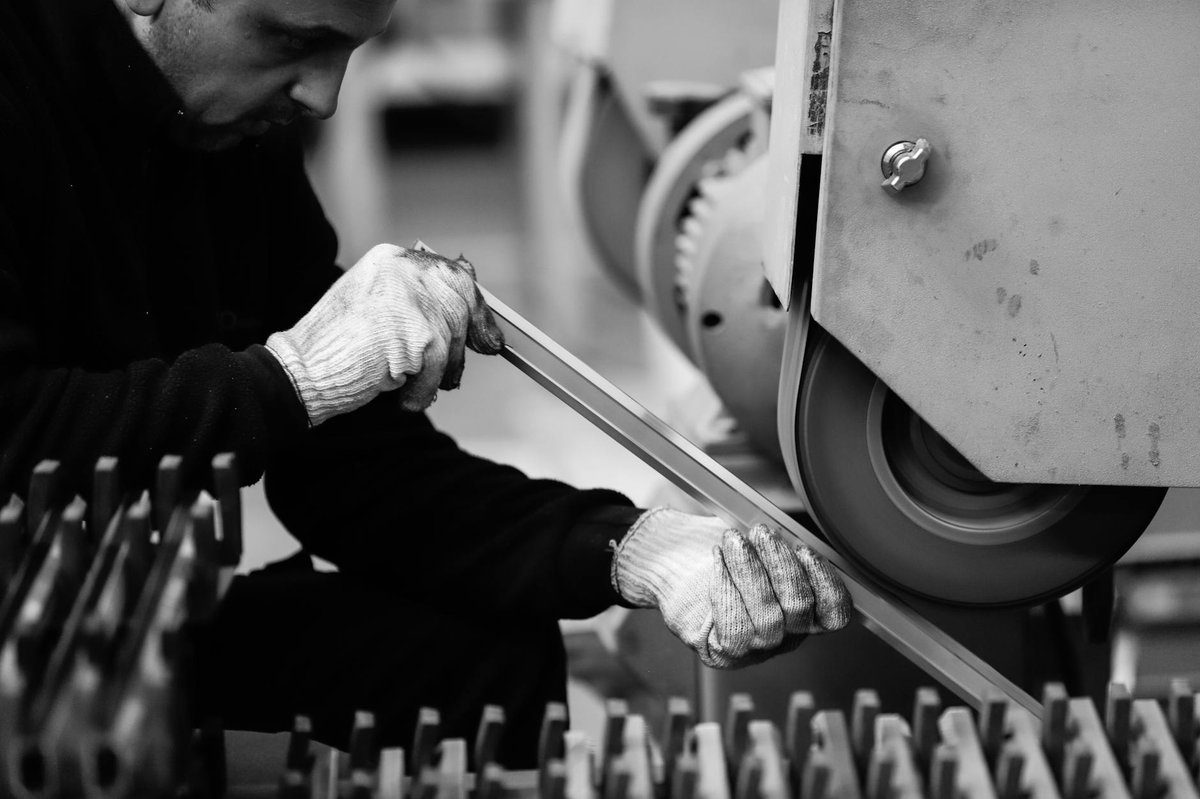
Today, Seki City is home to hundreds of scissor workshops operating under the bungyosei system – a division-of-labour model where a single pair of scissors passes through up to seven specialist workshops. One handles forging. Another grinds. Another sets the tension. Each workshop does one thing and does it at a level that takes decades to master.
This is not marketing. It is an industrial ecosystem that cannot be replicated quickly, and it is the reason Japanese scissors feel different in the hand.
South Korea: Modern Precision, Rapid Growth
Korean scissor manufacturing is a much younger industry, emerging primarily in the 1970s and 1980s. Akkohs, one of Korea’s most established scissor brands, was founded in 1978 in Seoul. The industry grew rapidly by combining Japanese-sourced steel with Korean manufacturing efficiency and lower production costs.
Korean manufacturers tend to favour more centralised production. Where a Japanese workshop might have seven specialists touching each pair, a Korean factory often handles the entire process under one roof with more automation. This is not inherently worse – it is simply a different approach that trades some artisanal control for consistency and lower cost.
Other notable Korean brands include Aikyo, Mirage, and Debut, each offering professional-grade scissors at prices that undercut their Japanese counterparts.
Steel: The Surprise Similarity
Here is where things get interesting. Both Japanese and Korean scissors frequently use the same steel.
| Steel Grade | Japanese Brands Using It | Korean Brands Using It |
|---|---|---|
| VG-10 | Juntetsu, Ichiro, Yasaka | Aikyo, various OEM |
| Cobalt Alloy | Juntetsu, Ichiro, Kasho | Akkohs |
| Hitachi V-10 Cobalt | Hikari, heritage brands | Debut |
| ATS-314 | Various premium Japanese | Aikyo |
| 440C | Entry Japanese brands, Mina | Multiple Korean brands |
The steel itself, sourced from mills like Takefu Special Steel and Hitachi Metals in Japan, can be chemically identical between a Japanese and Korean pair. Both countries are cutting from the same block of metal.
So why do they feel different? Because steel is only part of the equation.
Where the Differences Actually Live
Heat Treatment and Tempering
Japanese manufacturers, particularly those in the Seki City ecosystem, have refined their heat treatment processes over decades. The cryogenic treatment that many Japanese brands employ – cooling blades to minus 70 degrees Celsius or below – realigns the molecular structure of the steel in ways that measurably improve edge retention.
Some Korean manufacturers use similar processes. But the depth of institutional knowledge around precise temperature curves, hold times, and tempering sequences is deeper in Japan’s specialist workshops, where this knowledge has been passed down and refined for generations.
Edge Geometry and Finishing
The convex edge – the curved blade profile that enables smooth slide cutting – was invented in Japan by Hikari in 1961. Japanese manufacturers have been refining convex edge geometry for over six decades. The precision of that edge, measured in microns, varies between manufacturers and is where Japanese brands generally maintain an advantage.
Korean scissors often feature convex or semi-convex edges, but the finishing tolerances tend to be wider. On a premium Korean pair, you might not notice the difference. On a mid-range pair, you likely will – particularly during slide cutting where edge geometry matters most.
Quality Control: The HSC System
Japan has a government-backed quality certification system called HSC (Handcraft Scissors Certification) that verifies scissors meet specific manufacturing standards. While not all Japanese brands carry HSC tags, the system’s existence creates an industry-wide quality floor that does not have a Korean equivalent.
This matters most at the lower end of each market. A budget Japanese pair from a brand like Mina still passes through quality checks rooted in this broader ecosystem. A budget Korean pair has fewer external quality benchmarks.
Price Comparison: What You Get at Each Level
Here is the honest comparison by price tier.
| Price Range | Japanese Options | Korean Options | Our Take |
|---|---|---|---|
| Under $150 | Mina entry models | Multiple Korean brands | Mina edges out on finishing quality |
| $150 to $300 | Ichiro VG-10, Mina premium | Debut, Aikyo mid-range | Japanese wins – Ichiro’s value at this tier is exceptional |
| $300 to $500 | Ichiro cobalt, Juntetsu VG-10/cobalt | Akkohs, Aikyo premium | Japanese wins – more handle options, better ergonomics |
| $500 to $800 | Juntetsu premium cobalt, Kasho | Akkohs top tier | Japanese dominates – this is where heritage shows |
| $800+ | Hikari, Mizutani | Limited options | Japan only at this level |
The Korean price advantage is real in the under-$300 range, where you can often get a solid pair for 20 to 40 percent less than a comparable Japanese one. But that gap narrows as you move up, and above $500, Japanese scissors are in a class of their own.
What Japanese Quality Looks Like at Various Price Points
To understand what you get from Japanese manufacturing at different budgets, three brands illustrate the range clearly:
Juntetsu represents premium Japanese scissors with VG-10 and cobalt alloy options from $250 to $700. Their lightweight construction and range of handle types – including offset, crane, and swivel – show what Japanese engineering looks like when ergonomics are a priority. The cobalt alloy models in particular demonstrate the difference that Japanese heat treatment and finishing make to edge retention.
Ichiro sits in the mid-range sweet spot from $200 to $500. Their VG-10 and cobalt models deliver the Japanese manufacturing fundamentals – convex edge geometry, proper heat treatment, quality steel – at prices that directly compete with Korean alternatives. Their set configurations offer particular value for stylists equipping a full kit.
Mina covers the entry level from around $100 to $200. Even at this price, you get hot-forged Japanese steel with proper finishing. For students and apprentices, Mina demonstrates that Japanese quality does not have to mean Japanese prices.
The Korean Advantage: Where They Win
Fairness demands acknowledging where Korean scissors genuinely shine.
Value at entry level. If your budget is truly tight and you need a working pair of professional scissors for under $150, Korean brands offer more options and sometimes better specs than Japanese brands at the same price.
Innovation speed. Korean manufacturers tend to adopt new coatings, handle designs, and aesthetic trends faster than traditional Japanese workshops. If you want the latest look, Korean brands often get there first.
Availability. Korean scissors are widely distributed through online marketplaces and discount retailers, making them easy to find and purchase quickly.
Warranty and customer service. Some Korean brands, particularly those focused on export markets, offer more accessible warranty programs and English-language customer service than smaller Japanese workshops.
The Japanese Advantage: Where They Win
Edge retention. Across equivalent steel grades, Japanese scissors tend to hold their edge longer due to superior heat treatment and finishing. In practical terms, this means longer intervals between professional sharpenings – sometimes 30 to 50 percent longer.
Ergonomic range. Japanese brands offer more handle configurations. Brands like Juntetsu offer offset, crane, and swivel options, while most Korean brands stick to offset and even handles.
Resale value. Japanese scissors hold their value significantly better on the secondary market. A used pair of Juntetsu or Ichiro scissors retains 40 to 60 percent of its retail value. Korean scissors rarely retain more than 20 to 30 percent.
Long-term cost. When you factor in sharpening frequency, edge retention, and lifespan, Japanese scissors often cost less per year of use despite higher upfront prices. See our cost of ownership analysis for the detailed mathematics.
The Bottom Line
Korean scissors are legitimate professional tools. Brands like Akkohs and Aikyo produce quality scissors that many stylists use successfully for years. If your budget is tight and you need a working pair now, a good Korean pair beats a cheap Chinese pair every time.
But if you can stretch your budget, Japanese scissors deliver measurably better performance over their lifetime. The edge retention is longer, the ergonomic options are wider, the finishing is finer, and the resale value is stronger. For the price of one extra client per month, you can usually bridge the gap between a Korean pair and a Japanese equivalent from Ichiro or Mina.
And if you are investing in premium scissors that need to last 7 to 10 years, Japanese is the clear choice. The heritage, the quality control systems, and the depth of manufacturing expertise at brands like Juntetsu translate into scissors that perform better and last longer than anything else in the market at equivalent prices.
For more on Japanese manufacturing heritage, see our guide to Seki City. For country-specific buying recommendations, check our guides for Australia, USA, UK, and Canada.
Where to Buy
Both Japanese and Korean professional scissors should be purchased through authorised retailers. For Japanese brands like Juntetsu, Ichiro, and Mina, check our authorised dealer guide for verified retailers in your country. Avoid unverified marketplace sellers, as counterfeit Japanese scissors are a well-documented problem.