The Bungyosei System: How Seven Specialist Workshops Build One Pair of Scissors
Your scissors were probably made by seven different people in seven different workshops. That’s not a flaw; it’s the system that produces the world’s best blades.
If you’ve ever wondered why your Japanese scissors feel different from anything made in a single factory, you’re about to find out. The answer lies in a manufacturing philosophy that most Western stylists have never heard of, but that shapes every single pair coming out of Seki City.
It’s called bungyosei (分業制, division-of-labour system), and once you understand it, you’ll never look at “Made in Japan” the same way again.
What Bungyosei Actually Means
Bungyosei literally translates as “divided work system.” In practice, it means that no single person or workshop makes an entire pair of scissors. Instead, seven different specialists, each with decades of experience in their specific stage, handle one part of the manufacturing process before passing the work to the next.
Think of it as a relay race where every runner is an Olympic-level sprinter in their particular leg. The baton passes seamlessly. The result is a product where every single stage has been executed by someone who has spent their entire career perfecting that one thing.
This is the opposite of vertical integration, where one factory controls everything from raw steel to finished product. Both approaches have merit, but bungyosei produces a specific kind of quality that’s hard to replicate in any other system.
The Seven Stages
Here’s what happens to your scissors before they reach your hand. Each stage has its own specialists, its own workshops, and often its own family lineages stretching back generations.
Stage 1: Steel Procurement (鋼材商, Kozaisho)
Everything starts with the kozaisho, the steel merchants. These specialists source raw steel from Japan’s major mills: Hitachi Metals/Proterial (Yasuki Works in Shimane Prefecture), Takefu Special Steel (Fukui Prefecture), and Aichi Steel (Aichi Prefecture).
The kozaisho doesn’t just place orders. They maintain relationships with mills built over decades, ensuring priority access to the best batches. They understand the subtle variations between steel grades: the difference between standard VG-10 and VG-10W, or why one batch of cobalt alloy tests differently from another despite identical specifications.
A good kozaisho is the foundation of everything that follows. Bad steel cannot be rescued by brilliant forging; this is where quality begins or fails.
Stage 2: Forging (鍛造/プレス, Tanzo/Puresu)
The forging specialist receives steel blanks and transforms them into rough scissor shapes. In traditional hot forging (tanzo), the steel is heated to approximately 1,100 degrees Celsius (bright orange, just below melting) and hammered or pressed into shape.
This is the stage with the most direct lineage to swordsmithing. The forging families in Seki trace their techniques back to the katana tradition, and the principles are identical: control the grain structure of the steel through precise temperature management and mechanical deformation.
Modern forging workshops also use press forming (puresu) for efficiency, but the temperature control and material knowledge remain artisanal. A skilled forging specialist can feel the steel’s response to the hammer and adjust their technique in real time.
Stage 3: Rough Grinding (研削, Kensaku)
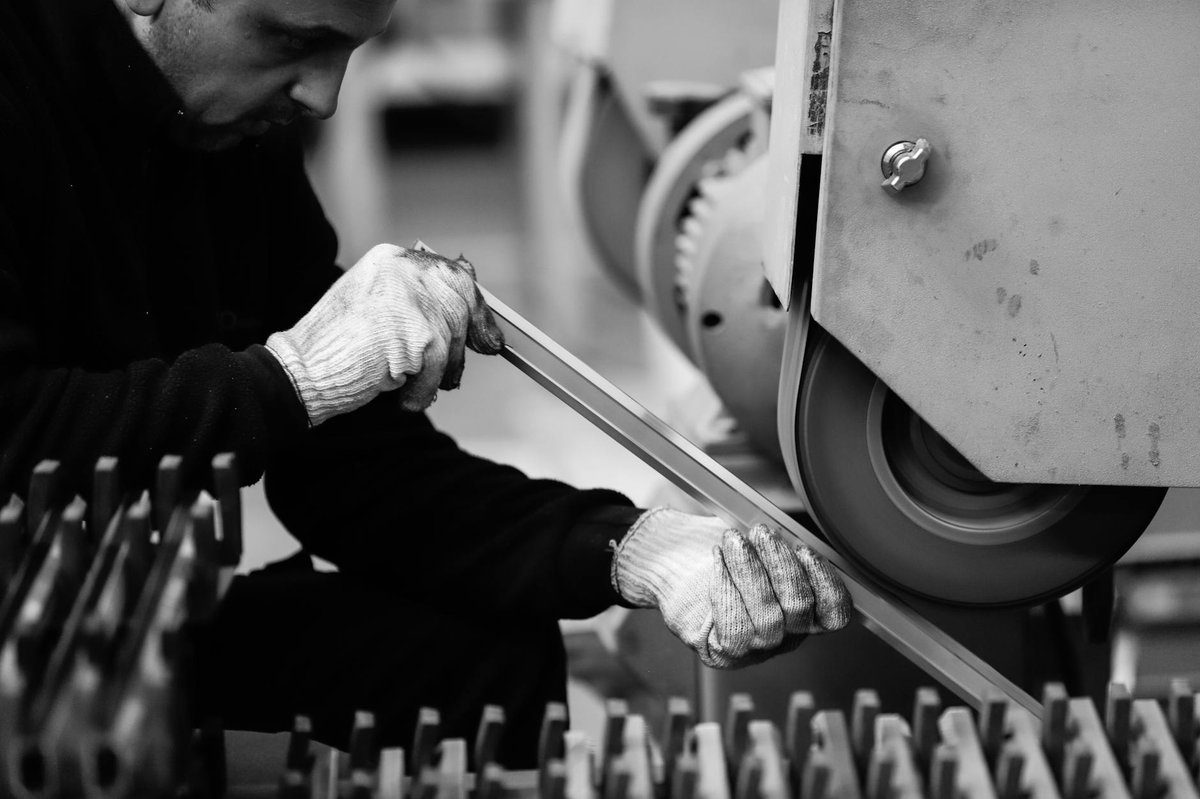
After forging, the rough blanks move to a grinding specialist. This stage establishes the basic blade geometry: the hollow grind, the blade thickness, the initial edge angle.
Kensaku specialists work with industrial grinding wheels and require extraordinary precision. They’re removing material to tolerances measured in hundredths of a millimetre. Too aggressive, and the blade is too thin and fragile. Too conservative, and the scissors will feel heavy and sluggish.
The grinding stage is where the blade line, whether sasaba (笹刃, bamboo leaf), yanagiba (柳刃, willow blade), or chokuba (直刃, straight blade), first takes shape. The grinder needs to understand how each line affects cutting performance, even though they’ll never use the finished scissors themselves. This is what determines whether your scissors feel nimble or sluggish in hand.
Stage 4: Heat Treatment (熱処理, Netsushori)
This is arguably the most scientifically demanding stage. Heat treatment specialists operate vacuum furnaces that precisely control the heating, quenching, and tempering process that gives the steel its final hardness and toughness.
The process: heat the forged blanks to 1,050-1,100 degrees Celsius in a vacuum (to prevent oxidation), then quench rapidly to lock in the crystal structure, then temper at a lower temperature to reduce brittleness. Some specialists add sub-zero treatment (サブゼロ処理), cooling the steel to minus 80 or even minus 196 degrees Celsius in liquid nitrogen to convert residual austenite to martensite.
A heat treatment specialist’s entire reputation rests on consistency. Every pair must hit the target hardness, typically HRC 58-63 depending on the steel grade and intended use. Too hard and the scissors chip. Too soft and they won’t hold an edge. The margin for error is essentially zero. Get this wrong and the scissors either chip on the first hard cut or can’t hold an edge past a week.
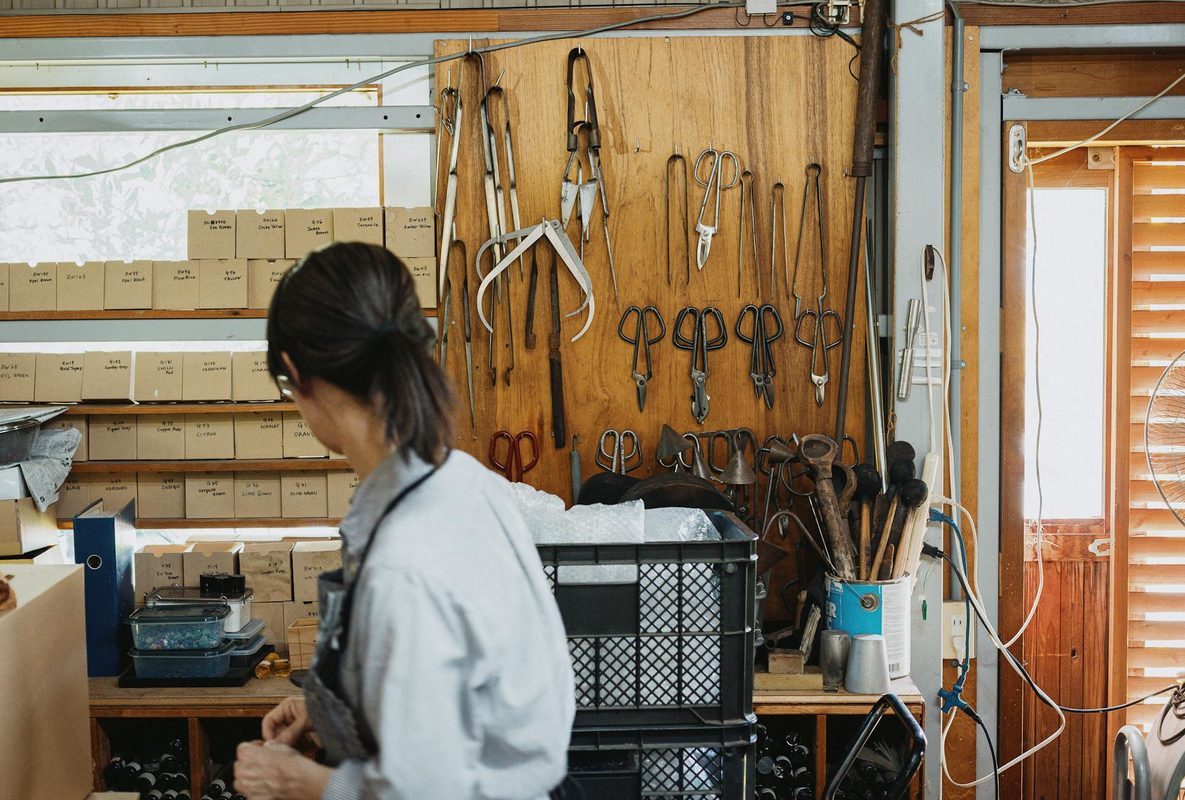 Photo by Guko via Pexels
Stage 5: Assembly (組立, Kumitate)
The assembly specialist receives heat-treated blades, handles, and pivot components and brings them together. This stage involves fitting the pivot mechanism (screw, ball bearing, or flat system), attaching handles, and ensuring the two blades work together as a matched pair.
Kumitate is more critical than it sounds. The pivot tension, the alignment of the blades, the relationship between the two halves: all of this is established during assembly. A perfectly forged, perfectly heat-treated pair of blades can be ruined by sloppy assembly.
The specialist checks ogami (おがみ, the approximately 0.03mm bow in each blade that creates the contact point), hineri (ヒネリ, the slight twist that ensures clean cutting), and aki (アキ, the gap between blades that prevents friction damage). These adjustments are measured by feel and eye, not instruments.
Stage 6: Final Sharpening (研ぎ/仕上げ, Togi/Shiage)
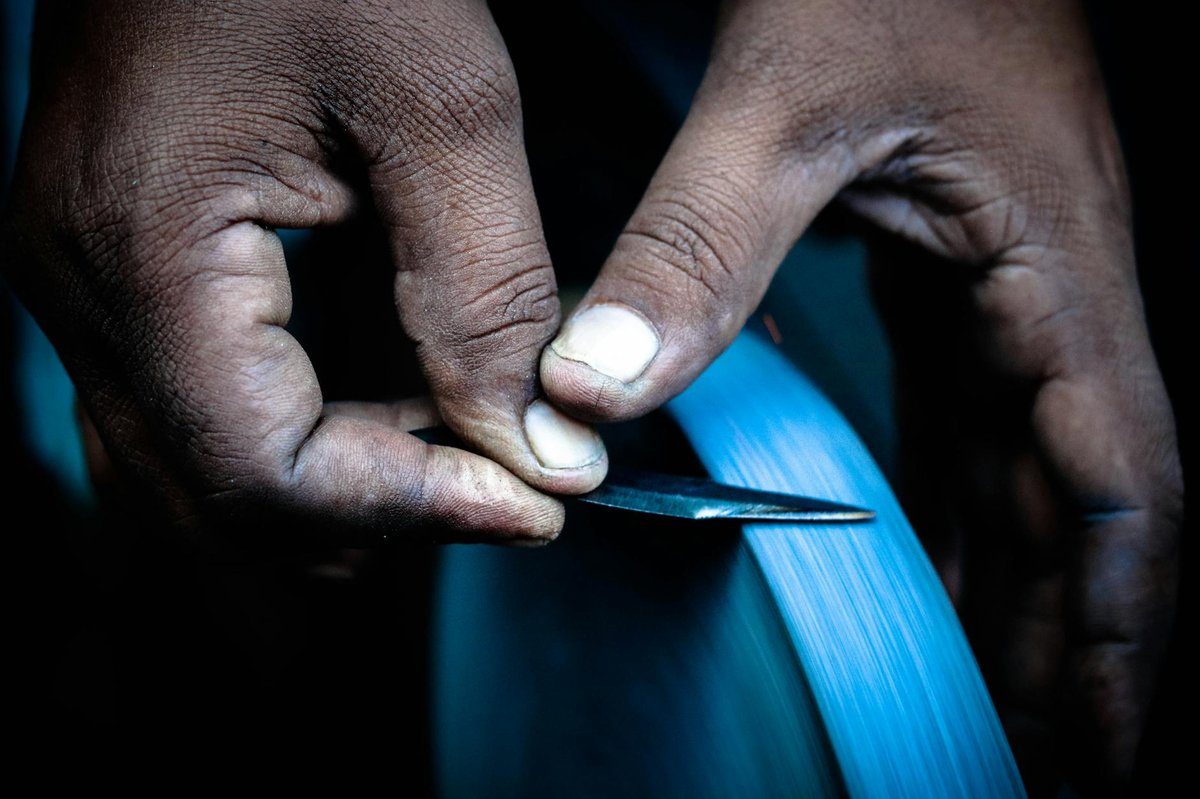
This is the most critical stage. The togishi (研ぎ師, sharpening master) creates the final edge, the part that actually touches hair. Everything before this was preparation. This is where the scissors become cutting tools.
The togishi works with a series of progressively finer sharpening stones, establishing the convex edge (hamaguri-ba/蛤刃) that defines Japanese scissors. The final edge is typically ground to an angle between 30 and 50 degrees, depending on intended use.
A master togishi can spend 30 minutes to an hour on a single pair. They test the cutting action repeatedly, adjusting the edge angle, the blade alignment, and the contact point until the kireaji (切れ味, cutting feel) meets their standard.
In the bungyosei system, the togishi has ultimate quality control. If the forging was off, or the heat treatment was inconsistent, the togishi discovers it here. They are the last line of defence before the scissors reach a professional’s hand. This is where your scissors get their character: the feel that makes you reach for one pair over another.
Stage 7: Engraving (刻印, Kokuin)
The final stage: engraving the brand name, model number, serial number, and any other identifying marks. Kokuin specialists use both traditional hand-engraving techniques and modern laser engraving.
This stage matters more than aesthetics. Serial numbers enable authentication and warranty service. Brand marks identify the commissioning company. In an industry plagued by counterfeits, the engraving stage is increasingly a security measure.
Bungyosei vs. the Alternatives
Not every scissors manufacturer uses this system. Here’s how the major approaches compare:
| System | Location | Control | Quality | Cost | Lead Time |
|---|---|---|---|---|---|
| Bungyosei (specialist network) | Seki City | Distributed across 7+ workshops | Exceptional: decades of focused expertise at each stage | Medium-High | 2-6 months |
| Integrated (single factory) | Various | One company, all stages | Consistent: full quality control chain | High | 1-3 months |
| Chinese factory | Zhangjiagang, others | Single facility, high volume | Variable: depends on factory tier | Low | 2-8 weeks |
| Solingen vertical | Germany | Company-owned facilities | High: German precision engineering | High | 1-4 months |
The key difference is that bungyosei concentrates specialist expertise at every stage, while integrated manufacturers distribute generalist capability across all stages. Neither is inherently better, but they produce different results.
How OEM Works in the Bungyosei System
Here’s where it gets interesting for the industry. The bungyosei system is what makes OEM (Original Equipment Manufacturing) possible at relatively small scale.
A new scissor brand doesn’t need to build a factory. They need a relationship with the right specialists. They commission a kozaisho for steel, a forging workshop for blanks, a heat treatment specialist for hardening, and so on through all seven stages. The brand provides specifications, the specialists execute.
This is why you’ll sometimes notice that two different brands’ scissors feel remarkably similar. They might be using the same forging specialist, the same heat treatment workshop, or even the same togishi. The differences come from the specifications, the steel grade chosen, and the brand’s quality control requirements.
Minimum orders vary by stage and specialist. Semi-custom work, where you choose from existing designs and modify details, can start as low as 10-20 pairs. Fully custom OEM with unique blade shapes, proprietary steel specifications, and custom handles typically requires 50-200+ pairs minimum. Lead times run from two to six months depending on complexity and specialist availability.
The Exceptions: Who Doesn’t Use Bungyosei
Two notable exceptions to the bungyosei system in the Japanese market:
Kasho (manufactured by KAI Corporation) operates an integrated facility right in Seki City. KAI controls every stage from steel cutting to final sharpening. This gives them exceptional consistency and quality control, but it’s a fundamentally different approach from the specialist network.
Mizutani is perhaps the most famous exception. Their facility in Chiba Prefecture is 100% in-house, with every stage performed under one roof. Mizutani’s founder deliberately chose to control the entire process, believing that only full integration could achieve the level of consistency he demanded.
Both approaches produce world-class scissors. The debate over which system produces better results has been running in the Japanese scissors industry for decades, and neither side has won.
Beyond Japan: Similar Systems Worldwide
Seki is not the only city with a specialist network. Thiers in France and Sialkot in Pakistan both operate their own versions of divided-labour blade manufacturing, and even Solingen retains pockets of specialisation despite its more vertically integrated tradition.
Why This Matters to You
Understanding bungyosei changes how you evaluate scissors in three practical ways.
First, it explains price. When seven specialists each need to earn a living from their contribution, there’s a floor below which quality cannot be maintained. Scissors priced significantly below the norm for their claimed steel grade and origin should raise questions about whether the full bungyosei process was actually followed.
Second, it explains variation. Even within a single brand and model, you might notice subtle differences between pairs. This isn’t a defect; it’s the signature of handwork at multiple stages. Each togishi brings slightly different technique to the final edge. This variation is actually a feature: it means every pair has been individually finished, not stamped out by a machine.
Third, it explains why Japanese scissors need specialist sharpening. The togishi who finished your scissors spent years learning to create that specific edge profile. A generalist sharpener using a grinding wheel will destroy it in seconds. When you send your scissors for maintenance, you’re ideally looking for someone who understands the bungyosei tradition and respects the edge that was originally created.
The next time you pick up a pair of Japanese scissors, remember: you’re holding the combined work of seven specialists, each with decades of expertise in their specific craft. That relay baton passed through at least seven pairs of hands before it reached yours.
That’s not inefficiency. That’s bungyosei.