Best Professional Hair Scissors in the USA: Complete Buying Guide
Let me tell you about the most expensive mistake cosmetology students in America make. It is not choosing the wrong school. It is not picking the wrong salon for their first job. It is buying scissors from a guy who showed up in the school parking lot with a briefcase and a smile.
We exposed that racket back in 2014 and nothing has changed since. Students are still paying $600-$1,200 for scissors worth $150-$200 because a smooth-talking salesman created a pressure cooker environment in their classroom.
This guide exists so you never fall for that. This guide covers every price point, from your first cosmetology school pair to the premium upgrade you have been eyeing for years. Real USD from real retailers.
The American Scissors Market: What You Need to Know
The United States is the largest market for professional hair scissors in the world. That is both good and bad news.
The good: You have access to every major brand, competitive pricing, and multiple authorized retailers. Japanese, German, Korean, and domestic brands all compete for your money, which keeps prices reasonable.
The bad: The massive market also attracts counterfeiters, grey market sellers, and those travelling salesmen. More choice means more ways to get burned if you do not know what you are looking for.
The ugly: American cosmetology programs rarely teach students anything about the tools they are required to buy. Most students walk in on day one, get handed a supply list, and are left to figure it out themselves – or worse, get steered toward whoever is paying the school a commission.
Let’s fix that.
For Cosmetology Students: Read This First
If you are currently enrolled in cosmetology school, this section is for you specifically.
Your budget should be $100-$300 for your first cutting shear. That is it. You do not need $800 scissors while you are learning. You are going to drop them. You are going to cut with bad technique until your technique improves. You are going to figure out whether you prefer offset handles or crane handles, 5.5-inch or 6-inch blades, and heavy or lightweight feel. You cannot learn any of that from a brochure. You learn it by cutting with decent scissors for a year.
Mina at $100-$200 is the best entry point for students. Hot-forged 440C Japanese steel, offset handles, and enough edge retention to get through school without constant sharpening. They are not glamorous. They are honest.
Ichiro entry models at $200-$300 step up to VG-10 steel with cobalt alloy options. If you can stretch your budget, the difference between 440C and VG-10 is noticeable in edge retention and smoothness. Ichiro also sells sets – a cutting shear plus thinning shear – which brings down the per-scissor cost.
Our student scissors guide covers exactly what new stylists need.
What to avoid: Anyone selling scissors in your school who is not an established retailer. Anyone offering “today only” pricing. Anyone claiming their $600 scissors normally retail for $1,800. Read our travelling salesmen expose for the full horror show.
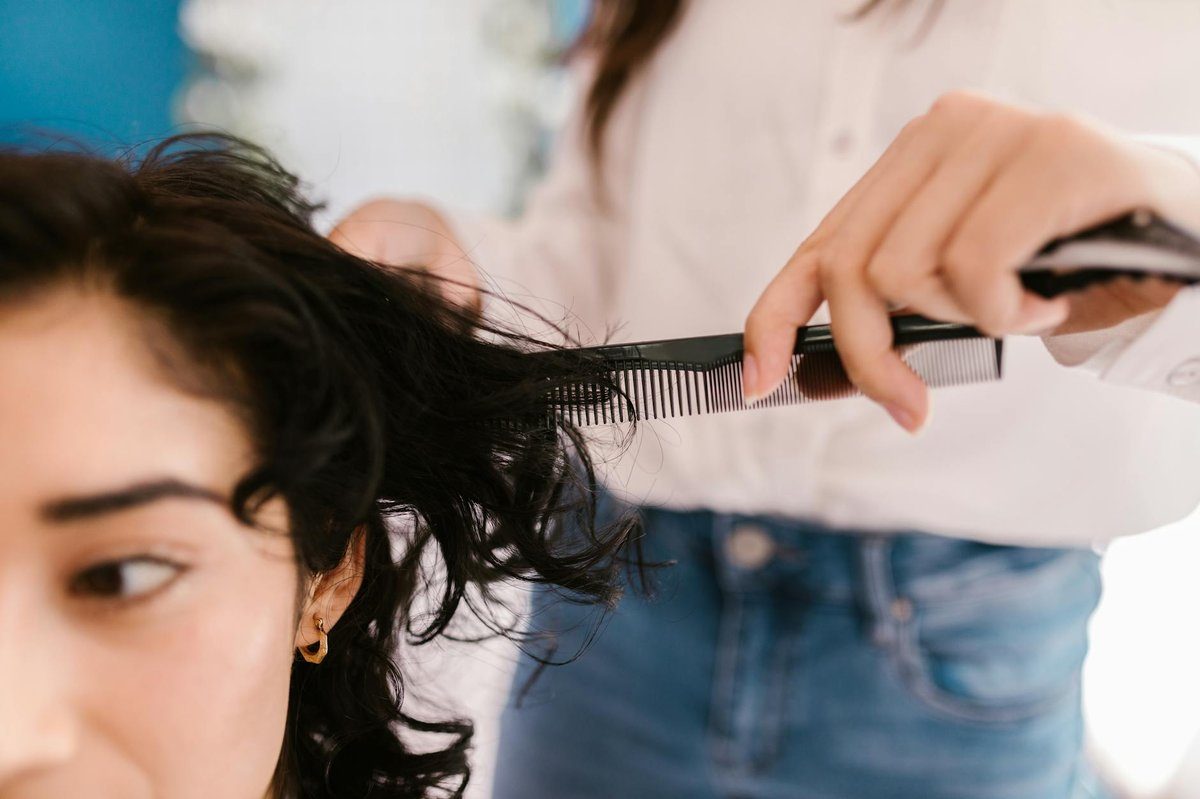
 Photo by RDNEStockProject via Pexels
Three Price Tiers for American Stylists
Tier 1: $100 - $250 USD (Entry Professional)
At this price you should expect forged construction (not stamped), a named steel grade like 440C or AUS-8, smooth operation, and a real warranty from an identifiable company.
Mina – Hot-forged 440C Japanese steel. Their straightforward manufacturing approach delivers consistent quality at $100-$200. No gimmicks, no flash. Just proper scissors that work.
Jaguar – German made in Solingen with Friodur ice-hardened steel. Jaguar has been in American salons for decades. Their strength is blunt cutting and precision work. $100-$350 depending on the line.
Cricket and Fromm fill out this tier with variable quality across their model ranges. Research the specific model, not just the brand.
What you get: Reliable daily tools that hold an edge for 3-4 months. What you do not get: convex edges, premium steel, or advanced pivot systems. That is fine at this stage.
Tier 2: $250 - $600 USD (The Professional Sweet Spot)
This is where the money-to-performance ratio peaks. The jump from Tier 1 to Tier 2 is the single biggest quality improvement in the entire scissor market. You get genuine VG-10 or cobalt alloy steel, convex edge options, better ergonomic handles, and scissors that hold their edge significantly longer.
Ichiro – VG-10 and cobalt alloy models from $200-$500. Their mid-range is where Ichiro really shines. Set options available with matched cutting and thinning shears, which is excellent value for building a complete kit. If you are an American stylist looking for the best bang for your buck, Ichiro belongs on your shortlist.
Juntetsu – The name means “purest steel” in Japanese, and they live up to it. Cobalt alloy steel in lightweight, ergonomic designs from $250-$600. The Aero Pro has become a favourite among high-volume American stylists because it weighs noticeably less than competitors at the same price point. When you are cutting 25+ clients a day, that weight difference adds up.
Yasaka – Japanese heritage brand with VG-10 steel at $200-$400. The M-series is a working stylist’s classic. Not the flashiest scissors in the drawer, but reliable performers that sharpeners love to work on.
Kamisori – A Canadian brand that uses Japanese steel and manufacturing. Their Jewel line at around $300-$350 has earned a following among North American stylists. Strong warranty support across the US and Canada.
Joewell – Made by Tokosha in Japan using CBA-1 cobalt steel. Joewell is also worth knowing about if you have nickel sensitivity – their cobalt-based alloy is nickel-free, which matters for the roughly 11% of stylists who deal with contact dermatitis.
Who this tier is for: Working professionals. If you are behind the chair full-time, this is where your money should go.
Tier 3: $600+ USD (Premium and Ultra-Premium)
At this level you are paying for the most advanced steel, hand finishing, proprietary technologies, and specialized blade geometries. These scissors are tools for experienced stylists who know exactly what they want.
Kasho – Made by KAI Corporation in Seki City, Japan. Their VG-10W steel with sintered metal technology and the Disc Operation System pivot deliver one of the smoothest cutting experiences available. $400-$800 puts you in the Design Master and Millennium series.
Hikari – Holds patents on their convex edge grinding. If slide cutting is central to your work, Hikari’s edge geometry is genuinely unique. $600-$1,500 in the US.
Mizutani – The top of the mountain. Nano Powder Metal steel, hand-finished blades, and a price tag that starts at $800 and climbs past $2,500 for their flagship models. If you ever visit Japan, their Omotesando showroom is worth a pilgrimage – you can try every model and get fitted in person.
Hanzo – Japanese manufacturing with a strong US distribution network. Their mid-to-premium range ($400-$1,000) has carved out a loyal following among American stylists who like a slightly heavier feel.
American Scissors Comparison Table
| Brand | Steel Type | Price (USD) | Best For | Where to Buy |
|---|---|---|---|---|
| Mina | 440C (hot-forged) | $100 - $200 | Students, budget-conscious | Japan Scissors USA, online |
| Jaguar | Friodur ice-hardened | $100 - $350 | Blunt cutting, men’s cuts | SalonCentric, salon supply |
| Ichiro | VG-10, cobalt alloy | $200 - $500 | All-round, value sets | Japan Scissors USA |
| Yasaka | VG-10 | $200 - $400 | Traditional Japanese cutting | Authorised dealers |
| Kamisori | Japanese steel blends | $200 - $600 | North American support | Kamisori direct, retailers |
| Juntetsu | VG-10, cobalt alloy | $250 - $600 | Lightweight, ergonomic, high-volume | Japan Scissors USA |
| Joewell | CBA-1 cobalt | $400 - $900 | Nickel-free, premium Japanese | HairArt Products |
| Kasho | VG-10W, sintered metal | $400 - $800 | Premium all-round, disc pivot | Authorised Kasho dealers |
| Hikari | Proprietary cobalt | $600 - $1,500 | Slide cutting specialists | Authorised Hikari dealers |
| Mizutani | Nano Powder Metal | $800 - $2,500+ | Ultra-premium, session work | Mizutani US distribution |
Where to Buy Professional Scissors in the USA
Authorized Online Retailers
Japan Scissors USA carries Juntetsu, Ichiro, and Mina with US-based stock and shipping. For a comprehensive look at trusted retailers, see our list of the only retailers professionals actually trust.
HairArt Products is the primary US distributor for Joewell. If Joewell is on your shortlist, buy through them for full warranty coverage.
SalonCentric and CosmoProf carry a mix of brands across their retail and wholesale channels. Selection varies by location.
Brand Direct
Some brands sell directly to US consumers. Mizutani and Kasho both have US distribution networks. Always verify that a “brand direct” website is actually operated by the brand and not a third-party reseller using a similar domain name.
What to Avoid
Amazon for any scissors over $200. The counterfeit and commingled inventory problem is real. We covered this in our counterfeit identification guide.
eBay for premium Japanese brands. Same issue, less buyer protection.
Travelling salesmen at beauty schools and salon shows. You already know the numbers from our 2014 investigation.
The Continuing Education Angle
Here is something American stylists sometimes overlook: your scissors are a tax-deductible business expense. If you are doing continuing education (CE) to maintain your cosmetology license – and you should be – the tools you purchase for professional use are deductible on your Schedule C or as employee business expenses if you work as a 1099 contractor.
Keep your receipts. Buy from authorized retailers who provide proper invoices. A $500 pair of Juntetsu scissors costs significantly less in real terms when Uncle Sam picks up part of the tab.
Japanese vs German: Which Style Suits American Cutting?
Most American cosmetology programs teach a foundation of scissor-over-comb, blunt cutting, and layering techniques. Both Japanese and German scissors handle this curriculum.
Where the split happens is after school, when stylists develop their own style.
Japanese scissors (convex edge, harder steel) dominate slide cutting, point cutting, and texturising – techniques that are increasingly popular in American salons. The harder steel (VG-10, cobalt alloy) holds that razor-sharp convex edge longer, but requires a specialist sharpener. Read about why your sharpener might be destroying your Japanese shears before you hand them to just anyone.
German scissors (beveled edge, slightly softer steel) excel at precision bobs, blunt cuts, and men’s barbering. Jaguar from Solingen is the gold standard here. The softer steel is easier to sharpen locally, and the beveled edge is more forgiving with lateral pressure.
Most American stylists end up with at least one of each – a Japanese convex-edge shear for their primary cutting and a German or Japanese thinning shear for texturising. Our Japanese vs German comparison covers this in full detail.
Choosing the Right Size
American cosmetology schools typically standardise on 5.5-inch or 6-inch scissors, but once you are in a salon, size should match your hand and cutting style. We surveyed 500 stylists on this, and the answers might surprise you.
Quick rule of thumb: hold the scissors with the finger rest sitting on your ring finger. The tip should reach somewhere between the last knuckle and tip of your middle finger. Too long and you lose control on detail work. Too short and you are making more cuts than necessary on long layers.
Check our scissor sizes reference for the full breakdown.
Editor's Picks by Price Tier


Prices are approximate guides. Visit retailer for current pricing and availability.
Final Recommendations for American Stylists
Cosmetology student? Mina at $100-$200. Learn your preferences without financial stress.
Working stylist ready to invest? Ichiro or Juntetsu in the $300-$500 range. This is the best value in the American market for VG-10 and cobalt alloy performance. See our Ichiro vs Juntetsu comparison for the detailed breakdown.
Experienced pro who knows what you want? Kasho, Hikari, or Mizutani depending on your cutting style and budget.
Nickel allergy? Joewell with CBA-1 cobalt steel should be your starting point.
Browse the full lineup in our Japanese scissors brand ranking.
Whatever your budget, buy from an authorized dealer, keep your receipt for tax purposes, and get your scissors sharpened by someone who understands convex edges. Those three things matter more than which brand you choose.