Best Professional Hairdressing Scissors in the UK: From Apprentice to Master Stylist
Walk into any salon supply shop on a British high street and you will find a wall of scissors priced from £30 to £300. Most of them look identical. The packaging says “professional.” The steel grade is listed in a font so small you need reading glasses. And the shop assistant, bless them, probably cannot tell you the difference between 440C and VG-10 any more than they can explain why one pair costs four times as much as the other.
This is the guide that actually explains the difference. In pounds sterling. With real brand recommendations from someone who has tested them, not someone being paid to promote them.
The UK Scissors Market: A Unique Position
Britain sits in a fascinating position for professional scissors. You are close enough to Solingen, Germany – the world capital of blade manufacturing – that German scissors are readily available at competitive prices. But Japanese scissors have surged in popularity over the past decade as British cutting techniques have evolved toward more textured, free-form styles.
German scissors have deep roots in British hairdressing. Brands like Jaguar have been in UK salons for generations. The strong German-British trade relationship means pricing is competitive and distribution is excellent. For more on the German tradition, see our Germany scissors guide.
Japanese scissors arrived later but have taken hold firmly. The harder steel and convex edge geometry suit the slide cutting and point cutting techniques that define modern British hairdressing. Brands like Juntetsu, Ichiro, and Kasho now have dedicated UK distribution.
British-made scissors are a smaller category, but Great British has carved out a niche for stylists who prefer locally manufactured tools. More on them below.
Post-Brexit import reality: Since leaving the EU, scissors imported from outside the UK attract VAT at the border plus potential customs duty. Japanese scissors are affected. German scissors – previously duty-free under EU membership – now carry a small additional cost. This has nudged prices up across the board, making the UK a slightly more expensive market than it was pre-2021.
For NVQ Apprentices: Your First Professional Scissors
If you are working toward your NVQ Level 2 or Level 3 in hairdressing, you need professional scissors but you do not need to spend a fortune. Here is the reality:
Budget: £100-£250 for your first pair. This gets you genuinely professional tools that will serve you through your apprenticeship. You are still developing your technique, discovering your preferences for handle type and blade length, and – let’s be honest – you are going to drop them at least once. Better to drop a £150 pair than a £500 pair.
Mina at £80-£150 is the best apprentice starting point. Hot-forged 440C Japanese steel, offset handles, and honest construction. They will hold an edge for 3-4 months of regular salon use, which is all you need while learning. No gimmicks, no inflated branding, just proper scissors that work.
Jaguar at £80-£200 is the other strong option, especially if your training emphasises classic British cutting – bobs, one-length cuts, and scissor-over-comb. Their Friodur ice-hardened steel handles blunt cutting techniques beautifully.
Our student scissors guide covers exactly what apprentices need at each stage.
What to avoid at this stage: Anything over £300. Travelling salesmen who visit colleges. “Professional kits” from unknown brands on Amazon. And scissors that come in a case more expensive than the scissors themselves – that is a red flag, not a selling point.
Once you are qualified and building your client base, that is when the upgrade conversation starts.
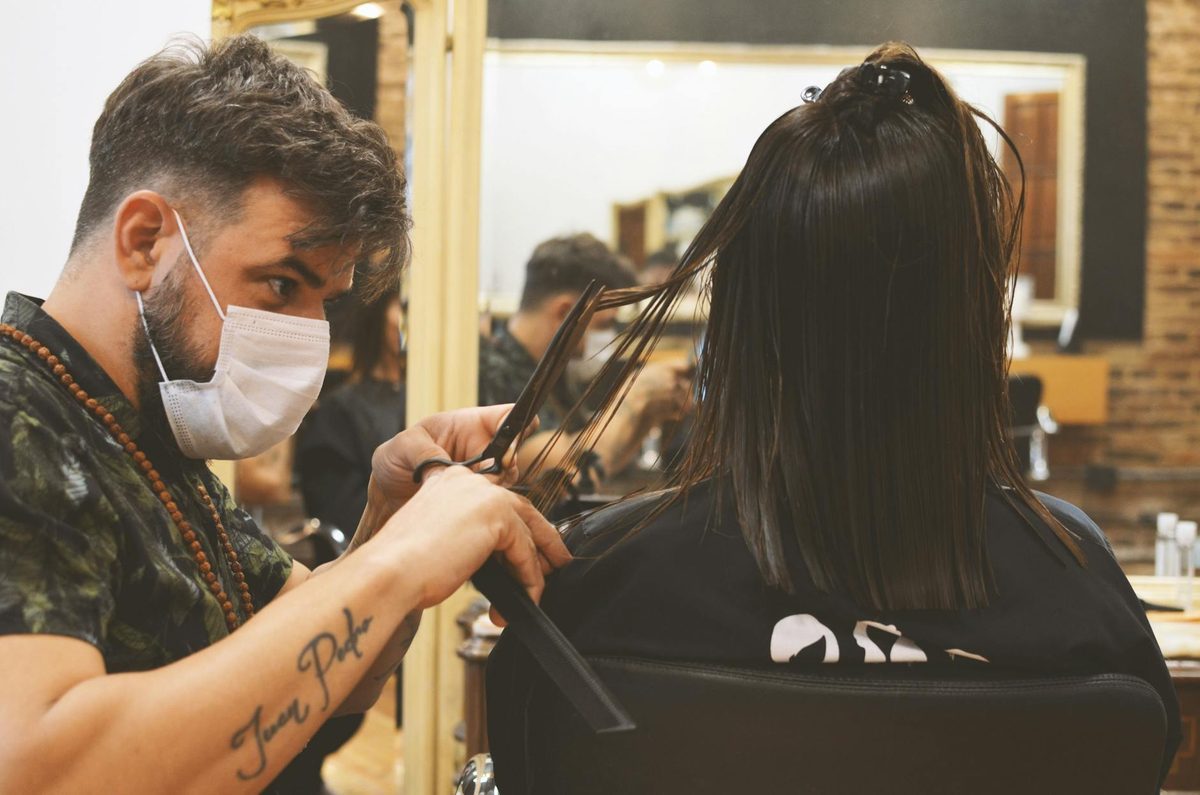 Photo by Ramon Benitez via Pexels
Three Price Tiers for British Stylists
Tier 1: £80 - £250 (Entry Professional)
Forged construction, named steel grade, smooth operation, and a warranty from a real company.
Mina – £80-£150. 440C Japanese steel, hot-forged. The no-nonsense choice for apprentices and stylists who want reliability without brand markup. Available through UK retailers.
Jaguar – £80-£250. German made in Solingen. Jaguar’s strength in the UK market is their distribution – you can find them in most salon supply shops, and replacement parts are easy to source. The Pre Style Ergo line is a solid all-rounder at around £120-£150.
Cricket – £60-£130. Japanese steel at accessible prices. Their S-1 series does the job for apprentices on a tight budget.
What you get: Reliable tools for daily salon work. What you do not get: convex edges, premium steel, or the kind of hand finishing that makes scissors feel effortless. Those features start in Tier 2.
Tier 2: £250 - £500 (The Professional Sweet Spot)
This is where the quality leap happens. You move from adequate to genuinely excellent. VG-10 steel, convex edges, better ergonomics, and edge retention that meaningfully extends the time between sharpenings.
Ichiro – £200-£400. VG-10 and cobalt alloy models that punch well above their weight. Their set options – cutting shear plus thinning shear with matched balance and feel – are particularly good value for UK stylists building a complete kit. If you are upgrading from apprentice scissors and want the best return on investment, Ichiro is where to look.
Juntetsu – £250-£500. The name means “purest steel” in Japanese, and their cobalt alloy scissors have earned a reputation for being noticeably lighter than competitors at the same price point. British stylists working full days in busy high street salons feel the difference. The Aero Pro line is a standout.
Yasaka – £200-£350. Japanese heritage manufacturing with VG-10 steel. The M-series is a working hairdresser’s classic – not the most exciting scissors in the shop, but unfailingly reliable and beloved by sharpeners.
Kasho (entry models) – KAI Corporation’s Design Master series starts around £350-£400 and bridges into this tier. The Disc Operation System pivot is one of the smoothest in the industry.
Who this tier is for: Qualified stylists working full-time. The £250-£400 range is where British money buys the most performance.
Tier 3: £500+ (Premium and Ultra-Premium)
Advanced steel, hand finishing, proprietary technologies. For experienced stylists who know exactly what they want from a blade.
Kasho – £350-£700 for the full range. VG-10W with sintered metal technology. KAI Corporation’s quality control is among the strictest in the industry.
Hikari – £500-£1,200. Holds patents on their convex edge grinding. If your cutting style centres on slide cutting, Hikari’s edge geometry is genuinely unique. Not cheap, but nothing else feels quite the same.
Joewell – £350-£700. Made by Tokosha in Japan using CBA-1 cobalt steel. Particularly relevant for the roughly 11% of stylists with nickel sensitivity – Joewell’s cobalt alloy is nickel-free.
Mizutani – £700-£2,500+. Nano Powder Metal steel at the absolute pinnacle of scissor manufacturing. Their hand-finishing process takes days per pair. These are heirloom tools for stylists at the top of their craft.
Great British – Priced across the mid-to-premium range, with the distinction of being manufactured in Britain. If supporting UK manufacturing matters to you, and it matters to some clients too, Great British is worth a look.
UK Scissors Comparison Table
| Brand | Steel Type | Price (GBP) | Best For | Where to Buy |
|---|---|---|---|---|
| Mina | 440C (hot-forged) | £80 - £150 | Apprentices, NVQ students | Japan Scissors UK, online |
| Jaguar | Friodur ice-hardened | £80 - £250 | Blunt cutting, classic British cuts | Sally Beauty, salon supply shops |
| Ichiro | VG-10, cobalt alloy | £200 - £400 | All-round, value sets | Japan Scissors UK |
| Yasaka | VG-10 | £200 - £350 | Traditional Japanese cutting | Authorised dealers |
| Juntetsu | VG-10, cobalt alloy | £250 - £500 | Lightweight, high-volume salons | Japan Scissors UK |
| Great British | Various | £200 - £500 | UK-made, local support | Great British direct, UK stockists |
| Kasho | VG-10W, sintered metal | £350 - £700 | Premium all-round, disc pivot | Authorised Kasho dealers |
| Joewell | CBA-1 cobalt | £350 - £700 | Nickel-free, premium Japanese | Authorised distributors |
| Hikari | Proprietary cobalt | £500 - £1,200 | Slide cutting specialists | Authorised Hikari dealers |
| Mizutani | Nano Powder Metal | £700 - £2,500+ | Ultra-premium, session work | Mizutani distribution |
Where to Buy Professional Scissors in the UK
Online Retailers
Japan Scissors UK stocks Juntetsu, Ichiro, and Mina with UK-based stock and domestic shipping. Prices are in GBP with no currency conversion surprises.
Sally Beauty UK carries a range of professional scissors across multiple brands. Their high street presence means you can sometimes handle scissors in person before buying, which is valuable for assessing weight and balance.
Direct brand websites for Kasho, Hikari, and Great British sell to UK customers. Verify that the website is the official UK distributor, not a third-party reseller.
For a broader look at trusted retailers, see our guide to the retailers professionals actually trust.
Salon Trade Shows
The UK has strong trade show culture for hairdressing. Salon International, Professional Beauty, and regional shows offer the chance to handle scissors from multiple brands in a single visit. This is one of the best ways to compare options, provided you resist pressure to buy on the spot. Note prices, try the scissors, then research at home.
German Brands: Easier Access Than Ever
Britain’s proximity to Germany gives UK stylists an advantage that Australian or American buyers do not have. Solingen brands like Jaguar distribute widely in the UK, and some German manufacturers sell directly to British salons. Shipping from Germany to the UK takes 3-5 days, though post-Brexit you may see customs charges on orders shipped from EU countries.
What to Avoid
Amazon UK for anything above £150. The counterfeit problem is real, and Amazon’s commingled inventory means even “sold by Brand X” listings can deliver fakes. We covered this in our counterfeit identification guide.
Unbranded “professional” scissors on eBay for £20-£40. These are stamped (not forged), made from unknown steel, and will dull faster than you can say “quality control.”
Japanese vs German: The British Perspective
This is a genuine fork in the road for UK stylists, and the answer is less clear-cut here than in other markets.
The case for German scissors: Britain has a long tradition of classic hairdressing techniques – precision bobs, one-length cuts, scissor-over-comb – that suit German beveled edge scissors perfectly. Jaguar scissors are forgiving, easy to sharpen locally, and built for the techniques that many British stylists learn first. Distribution is excellent, pricing is competitive, and your local sharpener probably knows German scissors inside out.
The case for Japanese scissors: Modern British hairdressing has evolved. Slide cutting, texturising, and point cutting are now standard techniques in most salons. Japanese convex edge scissors with VG-10 steel are purpose-built for these techniques. Brands like Juntetsu and Ichiro have gained significant ground in the UK market because they deliver what these techniques demand.
The practical answer: Most established British stylists own both. A Japanese convex-edge cutting shear for their primary work and a German or Japanese thinning shear for texturising. Some keep a German pair specifically for precision blunt work. For the full analysis, read our Japanese vs German scissors comparison.
Sharpening: The UK Situation
The UK has a reasonable network of professional scissor sharpeners, but quality varies enormously. A sharpener who is excellent with German beveled-edge scissors may not understand Japanese convex-edge geometry at all – and using the wrong technique can destroy your scissors.
Before buying Japanese scissors, find a sharpener in your area who specifically understands convex edge sharpening. Ask them what angle they sharpen at (convex edges need a different approach than beveled). If they cannot answer that question confidently, they are not the right person for your Japanese shears.
German scissors are more forgiving on this front. Most competent sharpeners can handle a beveled edge correctly. This is one practical advantage of choosing German scissors in the UK.
The typical sharpening interval is 3-4 months for regular salon use with entry-level steel, extending to 6-12 months for premium VG-10 and cobalt alloy scissors. For the detailed breakdown, see our guide on how often you should actually sharpen your scissors.
Tax Relief for UK Hairdressers
Self-employed stylists (sole traders, partnerships, limited companies): Professional scissors are a deductible business expense. Claim the full cost against your income in the year of purchase.
Employed stylists who are required to provide their own tools: HMRC offers a flat rate expense allowance for certain occupations. Hairdressers and barbers are on the list. The exact amount is modest, but it is something. Check the current HMRC guidance or speak to an accountant.
Either way, keep your receipts and buy from retailers who provide VAT invoices. A £400 pair of scissors costs less in real terms when the tax relief is factored in.
Choosing the Right Size for British Cutting
British hairdressing education typically starts with 5.5-inch scissors, but size should ultimately match your hand and technique. We surveyed 500 stylists on their preferred size, and the results are worth reading.
Quick test: hold the scissors with the finger rest on your ring finger. The tip should reach roughly to the last knuckle of your middle finger. If you primarily do texturising and detail work, go shorter. If you do a lot of long layers and scissor-over-comb, go longer.
Our scissor sizes reference covers this in full detail.
British-Made: The Great British Option
Great British scissors deserve a mention for UK stylists who value local manufacturing. In an industry dominated by Japanese and German imports, having a British-made option matters to some stylists – both as a point of pride and because it simplifies warranty service, returns, and customer support.
Their range spans from mid-tier to premium, with various steel options and handle configurations. The build quality is solid, and the fact that everything from manufacturing to warranty service happens within the UK is a genuine practical advantage.
Are they better than Japanese scissors at the same price? That depends on your priorities. If supporting British manufacturing and having the simplest possible aftercare chain matters to you, they are worth trying. If raw steel quality and edge retention are your only criteria, Japanese VG-10 and cobalt alloy still lead at most price points.
Scissors Worth Considering


Prices are approximate guides. Visit retailer for current pricing and availability.
Final Recommendations for UK Stylists
NVQ apprentice? Mina at £80-£150. Genuine Japanese steel at a price that will not hurt while you are learning. Pair with a basic thinning shear and you are set for your entire apprenticeship.
Newly qualified and upgrading? Ichiro at £200-£350 or Juntetsu at £250-£400. The VG-10 and cobalt alloy steel in this range is a significant step up from apprentice scissors. You will notice the difference immediately. See our Ichiro vs Juntetsu comparison for help choosing.
Established stylist investing in the best? Kasho for the smoothest pivot system, Hikari for unmatched slide cutting, Mizutani for the absolute peak of the craft.
Nickel sensitivity? Joewell CBA-1 cobalt steel is your safest option.
Want British-made? Great British with domestic manufacturing and support.
Whatever you choose, buy from an authorised UK retailer, find a sharpener who understands your scissors’ edge type before you need them, and remember that the best scissors are the ones that match your technique – not the ones with the highest price tag.
For the foundations, start with our steel types reference and edge types guide. And if you are curious about what makes Japanese scissors genuinely different from their German counterparts, our deep dive from 2012 is still the best starting point.