Best Japanese Scissors Brands Ranked: From Budget to Ultra-Premium
There are over 200 scissor manufacturers in Japan. Most of them are concentrated in Seki City, a place with 700 years of blade making history that produces roughly 99% of the country’s professional hairdressing shears. Walking into this market cold is overwhelming. You see brand names you cannot pronounce, steel grades that read like serial numbers, and prices that range from $100 to $3,000 for tools that all claim to be “the best.”
We cut through the noise. These are the 10 Japanese scissors brands that matter most for working stylists, ranked by steel quality, real-world performance, and value for money. No sponsorships. No affiliate deals. Just the brands that consistently deliver.
The Master Ranking
Scan this table first, then read the detailed breakdowns below.
| Rank | Brand | Steel | Price Range | Best For |
|---|---|---|---|---|
| 1 | Mizutani | Nano Powder Metal, Stellite | $800 to $3,000+ | Ultra-premium, investment pieces |
| 2 | Hikari | Proprietary, convex patents | $600 to $1,500 | Convex specialists, longevity |
| 3 | Kasho | VG-10W, Sintered Metal | $400 to $800 | Reliable premium, global support |
| 4 | Juntetsu | VG-10, Cobalt Alloy | $250 to $700 | Ergonomics, lightweight, value premium |
| 5 | Joewell | CBA-1 Cobalt Base Alloy | $400 to $900 | Nickel sensitivity, design quality |
| 6 | Yasaka | VG-10 | $200 to $400 | Heritage reliability, mid-range |
| 7 | Ichiro | VG-10, Cobalt Alloy | $200 to $500 | Best value, sets, wide distribution |
| 8 | Kamisori | Japanese steel (various) | $200 to $600 | Canadian distribution, Japanese steel |
| 9 | Mina | 440C | $100 to $200 | Students, budget professionals |
| 10 | Naruto | Various Japanese | $150 to $300 | Heritage, entry professional |
A note on methodology: ranking scissors is not like ranking phones. There is no single “best.” A $200 pair of Ichiro scissors is not worse than a $2,000 pair of Mizutani scissors in any absolute sense. They are different tools for different budgets and different career stages. This ranking weighs steel sophistication, craftsmanship, innovation, and value together. Your personal number one depends on what you need and what you can spend.
Premium Tier: $600 and Up
These are the brands where Japanese scissors craftsmanship reaches its highest expression. The steel is more exotic, the finishing is more refined, and the price reflects it. Whether the premium is worth it depends on your cutting volume and career stage. Our analysis of 5-year cost of ownership found that the daily cost difference between mid-range and premium scissors is less than 40 cents.
1. Mizutani ($800 to $3,000+)
Mizutani is the brand that other brands benchmark against. Based in Japan with showrooms in Asakusa, Omotesando, and Osaka, they operate at a level of steel science that most manufacturers cannot touch.
Their signature innovation is Nano Powder Metal steel, developed in collaboration with the University of Tokyo. The process atomises molten steel into nano-scale particles before sintering them under extreme pressure. The result is a steel with virtually no carbide segregation, which means the edge is uniform at a microscopic level. In your hand, that translates to an edge that feels identical from the first cut to the thousandth.
Their Stellite alloy models contain over 50% cobalt and are so hard they approach ceramic territory while remaining sharpenable. Mizutani’s proprietary Extramarise heat treatment further refines the grain structure beyond standard hardening.
Who it is for: Established stylists cutting 30+ clients per week who want a tool that will last 15 to 20 years with proper maintenance. The per-day cost is surprisingly reasonable when you do the math over a decade.
Who it is not for: Anyone early in their career. Not because the scissors are not good, but because you will not fully utilise what they offer until your technique is locked in.
2. Hikari ($600 to $1,500)
Hikari holds patents on their hamaguri-ba convex edge technology that no other manufacturer can replicate. Where most brands grind a convex edge and call it done, Hikari engineers the entire blade geometry around the convex principle, from spine to edge.
The practical result is scissors that are designed for 20 or more resharpening cycles without losing their cutting character. Most professional scissors degrade subtly with each sharpening as the original geometry is slowly altered. Hikari’s approach means the scissors you are using after the tenth sharpening still feel like the scissors you bought.
Their limited production runs mean each pair receives more individual attention than mass-produced brands. The trade-off is availability. You may need to wait or work through specific retailers.
Who it is for: Slide cutting specialists and stylists who value longevity above all else. Also excellent for anyone frustrated by scissors that feel different after sharpening.
3. Kasho ($400 to $800)
Kasho is manufactured by KAI Corporation, one of Japan’s largest blade manufacturers, headquartered in Seki City. KAI also produces kitchen knives, surgical instruments, and industrial blades. That scale gives Kasho something smaller brands cannot match: consistency.
Their workhorse steel is VG-10W, an enhanced version of standard VG-10 with improved wear resistance. Their premium Millennium Series uses sintered metal, which is produced through a process similar to Mizutani’s powder metal but at a different price point.
Kasho’s global distribution through KAI’s network means parts, service, and warranty support are more accessible than most Japanese brands. If something goes wrong, there is a real company with real infrastructure behind the product.
Who it is for: Stylists who want premium Japanese quality with the reliability and support of a major manufacturer. Also a strong choice if you want sintered metal technology without Mizutani pricing.
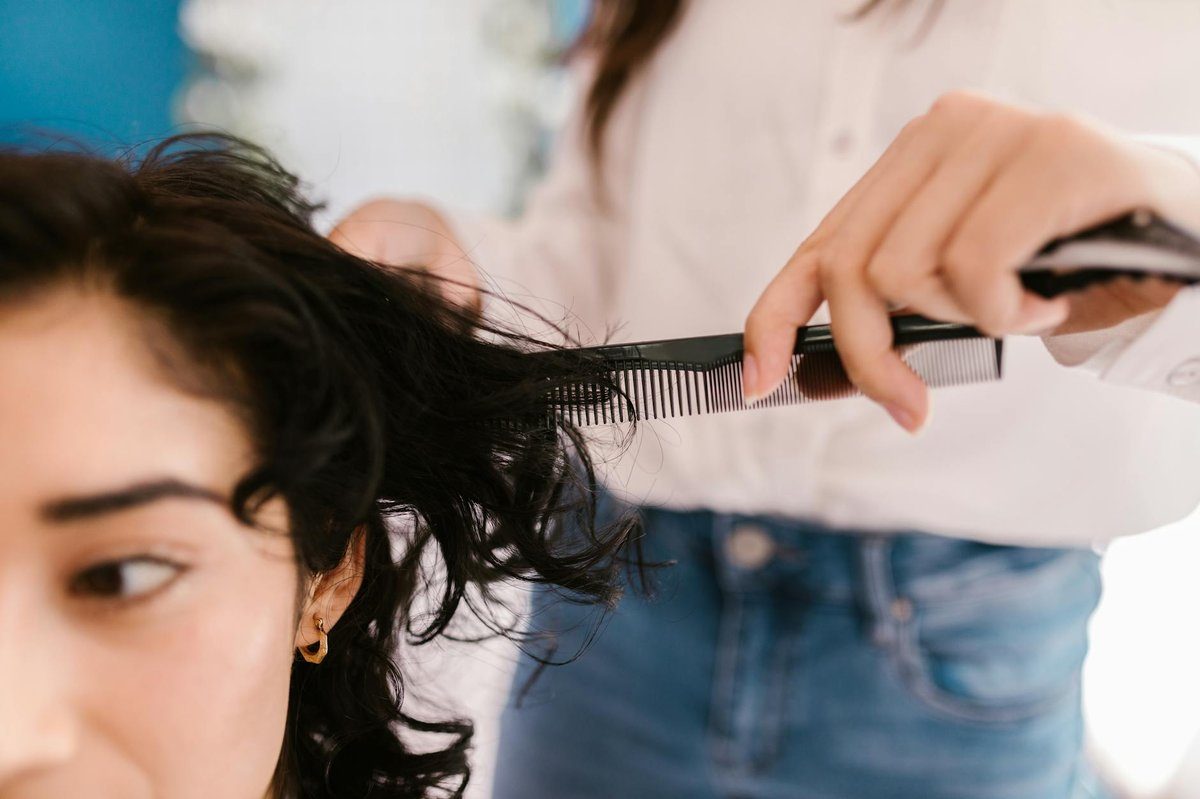
 Photo by Pavel Danilyuk via Pexels
Mid-Range Tier: $200 to $600
This is where most working stylists should be shopping. The steel is genuine Japanese professional grade. The craftsmanship is high. And the prices leave room in your budget for proper maintenance and eventual upgrades.
4. Juntetsu ($250 to $700)
Juntetsu translates to “Purest Steel” (純鉄), and their brand philosophy matches the name. They focus on high-purity Japanese steel paired with lightweight construction that reduces hand fatigue across long cutting days.
Their range spans from entry VG-10 models around $250 to premium cobalt alloy scissors pushing $700. That breadth means you can start with Juntetsu as an entry professional and upgrade within the same brand as your career develops, without having to learn a new tool’s balance and feel.
The standout feature is their handle variety. Juntetsu offers offset, crane, and swivel handles, making them one of the most ergonomically versatile brands in this price range. The swivel option is particularly notable. Full swivel scissors from premium brands start at $600 or more. Juntetsu gets you there for less.
For a detailed comparison with their closest competitor, see our Ichiro vs Juntetsu head-to-head.
Who it is for: Stylists who prioritise hand health and want a brand they can grow with from entry professional to premium.
5. Joewell ($400 to $900)
Joewell is manufactured by Tokosha Co., and they bring something genuinely unique to the table: CBA-1 cobalt base alloy with less than 0.6% nickel content.
That nickel number matters. Approximately 11% of stylists have some degree of nickel sensitivity, and standard stainless steels contain significantly more nickel than Joewell’s proprietary alloy. If you have ever experienced contact dermatitis from your scissors, Joewell should be at the top of your list.
Beyond the alloy, Joewell’s design quality earned them the Good Design Award in 2017. These are beautifully made scissors that happen to also solve a real medical problem for a significant percentage of stylists.
Who it is for: Anyone with nickel sensitivity, full stop. Also excellent for stylists who value design and cobalt alloy performance.
6. Yasaka ($200 to $400)
Yasaka is a heritage Japanese brand that does not chase trends. They make VG-10 scissors that cut well, hold an edge reliably, and cost a fair price. That is their entire proposition, and it has worked for decades.
In a market full of brands competing on exotic steel and marketing, Yasaka’s straightforwardness is refreshing. Their VG-10 models deliver consistent 60 to 62 HRC hardness, clean convex edges, and the kind of no-nonsense reliability that salon owners appreciate when equipping junior stylists.
Who it is for: Stylists who want proven VG-10 performance without paying for features they do not need. Salon owners buying tools for their team.
7. Ichiro ($200 to $500)
Ichiro is the best value proposition in Japanese scissors. That is not a backhanded compliment. It means they deliver 80 to 90% of what premium brands offer at 40 to 60% of the price.
Their range covers VG-10 and cobalt alloy steel across cutting, thinning, texturizing, and left-handed models. They also offer some of the best pre-matched sets in the industry, where cutting and thinning scissors are designed to complement each other and sold at a genuine discount.
Distribution is another strength. Ichiro is available through authorised retailers in the US, UK, Australia, Canada, and New Zealand. You can actually find them, try them, and service them locally.
For a detailed breakdown, see our Ichiro vs Juntetsu comparison.
Who it is for: Any stylist who wants genuine Japanese quality without overpaying. Particularly strong for set buyers and those in their first 5 years of professional work.
8. Kamisori ($200 to $600)
Kamisori is a Canadian brand that sources Japanese steel and manufacturing. They bridge the gap between Japanese craftsmanship and North American distribution and service expectations.
Their range is broad, covering multiple steel grades and handle styles. The Canadian headquarters means warranty service, customer support, and returns are handled locally for North American buyers, which removes one of the friction points of buying from smaller Japanese-only brands.
Who it is for: North American stylists who want Japanese steel with local service and support.
Entry Tier: $100 to $300
These brands prove that professional quality does not require a professional salary. They use simpler steels and less exotic finishing, but they are real tools made with real manufacturing processes. Starting here is smart, not cheap.
9. Mina ($100 to $200)
Mina is the brand we recommend most often for students and early-career stylists. They use hot-forged Japanese 440C steel, which is a genuine professional grade that gets overlooked because it does not have the prestige of VG-10 or cobalt.
Here is what 440C actually gives you: a properly hardened blade that holds a convex edge for 3 to 4 months between sharpenings. That is shorter than VG-10, yes. But at $100 to $200, you can afford professional sharpening every few months and still spend less over two years than you would on a single pair of premium scissors.
Our guide on what makes Japanese scissors different explains why even entry-level Japanese steel outperforms most of what you will find at the same price from non-Japanese manufacturers.
Who it is for: Students, apprentices, and anyone who needs a real professional tool without the real professional price. See our complete guide to student scissors for more.
10. Naruto ($150 to $300)
Naruto has been manufacturing scissors since 1963, giving them over six decades of continuous production experience. They are a heritage brand in the truest sense, producing scissors in Japan using established methods that predate the modern marketing era.
Their scissors are straightforward, well-made, and priced fairly. They do not have the distribution reach of Ichiro or the brand recognition of Kasho, but the quality is genuine.
Who it is for: Stylists who value heritage manufacturing and want an honest Japanese tool without trend-driven pricing.
How to Use This Ranking
Do not read this list top to bottom and assume number one is best for you. Read it by tier and by budget.
If you are a student or in your first two years: Start at rank 9 or 10. Mina or Naruto will serve you well while you develop your technique. When you are ready, jump to rank 6 or 7.
If you are an established stylist on a budget: Ranks 4 through 7 are your sweet spot. Juntetsu, Joewell, Yasaka, and Ichiro all deliver professional performance that will last 7 to 10 years with proper maintenance.
If you are investing in career-long tools: Ranks 1 through 3 offer steel and craftsmanship that justify the premium for high-volume stylists. The jump from mid-range to premium is smaller than the jump from budget to mid-range, but it is real.
If you have nickel sensitivity: Go directly to Joewell, rank 5, regardless of budget.
Steel Reference
Every steel type mentioned in this ranking is covered in detail in our reference section:
- VG-10: The industry standard for mid-range Japanese scissors
- Cobalt Alloy: The step up from VG-10, used by Ichiro, Juntetsu, Joewell, and others
- 440C: The workhorse entry-level Japanese steel used by Mina
- Powder Metal: The premium steel technology used by Mizutani and Kasho
For a deeper look at how steel grade affects your daily cutting experience, see our post on the steel hierarchy every stylist should understand.
Final Thought
Japan makes the best professional scissors in the world. That is not nationalism or marketing. It is the result of 700 years of blade craft concentrated in a single city, combined with modern metallurgy and a manufacturing culture that treats scissors as serious tools rather than commodity products.
Pricing and availability vary by market. For local currency pricing and authorised retailers, see our country guides: Australia, USA, UK, Canada, Japan, Germany, and France.
One From Each Tier


Prices are approximate guides. Visit retailer for current pricing and availability.
The 10 brands on this list represent the best of what that tradition produces for working stylists worldwide. Whether you spend $100 or $3,000, you are getting a tool made by people who take blade making personally. The only question is which brand matches your hands, your budget, and your career stage.
Choose accordingly.