The Craftsman's Dictionary: Essential Japanese Scissors Terminology

You don’t need to speak Japanese to buy Japanese scissors. But understanding 20 key terms will save you from being sold something you don’t need.
The Japanese scissors industry uses a vocabulary that mixes centuries-old bladesmithing language with modern manufacturing terminology. Some of these words have no direct English equivalent. Others have been deliberately left untranslated by brands that want their products to sound more exotic than they are. And a few are genuinely useful concepts that English lacks a good word for.
This glossary covers roughly 30 terms, organised by category. Each entry includes the kanji (or katakana), the reading, the romaji, the English meaning, and a one-sentence context for how you will encounter it. This is not an academic exercise. Every term here is something you will see on a product page, hear from a dealer, or read in a manufacturer’s catalogue.
Quality and Performance
These are the words Japanese manufacturers use when they talk about what makes a scissor good. Two of them – kireaji and nagakire – are arguably the most important concepts in the entire industry.
切れ味 (きれあじ, kireaji) – cutting taste / cutting feel The subjective quality of how a scissor cuts, encompassing smoothness, resistance, and precision. Kireaji is the single most important quality measure in Japanese scissor manufacturing. When a Mizutani engineer evaluates a finished scissor, they are primarily assessing kireaji. There is no single English word that captures this concept; “sharpness” is close but incomplete, because kireaji also describes the sensation of the cut, not just the result.
永切れ (ながきれ, nagakire) – lasting sharpness The ability of a scissor to maintain its cutting quality over extended use. Mizutani uses nagakire as a core marketing concept, and for good reason: it distinguishes a genuinely well-made scissor from one that is merely sharp out of the box. A VG-10 scissor typically delivers 6-12 months of nagakire before it needs professional sharpening. A cobalt alloy scissor can deliver 12 months or more. The cheapest scissors have almost no nagakire at all – they are sharp on day one and dull by week three.
Quality is what you feel. These next terms describe what you see: the physical characteristics of the blade itself.
Blade Geometry and Structure
This is where the language gets technical. Japanese bladesmiths developed an extraordinarily precise vocabulary for describing what is happening along the length of a scissor blade, down to fractions of a millimetre.
おがみ (ogami) – blade bow The slight outward curvature of a blade, typically around 0.03mm. Ogami creates the precise contact dynamics that allow the blades to cut cleanly along their full length. Too much ogami and the scissor feels stiff; too little and it will not cut properly at the tips. This is one of the adjustments that separates hand-finished scissors from mass-produced ones.
ヒネリ (hineri) – twist A deliberate, subtle twist along the blade’s length that ensures even contact pressure from pivot to tip during cutting. Hineri works in concert with ogami to create a smooth, consistent cutting action. Adjusting hineri is one of the most skilled tasks in scissor finishing.
アキ (aki) – gap The visible gap between the two blades when the scissor is closed. Proper aki is essential: it ensures the blades only make contact at the cutting point rather than dragging against each other along their full length. A well-set aki contributes directly to kireaji.
触点 (しょくてん, shokuten) – contact point The single point where the two blades actually meet during cutting. The contact point travels from the pivot toward the tip as the scissor closes. The precision of this travelling contact point is what makes a convex edge scissor capable of techniques like slide cutting.
刃線 (はせん, hasen) – blade line / blade curve The curvature profile of the cutting edge from pivot to tip. Different hasen profiles produce different cutting characteristics. A straight hasen gives a consistent, predictable cut. A curved hasen can be optimised for specific techniques. Manufacturers in Seki City spend considerable time designing and testing hasen profiles.
Now we get into the shapes that determine how your scissors actually cut.
Edge Types
Japanese scissors are classified by their edge geometry. Each type has a name, a distinct cross-section, and a purpose. Understanding these five terms will tell you more about a scissor than any amount of marketing copy.
蛤刃 (はまぐりば, hamaguriba) – clamshell / convex edge The curved, convex edge geometry that revolutionised professional scissors. Named because the cross-section resembles a clamshell. Hikari holds patents related to hamaguri edge refinements and has been one of the leading innovators in convex blade technology. This is the edge type that enables slide cutting, point cutting, and other advanced techniques.
笹刃 (ささば, sasaba) – bamboo leaf curve A blade with a subtle S-curve resembling a bamboo leaf. Sasaba blades are designed for smooth, flowing cuts and are particularly popular for techniques that require the hair to slide along the blade. The gentle curve reduces the resistance felt during cutting.
柳刃 (やなぎば, yanagiba) – willow blade A long, slender blade profile optimised for slide cutting techniques. The name comes from the resemblance to a willow leaf. In the kitchen knife world, yanagiba refers to the sashimi knife; in scissors, it describes a blade shape that excels at the same kind of precise, single-direction slicing.
直刃 (ちょくば, chokuba) – straight edge A flat, straight edge without convex curvature. Chokuba scissors are less common in professional Japanese scissors today but remain popular for specific applications where a crisp, definitive cut is preferred over a sliding action.
鎌刃 (かまば, kamaba) – sickle edge A concave or hooked edge profile, sometimes used in thinning scissors. The sickle shape helps grip and control hair during thinning, preventing strands from slipping out before they are cut.
Blade Orientation
Two terms that matter more than you might think, especially if you are left-handed or use aggressive thinning techniques.
正刃 (せいば, seiba) – standard blade orientation The default blade configuration where the still blade sits on the bottom (thumb side). The vast majority of scissors are seiba. When a product page does not specify orientation, it is seiba.
逆刃 (ぎゃくば, gyakuba) – reversed blade A reversed blade configuration used in some thinning scissors for more aggressive texture work. Gyakuba thinners cut differently because the tooth pattern and blade mechanics are inverted. Some stylists specifically seek out gyakuba thinners for particular texturing effects.
These are the terms you will hear when your scissors are being serviced, and knowing them helps you evaluate whether your sharpener actually knows what they are doing.
Maintenance and Sharpening
Japanese scissors require maintenance by specialists who have their own vocabulary. Knowing these terms helps you communicate with your sharpener and understand what they are doing to your scissors.
返り刃 (かえりば, kaeriba) – wire edge / burr The microscopic metal burr that forms on the edge during sharpening. Kaeriba must be carefully removed to achieve a clean cutting edge. How a sharpener handles kaeriba is one of the markers of their skill level.
刃付け (はつけ, hatsuke) – edge creation / edge setting The process of creating or restoring the cutting edge on a scissor. Hatsuke is both a noun (the edge itself) and a verb (the act of creating it). When you read 刃付け in a product specification, it refers to the type of edge that has been applied.
裏スキ (うらすき, urasuki) – hollow grind (inside) The concave hollow ground into the inside face of each blade. Urasuki reduces the contact area between the blades, which reduces friction and improves the cutting action. The depth and consistency of the urasuki is a quality indicator; uneven urasuki means uneven cutting performance.
矯木 (ためぎ, tamegi) – wooden correction tool A hardwood tool used by sharpening specialists to make micro-adjustments to blade curvature (ogami and hineri). The tamegi allows a skilled technician to bend the blade by fractions of a millimetre. It is a simple tool that requires years of experience to use correctly.
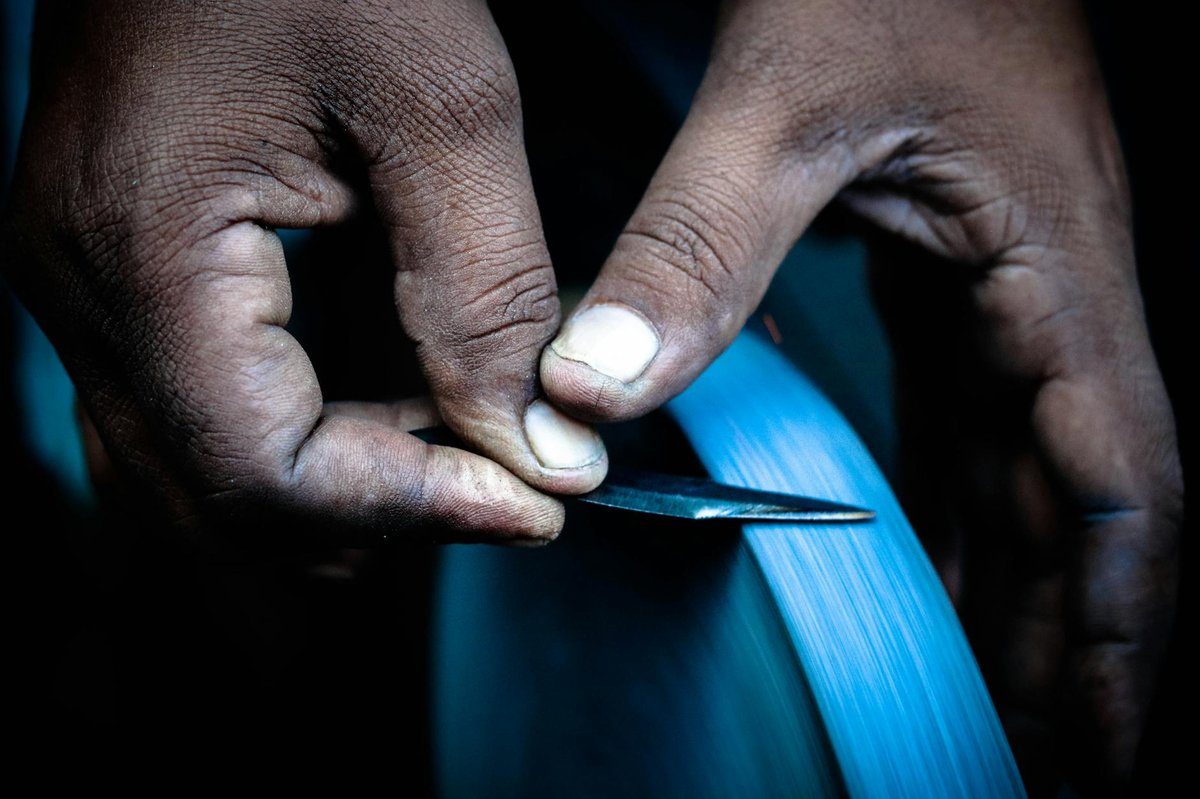
研ぎ師 (とぎし, togishi) – sharpening master A specialist whose sole profession is sharpening and maintaining cutting tools. In Japan, togishi is a respected trade with its own apprenticeship tradition. A good togishi does not just sharpen your scissors – they restore the ogami, adjust the hineri, set the aki, and return the scissor to its original cutting performance.
Understanding how scissors are made helps you understand what you are paying for.
Manufacturing
These terms describe how Japanese scissors are made. They help you understand the difference between a ¥30,000 factory scissor and a ¥300,000 hand-forged one.
鍛造 (たんぞう, tanzō) – forging The process of shaping steel through hammering and pressing, either by hand or machine. Forged scissors have a denser grain structure than cast or stamped scissors, which generally translates to better edge retention. Premium Seki City manufacturers still use forging as a primary shaping method.
研削 (けんさく, kensaku) – grinding The process of shaping the blade profile and creating the edge geometry using grinding wheels and stones. Grinding is where the hamaguriba, sasaba, or other edge profiles are actually created. The skill of the grinder determines the precision of the blade geometry.
熱処理 (ねつしょり, netsushori) – heat treatment The controlled heating and cooling process that determines the final hardness (HRC) and toughness of the steel. Heat treatment is arguably the single most critical manufacturing step. Two scissors made from identical VG-10 steel can perform completely differently based on their heat treatment. This is why manufacturer reputation matters.
分業制 (ぶんぎょうせい, bungyōsei) – division of labour system The traditional Seki City manufacturing model where different specialists handle different stages of production: forging, grinding, heat treatment, assembly, finishing, and sharpening. Bungyōsei means that your scissor may have been touched by six or more different craftspeople, each an expert in their specific stage. This system produces higher quality than a single factory handling everything, but it also means production is slower and coordination is critical.
A few terms for navigating the Japanese scissors market.
Business and Industry
The commercial side of the Japanese scissors world has its own vocabulary.
ディーラー (diiraa) – beauty dealer / distributor The sales representatives who visit salons to sell scissors directly. In Japan, ディーラー visits are the primary sales channel for professional scissors. Dealers carry multiple brands and can offer hands-on comparisons. The dealer relationship is central to how Japanese stylists buy their tools.
工場見学 (こうじょうけんがく, kōjō kengaku) – factory tour An organised visit to a scissors manufacturing facility. Several Seki City manufacturers offer kōjō kengaku for dealers and stylists. These tours are partly educational and partly sales tools, but they provide genuine insight into the manufacturing process.
師匠 (ししょう, shishō) – master smith / master craftsman An honorific title for the senior craftsperson who oversees production and quality. Kasho uses the concept of shishō prominently, emphasising the master-apprentice lineage behind their products. The shishō is the person whose standards define the quality of everything that leaves the workshop.
Reading Japanese Specifications
When you encounter a Japanese scissor spec sheet, here are the key fields:
- 鋼材 (こうざい, kōzai) – steel type (e.g., VG-10, cobalt alloy, ATS-314)
- 硬度 (こうど, kōdo) – hardness, measured in HRC
- 刃線 (はせん, hasen) – blade line / curve type
- 刃付け (はつけ, hatsuke) – edge type (e.g., hamaguriba, sasaba)
- ハンドル (ハンドル, handoru) – handle type (offset, even, crane)
- 全長 (ぜんちょう, zenchō) – total length in inches or millimetres
Quick Reference: The 10 Most Important Terms
| Japanese | Reading | Romaji | English | Why It Matters |
|---|---|---|---|---|
| 切れ味 | きれあじ | kireaji | cutting feel | The ultimate quality measure |
| 永切れ | ながきれ | nagakire | lasting sharpness | Distinguishes quality from hype |
| 蛤刃 | はまぐりば | hamaguriba | convex edge | The edge type that changed everything |
| 裏スキ | うらすき | urasuki | hollow grind | Key quality indicator on inside face |
| 鍛造 | たんぞう | tanzō | forging | Tells you how the steel was shaped |
| 熱処理 | ねつしょり | netsushori | heat treatment | The most critical manufacturing step |
| 研ぎ師 | とぎし | togishi | sharpening master | Who maintains your investment |
| 刃線 | はせん | hasen | blade line | Defines the cutting characteristics |
| おがみ | おがみ | ogami | blade bow | Precision that separates hand-finished work |
| ヒネリ | ヒネリ | hineri | twist | The subtle adjustment only experts feel |
Why This Vocabulary Matters
Understanding these terms does three practical things for you.
First, it lets you read Japanese product pages and spec sheets directly, rather than relying on whatever the English marketing team decided to include. Japanese-language product pages almost always contain more technical detail than their English equivalents.
Second, it helps you evaluate quality claims. When a brand says “hand-forged,” you can ask whether that means tanzō with hand hammering or machine press forging. When they say “convex edge,” you can ask whether it is hamaguriba or something else. The vocabulary gives you the tools to ask precise questions.
Third, it helps you communicate with sharpeners and technicians. If you can tell your togishi that the ogami feels off, or that the aki has widened, you are describing specific, actionable problems rather than saying “it doesn’t cut right.”
The Japanese scissors industry has spent centuries developing a precise technical vocabulary because precision matters when you are working at tolerances measured in hundredths of a millimetre. Learning even a fraction of that vocabulary makes you a more informed buyer, a better communicator with your maintenance professionals, and ultimately a stylist who understands their tools at a deeper level.