Hayashi Scissors: The Wakayama Workshop That Broke the Hardness Ceiling
HRC 67. That number means nothing to most people. To scissor metallurgists, it is the equivalent of breaking the sound barrier.
For decades, the practical ceiling for professional hairdressing scissors sat around HRC 60-63. Push higher and the steel becomes brittle. The blade chips. The edge that was supposed to last forever shatters on the first drop, the first piece of grit, the first moment of real-world imperfection. Every manufacturer who tried to push past 63 hit the same wall: hardness and toughness are opposing forces, and steel does not care about your ambitions.
Then a workshop in Wakayama Prefecture figured out how to get to 67.
Outside the Seki System
Here is the first thing to understand about Hayashi Scissors: they are not from Seki City.
That matters more than geography. Seki is the center of Japan’s scissor industry, producing roughly 99% of the country’s hairdressing shears through its bungyosei (分業制) division-of-labor system. Being in Seki means access to specialized heat treaters, grinders, assemblers, and decades of institutional knowledge. It also means operating within a particular manufacturing paradigm.
Hayashi operates in Wakayama Prefecture, on the Kii Peninsula south of Osaka. They are independent innovators, outside the Seki ecosystem, developing their own steels, their own manufacturing processes, and their own solutions to problems that the mainstream industry considered solved, or unsolvable.
Wakayama is not a scissor town. But it is becoming one, because Hayashi is not the only innovative manufacturer there. Kikui, the company that invented cobalt alloy scissors in 1973, also calls Wakayama home. Hayashi shares Wakayama Prefecture with Kikui, making this quiet prefecture home to both the hardest and the most corrosion-proof scissors ever made. Something about operating outside the established system seems to encourage radical thinking.
The HYS Steel Family
Hayashi’s proprietary steel is called HYS, and it is a powder metallurgy product engineered specifically for scissors. That “specifically for scissors” part is important; most scissor steels are adapted from knife steels or industrial cutting tool steels. HYS was designed from the ground up for the unique demands of a two-blade pivoting tool.
The alloy contains three key elements:
| Element | Role | Effect |
|---|---|---|
| Tungsten (W) | Hardness | Forms ultra-hard tungsten carbides in the steel matrix |
| Molybdenum (Mo) | Toughness | Increases resistance to impact and deformation |
| Vanadium (V) | Wear resistance | Creates fine vanadium carbides that resist abrasion |
The powder metallurgy manufacturing process is crucial. Instead of casting molten steel into a mold (which produces inconsistent grain structure and trapped impurities), powder metallurgy atomizes the metal into fine particles, sorts them for uniformity, and then consolidates them under extreme heat and pressure.
The result is a steel with an ultra-fine, uniform grain structure. Grain size directly affects how sharp an edge can be ground and how long it holds. Coarse grains mean a rough edge at the microscopic level, like a serrated knife you cannot see. Fine grains mean a smooth edge that cuts cleanly and maintains its geometry longer.
Standard HYS achieves HRC 63-64, already at the top of the conventional range for professional scissors. For comparison, most VG-10 scissors run HRC 60-62.
HYS-MAX67: Breaking Through
The HYS-MAX67 is where Hayashi did something nobody else has done.
HRC 67 in a professional styling scissor. The concept-to-product development reportedly took several years of iteration, testing, and failure before Hayashi cracked the problem.
The solution was not simply making harder steel. That path had already been tried and it always hit the same brittleness wall. Instead, Hayashi used a two-piece welding construction.
Here is the concept: rather than making the entire scissor blade from one piece of ultra-hard steel, Hayashi welds two different metals together. The cutting edge, the part that actually contacts hair, is made from their hardest powder metallurgy steel at HRC 67. The body of the blade, the part that absorbs shock, handles torque from the pivot, and provides structural support, is made from a tougher, more flexible base material.
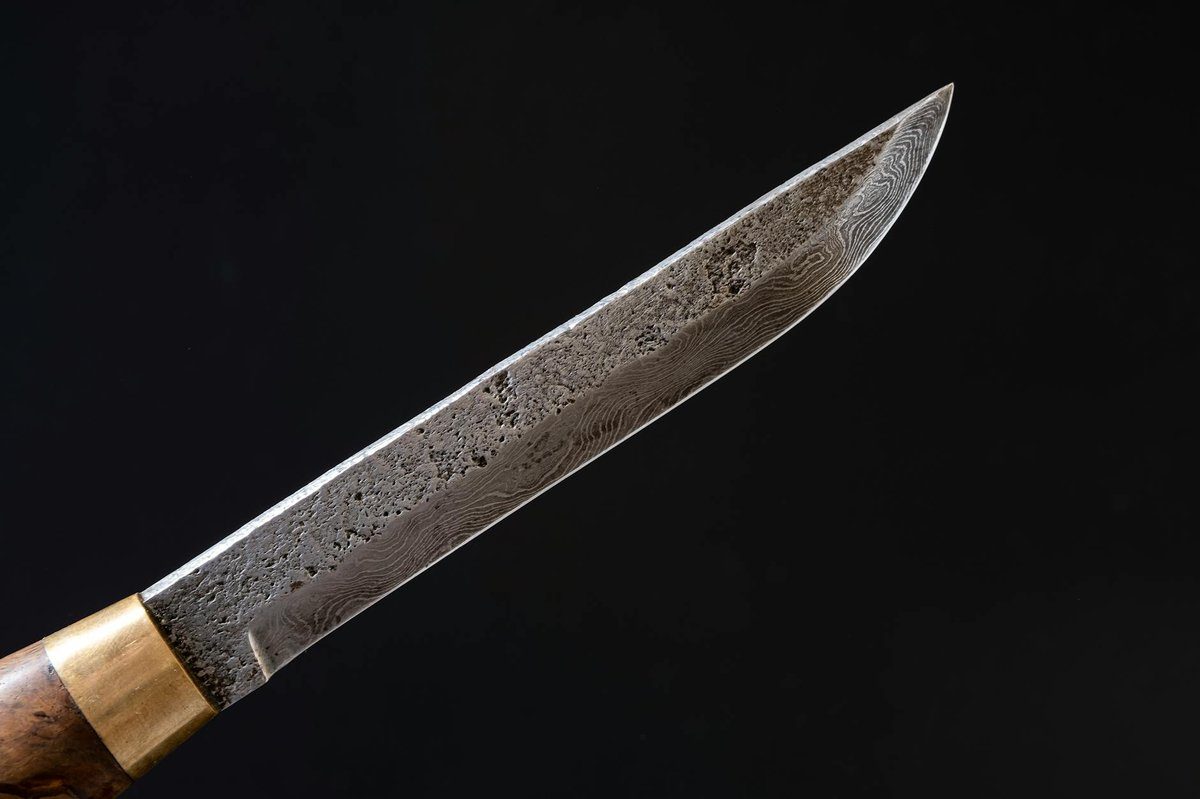
This is directly analogous to traditional Japanese sword construction. A katana is not one piece of steel. It is a hard cutting edge (hagane) wrapped around or welded to a softer, tougher core (shingane). The hard edge cuts. The soft core absorbs impact. Together, they achieve what neither material could alone.
Hayashi applied this centuries-old principle using modern metallurgy and precision welding. The result is a scissor that cuts with HRC 67 hardness but handles with the toughness of a conventional blade.
The company describes the cutting experience as 全てを超えるなめらかさ (subete wo koeru namerakasa): “smoothness surpassing everything.” That is a bold claim. But when your blade is harder than anything else on the market by four full HRC points, the edge geometry is simply finer, the surface finish is smoother, and the cutting resistance is measurably lower.
Pure Cobalt: A Different Approach Entirely
Hayashi does not only make hard stainless steel. They also produce Pure Cobalt scissors that operate on completely different metallurgical principles.
Their cobalt scissors run at approximately HRC 47. On paper, that looks terrible: nearly 20 points below HYS-MAX67 and well below budget stainless scissors. But comparing cobalt hardness to stainless hardness is like comparing a tire’s durometer to a ball bearing’s; the materials function differently at a fundamental level.
Key characteristics of Hayashi’s Pure Cobalt line:
- Non-magnetic. This is the quickest test for genuine high-cobalt alloy. If a magnet sticks to “cobalt scissors,” they are cobalt-added stainless, not true cobalt alloy. Hayashi’s Pure Cobalt scissors will not attract a magnet.
- No heat treatment required. Unlike stainless steel, which must be quenched and tempered to achieve useful hardness, cobalt alloys derive their properties from the alloy composition itself. This eliminates an entire category of potential manufacturing defects.
- Absolutely rust-proof. Not rust-resistant. Rust-proof. Cobalt does not corrode in salon environments, period.
- Different wear mechanism. Cobalt loses its edge through abrasion resistance, not hardness. The wear is slower and more uniform than stainless, meaning the cutting feel degrades gradually rather than falling off a cliff when the edge dulls.
For more on how cobalt alloys work across the industry, see our cobalt alloy reference.
Hayashi also produces a Cobalt Special line (~3% cobalt added to stainless) and a SUS-based cobalt line (~1.5% cobalt), giving stylists a gradient of cobalt content to choose from based on their priorities.
Hamaguri Blade Geometry Pioneer
Beyond their steel innovations, Hayashi is recognized as a pioneer of the 蛤 (hamaguri, clamshell) blade geometry in scissors.
The hamaguri-ba (蛤刃) convex edge is now widely associated with premium Japanese scissors, and Hikari holds patents on specific applications of this technology. But Hayashi was among the early innovators working with this blade profile, applying the traditional Japanese sword principle to modern hairdressing scissors.
The clamshell shape, a subtle convex curve on the blade face, reduces cutting resistance and distributes stress across the blade cross-section. When combined with HYS steel’s ultra-fine grain structure, the result is an edge that is not only hard but geometrically optimized for smooth cutting.
Part-by-Part Custom Ordering
One feature that sets Hayashi apart from mass manufacturers: they offer part-by-part custom ordering.
Rather than selecting from a fixed catalog of finished scissors, stylists can specify individual components (blade length, handle style, steel grade, finish, screw type) and have a scissor built to their exact requirements. This is not a common offering in the industry, where even premium brands typically sell pre-configured models.
For a workshop that already welds two different metals together in a single blade, building to custom specifications is a natural extension. The manufacturing process is already non-standardized at the material level, so accommodating custom configurations adds relatively little complexity.
The Maintenance Equation
Hayashi makes a claim that would be outrageous from most manufacturers: their HYS steel scissors require maintenance at a frequency “incomparably lower than standard scissors.”
This is the practical payoff of HRC 63-67 hardness combined with powder metallurgy’s fine grain structure. Edge retention is not just about hardness; it is about how uniformly the edge degrades under use. HYS steel’s ultra-fine carbide structure means the edge wears evenly, maintaining its geometry for much longer than conventional steels where larger, irregularly distributed carbides break out and create micro-chips.
For a stylist cutting 30-40 clients per day, the difference between sharpening every 6 months and sharpening every 12-18 months is significant. It means less time without your primary scissors. Less risk of sharpening damage. Less cost. And a more consistent cutting experience over the life of the tool.
In interviews, references to Hayashi’s work have described their scissors as approaching the “maintenance-free dream”: scissors that stay sharp so long that sharpening schedules become almost irrelevant.
Comparison: Powder Metal Approaches
Hayashi is not the only company using powder metallurgy for scissors. Here is how the major PM approaches compare:
| Manufacturer | PM Steel | Peak HRC | Construction | Key Innovation |
|---|---|---|---|---|
| Hayashi | HYS-MAX67 | 67 | Two-piece welded | Highest hardness achieved |
| Hayashi | HYS Standard | 63-64 | Single-piece | Tungsten + Mo + V formula |
| Mizutani | Nano Powder Metal | Not published | Single-piece | HIP process, Univ of Tokyo collaboration |
| Various Seki makers | VG-10 PM variants | 60-62 | Single-piece | Industry standard baseline |
Hayashi’s two-piece welded approach is unique in the industry. Mizutani’s HIP (Hot Isostatic Pressing) process focuses on eliminating impurities at the nanometer level, achieving blade smoothness under 0.0001mm. Hayashi’s approach focuses on maximum hardness, solving the brittleness problem through construction rather than chemistry.
Both are valid paths to the same goal: scissors that cut better and last longer. The difference is in which performance characteristic gets prioritized.
The Wakayama Factor
Hayashi’s location in Wakayama is not just trivia. It reflects a pattern in Japanese scissors manufacturing where the most radical innovations sometimes come from outside the established center.
Seki City produces 99% of Japan’s scissors and has an extraordinary manufacturing ecosystem. But ecosystems, by their nature, tend toward consensus. The bungyosei system rewards optimization within established parameters, not radical departures from them.
Wakayama, outside that system and without those constraints, is where a company decided to weld two metals together, push hardness to HRC 67, and offer part-by-part custom builds. It is also where Kikui (see our full Kikui profile) decided to make scissors from 70% cobalt when the entire industry used stainless steel.
Premium Wakayama Award recognition validates what Hayashi has achieved: world-class manufacturing from a workshop that chose to do things differently, in a place nobody expected.
Who Should Consider Hayashi
Hayashi scissors are for stylists who understand steel and want to push the limits of edge performance.
If you have worked through several pairs of VG-10 scissors and want to know what the next level feels like, HYS steel at HRC 63-64 is a significant step up. If you are a high-volume cutter who resents every trip to the sharpener, HYS-MAX67 at HRC 67 is the furthest the industry has gone in your direction.
If you are a stylist with nickel sensitivity or a preference for the unique cobalt cutting feel, Hayashi’s Pure Cobalt line offers a genuine high-cobalt option. And if you know exactly what you want in a scissor and cannot find it in any catalog, their custom ordering system means you do not have to compromise.
Not every stylist needs the hardest steel ever made. But for those who do, Hayashi is the only workshop that has figured out how to make it work.
Sources: Hayashi Scissors, Hayashi Material Reference