Convex vs Semi-Convex vs Beveled Edge: Which Do You Need?
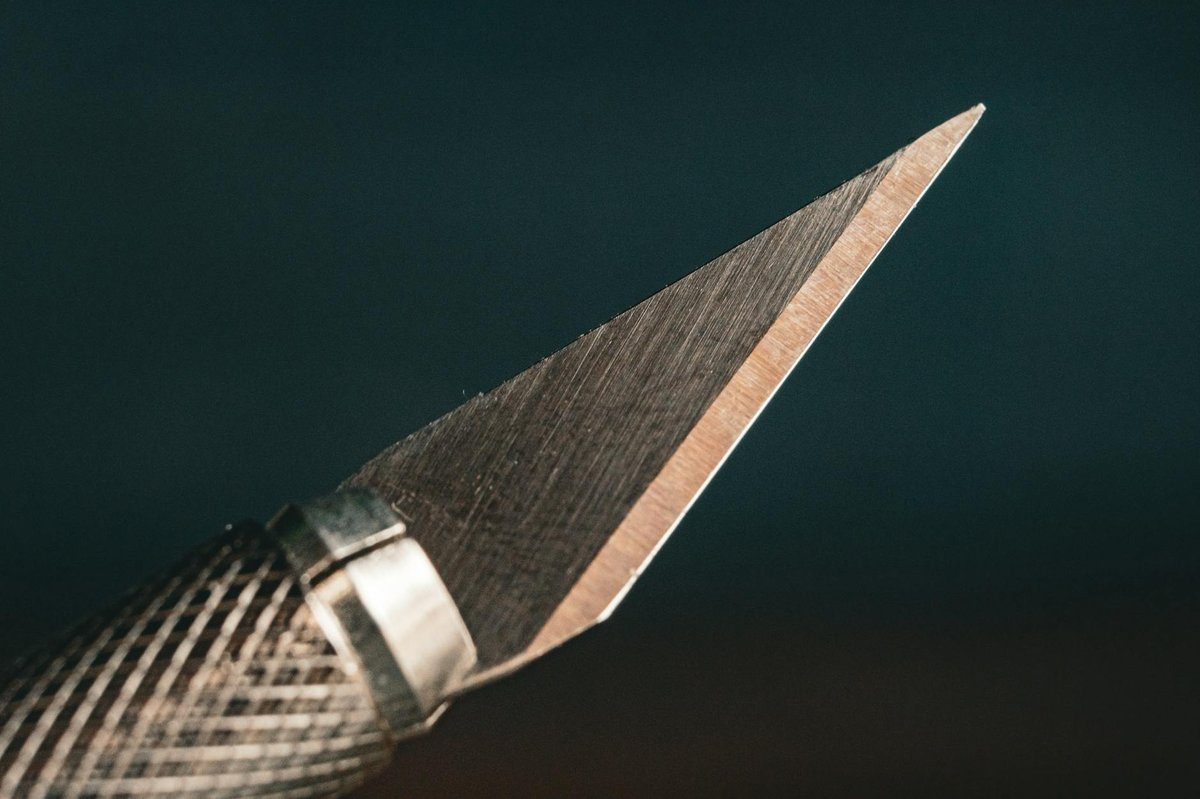
Every pair of professional scissors has an edge type, and that edge type determines more about how the scissors perform than most stylists realise. The steel gets all the attention. The handle gets all the comfort conversation. But the edge is where the cutting actually happens, and the three main edge types – convex, semi-convex, and beveled – produce fundamentally different cutting experiences.
Understanding edge types helps you choose scissors that match your technique, budget your maintenance costs accurately, and stop blaming your scissors for problems that are actually edge-type mismatches.
How a Scissor Edge Actually Cuts Hair
Before comparing edge types, it helps to understand what happens at the microscopic level when scissors cut hair.
A human hair strand is roughly 50 to 100 micrometres in diameter. When two scissor blades close on a hair, the edge does not slice through it like a knife through butter. Instead, the closing blades compress the hair between them, and the edge geometry determines whether the hair is sheared cleanly, crushed and torn, or bent before cutting.
A sharper, finer edge compresses less before cutting. This means less damage to the hair shaft, cleaner ends, and less effort required from the stylist. Edge type determines how fine that edge can be, how long it stays fine, and how it interacts with hair during different techniques.
The Three Edge Types Explained
Convex Edge
The convex edge has a smooth, continuously curved profile when viewed in cross-section. The blade tapers from spine to edge in a gentle arc, resembling a clamshell. In Japanese manufacturing, this is called the hamaguri (蛤) grind, named after the hamaguri clam whose shell it resembles.
Hikari introduced the first convex-edge hairdressing scissors in 1968, adapting sword-making techniques to create a blade profile that had never been used in hairdressing tools. This single innovation transformed the industry and established the Japanese approach to scissor manufacturing that dominates today.
How it cuts: The rounded profile creates the least resistance as hair passes along the blade. Hair slides along the curved surface rather than catching on a flat facet. This produces the smoothest, cleanest cut with minimal compression damage.
Cross-section profile:
    ╱ ╲        Gradual curve from
   ╱   ╲       spine to edge.
  ╱     ╲      No flat facets.
 ╱       ╲     Smooth, continuous arc.
╱____V____╲    Very acute edge angle.
Edge angle: Typically 30 to 40 degrees inclusive (very acute). Some high-end convex scissors achieve angles below 30 degrees.
Key characteristics:
| Property | Convex Edge |
|---|---|
| Sharpness | Highest achievable |
| Edge retention | Good to excellent (depends on steel) |
| Slide cutting | Excellent |
| Blunt cutting | Good |
| Maintenance difficulty | High (specialist required) |
| Repair cost | High |
| Price range | $200 to $2,000+ |
Semi-Convex Edge
The semi-convex edge is a hybrid that combines elements of convex and beveled geometry. It has a slightly convex profile near the edge but transitions to a flatter surface further up the blade. Think of it as a convex edge with training wheels.
How it cuts: The semi-convex profile provides smoother cutting than a beveled edge but with slightly more resistance than a full convex. Hair still moves along the blade reasonably well, making limited slide cutting possible, but with less of the buttery feel that a true convex edge provides.
Cross-section profile:
    ╱ ╲        Slight curve near
   ╱   ╲       the edge only.
  │     │      Flatter surfaces
  │     │      further from edge.
 ╱___V___╲     Moderate edge angle.
Edge angle: Typically 40 to 50 degrees inclusive (moderate).
Key characteristics:
| Property | Semi-Convex Edge |
|---|---|
| Sharpness | Good |
| Edge retention | Good (more durable than convex) |
| Slide cutting | Limited (wet hair only) |
| Blunt cutting | Very good |
| Maintenance difficulty | Moderate |
| Repair cost | Moderate |
| Price range | $150 to $800 |
Beveled Edge
The beveled edge is the traditional edge type used in Western scissor manufacturing for centuries. It has flat facets ground at a specific angle to the blade, creating a V-shaped profile. This is the same basic geometry used in kitchen knives, chisels, and most other cutting tools.
German manufacturers like Jaguar have refined the beveled edge to exceptional standards. Their konvex-schliff (convex grind) is technically a very refined beveled edge with slight convexity, demonstrating that the line between edge types can be subtle at the premium end of manufacturing.
How it cuts: The flat facets create a crisp, positive cutting action. Hair is compressed between the flat surfaces and sheared at the edge. This produces a clean, decisive cut that feels firm and controlled. The trade-off is that the flat surfaces create more friction during any sliding motion.
Cross-section profile:
    │ │         Flat, parallel
    │ │         surfaces along
    │ │         most of the blade.
   ╲   ╱       Angled facets near
    ╲ ╱        the edge only.
     V         Clear V-shape at edge.
Edge angle: Typically 45 to 60 degrees inclusive (wider).
Key characteristics:
| Property | Beveled Edge |
|---|---|
| Sharpness | Good (less acute than convex) |
| Edge retention | Very good (wider angle is more durable) |
| Slide cutting | Not recommended |
| Blunt cutting | Excellent |
| Maintenance difficulty | Low (most sharpeners can service) |
| Repair cost | Low to moderate |
| Price range | $50 to $600 |
Side-by-Side Comparison
| Factor | Convex | Semi-Convex | Beveled |
|---|---|---|---|
| Edge angle | 30-40 degrees | 40-50 degrees | 45-60 degrees |
| Initial sharpness | Highest | Good | Good |
| Edge durability | Lower (thinner edge) | Moderate | Highest (thicker edge) |
| Slide cutting | Excellent | Limited | Not suitable |
| Blunt cutting | Good | Very good | Excellent |
| Point cutting | Excellent | Good | Good |
| Scissor-over-comb | Good | Good | Excellent |
| Wet cutting | Excellent | Good | Good |
| Dry cutting | Good | Good | Very good |
| Sharpening frequency | Every 6-12 months | Every 8-14 months | Every 4-10 months* |
| Sharpening cost | $50-$85 | $35-$65 | $25-$50 |
| Sharpener access | Specialist needed | Moderate availability | Widely available |
| Drop damage risk | High (chips easily) | Moderate | Low |
*Beveled edges may need more frequent sharpening but each sharpening is faster, easier, and cheaper.
The Physics Behind the Differences
Why Convex Edges Slide Better
When hair encounters a convex blade surface during a slide cut, the rounded profile deflects the hair strand gradually. The strand bends around the curve and is cut as it reaches the edge. This gradual deflection produces minimal friction and no catching.
A beveled edge presents a flat surface that the hair presses against. Instead of being gradually deflected, the hair catches on the flat facet. Pulling the scissors through creates a grabbing sensation that can bend, stretch, or damage the hair rather than cutting it cleanly. This is why slide cutting with beveled scissors produces rough, damaged ends.
Why Beveled Edges Last Longer
A wider edge angle means more steel supporting the cutting edge. Think of it like a wedge: a thin wedge splits easily but bends under force. A thick wedge is harder to push through material but resists deformation.
A convex edge at 35 degrees has very little steel behind the cutting edge. It cuts with less force but the thin edge is more vulnerable to rolling, chipping, or micro-fracturing. A beveled edge at 55 degrees has significantly more steel behind the edge, making it tougher and more resistant to damage from hard use, drops, and aggressive technique.
Why Semi-Convex Is a Compromise
The semi-convex edge gains some of the sliding capability of a convex edge while retaining some of the durability of a beveled edge. It does neither as well as the dedicated geometry but offers a broader range of acceptable performance.
For stylists who do some slide cutting but primarily blunt cut, or who want convex-like performance without the full maintenance commitment, semi-convex is a practical middle ground.
Matching Edge Type to Technique
If You Primarily Slide Cut
You need convex. There is no practical alternative. Slide cutting is the technique most dependent on edge type, and a convex edge is the only geometry that allows hair to flow smoothly along the blade during a slide stroke. Attempting slide cutting with a beveled edge will frustrate you and damage your clients’ hair.
If You Primarily Blunt Cut
Beveled edges work excellently for blunt cutting and may actually be preferable. The firm, positive cutting action of a beveled edge produces crisp, clean lines. Many experienced blunt-cutting specialists prefer the decisive feel of a beveled edge over the softer feel of convex.
That said, convex edges also blunt cut well. The choice comes down to feel preference and maintenance willingness.
If You Do Scissor-Over-Comb
Beveled edges have a slight advantage for scissor-over-comb because the firmer cutting action gives more tactile feedback as you work along the comb. The wider edge angle is also more forgiving of the slight lateral forces that scissor-over-comb technique places on the blade.
If You Do a Mix of Everything
Semi-convex is designed for you. It handles blunt cutting well, manages basic slide cutting on wet hair, works for point cutting and texturising, and does not demand specialist sharpening. If you are a generalist stylist who does a little of everything, semi-convex gives you the broadest technique range.
Alternatively, many professionals solve this by owning two pairs: a convex-edge scissor for slide cutting and precision work, and a beveled or semi-convex scissor for everyday blunt cutting and scissor-over-comb. This is more expensive upfront but gives you the right tool for each technique.
Maintenance and Sharpening Implications
Convex Edge Maintenance
Convex edges must be sharpened on waterstones by someone who understands the hamaguri profile. The sharpener must maintain the continuous curve of the blade surface while refreshing the edge. Using a flat hone or grinding wheel on a convex blade flattens the curve and converts it into a semi-convex or beveled edge, permanently changing how the scissors cut.
Finding a qualified convex-edge sharpener can be challenging outside major cities. Ask your sharpener specifically whether they work with Japanese convex edges and what equipment they use. If they mention a flat hone or bench grinder as their primary tool, find someone else.
Semi-Convex Edge Maintenance
Semi-convex edges are more forgiving during sharpening because the profile is less extreme. A skilled sharpener who primarily works with beveled edges can usually service a semi-convex edge adequately, though a specialist will do better work.
Beveled Edge Maintenance
Beveled edges are the most straightforward to sharpen. The flat facets can be re-ground on standard equipment, and most professional sharpeners handle beveled edges routinely. This wider availability means shorter turnaround times, lower costs, and less risk of receiving your scissors back worse than you sent them.
Cost Implications
Edge type affects both purchase price and ongoing costs.
| Cost Factor | Convex | Semi-Convex | Beveled |
|---|---|---|---|
| Purchase premium | Highest | Moderate | Lowest |
| Sharpening per visit | $50-$85 | $35-$65 | $25-$50 |
| Sharpenings per year | 1-2 | 1-2 | 2-3 |
| Annual sharpening cost | $50-$170 | $35-$130 | $50-$150 |
| Drop repair cost | $40-$100 | $25-$60 | $15-$40 |
The annual sharpening costs are surprisingly similar across edge types. Convex edges cost more per visit but need less frequent service. Beveled edges cost less per visit but need more frequent service. The difference in total annual maintenance cost is usually less than $50.
The purchase price difference is where edge type really affects your budget. Convex-edge scissors command a premium because the manufacturing process is more complex and labour-intensive. The hamaguri grind requires skilled hand finishing that cannot be fully automated.
Making Your Choice
Choose Convex If:
- Slide cutting is a significant part of your work
- You have access to a specialist sharpener for Japanese convex edges
- You want the sharpest possible edge and the smoothest cutting feel
- You are disciplined about tool handling (proper storage, no dropping)
- Your budget accommodates the higher purchase price and sharpening costs
Choose Semi-Convex If:
- You use a mix of techniques and want one versatile edge type
- You want some slide cutting capability without full convex maintenance
- Specialist sharpener access is limited in your area
- You are upgrading from beveled and want to try something closer to convex
- You want a balance of performance and practicality
Choose Beveled If:
- You primarily blunt cut, point cut, and do scissor-over-comb work
- You want the lowest maintenance requirements and widest sharpener access
- Durability and toughness are priorities (high-volume cutting, barbering)
- You are a beginner building technique fundamentals
- Budget is a primary consideration
There is no wrong answer. The wrong choice is using an edge type that does not match your technique and then blaming the scissors. Match your edge to your work, maintain it properly, and any of these three geometries will serve you well.
Edges Compared


Prices are approximate guides. Visit retailer for current pricing and availability.
For more on choosing the right scissors, see our guides on steel types, scissor sizing, and handle ergonomics.