5 Inch vs 6 Inch vs 7 Inch Scissors: The Complete Size Guide by Technique
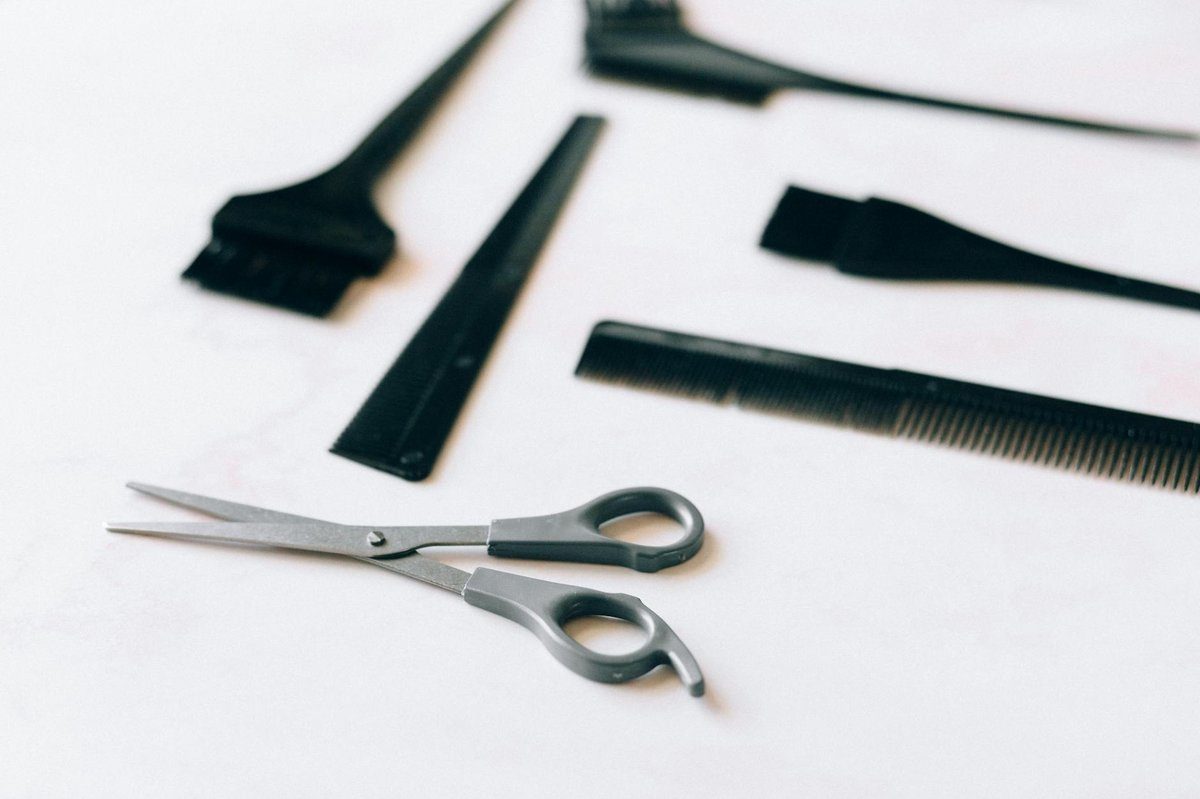
Scissor length is the first spec most stylists see and the last one they truly understand. The difference between a 5 inch and a 7 inch blade is not just two inches of steel. It changes your cutting speed, your precision, the leverage you generate, how quickly your hand fatigues, and which techniques you can perform comfortably.
Most stylists own one pair and hope it works for everything. It does not. Understanding why different lengths exist – and which techniques each length actually serves – is one of the fastest ways to improve your cutting and reduce hand strain.
How Scissor Length Is Measured
Before comparing sizes, it helps to know what the number actually represents. Scissor length is measured from the tip of the blade to the end of the longest finger ring, in a straight line. It is the total tool length, not just the blade.
This matters because two 6-inch scissors from different manufacturers may have different blade-to-handle ratios. A 6-inch scissor with a longer handle and shorter blade cuts differently from a 6-inch scissor with a longer blade and shorter handle. When possible, check the blade length separately from the overall length.
| Overall Length | Typical Blade Length | Typical Handle Length |
|---|---|---|
| 5.0 inches | 2.0-2.2 inches | 2.8-3.0 inches |
| 5.5 inches | 2.3-2.5 inches | 3.0-3.2 inches |
| 6.0 inches | 2.6-2.8 inches | 3.2-3.4 inches |
| 6.5 inches | 2.9-3.1 inches | 3.4-3.6 inches |
| 7.0 inches | 3.2-3.5 inches | 3.5-3.8 inches |
The blade-to-handle ratio affects leverage. A longer blade relative to the handle gives more cutting force per squeeze but requires more hand strength to control.
The Physics of Blade Length
Leverage and Force
A longer blade acts as a longer lever arm. This means each squeeze of your hand moves more hair through the cutting edge. For bulk removal and long blunt lines, this is an advantage: fewer strokes means faster work and more consistent lines.
For detail work, the same physics works against you. A longer lever amplifies the movement at the tip. A tiny rotation of your thumb translates into a larger sweep at the end of a 7-inch blade than at the end of a 5-inch blade. This is why precision cutting with long scissors demands exceptional hand control.
Weight and Fatigue
Longer scissors weigh more. The difference may seem small on paper – perhaps 10 to 20 grams between a 5-inch and 7-inch version of the same model – but compounded over hundreds of opening and closing motions per client, and 15 to 30 clients per day, the difference becomes significant.
The weight also shifts the balance point. Longer scissors have their centre of gravity further forward (toward the blade tip), which means your hand works harder to maintain control. Shorter scissors balance closer to the pivot, giving a lighter, more responsive feel.
Cutting Line Length
This is the simplest advantage of longer blades: they cut more hair per stroke. A single closing motion on a 7-inch scissor covers roughly 40% more hair than a 5-inch scissor. For techniques that rely on consistent, continuous lines – like blunt bobs or one-length cuts – this reduces the number of entry points and creates smoother results.
Size-to-Technique Matrix
This is the core reference. Not every technique works equally well at every length.
| Technique | 5-5.5” | 5.5-6” | 6-6.5” | 6.5-7” |
|---|---|---|---|---|
| Point cutting | Excellent | Good | Fair | Difficult |
| Slide cutting | Good | Excellent | Good | Fair |
| Blunt cutting (short hair) | Good | Excellent | Good | Fair |
| Blunt cutting (long hair) | Fair | Good | Excellent | Excellent |
| Scissor-over-comb | Poor | Fair | Good | Excellent |
| Texturising | Excellent | Good | Fair | Poor |
| Detail/fringe work | Excellent | Good | Fair | Poor |
| Bulk removal | Poor | Fair | Good | Excellent |
| Layering | Good | Excellent | Good | Fair |
5 to 5.5 Inch: The Precision Specialist
These are your detail scissors. The short blade gives maximum control for:
- Point cutting and texturising. The short blade lets you work close to the hair with precise tip control. Each snip removes a small, controlled amount. This is essential for creating texture, breaking up weight lines, and softening blunt edges.
- Fringe and face-framing. When you are cutting millimetres from someone’s eyebrow, you want the shortest blade that still functions efficiently. Short scissors reduce the risk of over-cutting because the blade tip is always close to your hand.
- Children’s cuts and movement. Smaller scissors are less intimidating and easier to control around a moving target.
Short scissors are less effective for long blunt lines because you need more entry points to complete each section, increasing the chance of visible steps in the line.
Who typically uses this size: Detail-focused stylists, those specialising in short pixie cuts and textured styles, stylists with smaller hands (under 17cm palm length), and anyone doing significant precision work.
5.5 to 6 Inch: The All-Rounder
This is the most popular size range in salon hairdressing worldwide, and for good reason. A 5.5 to 6 inch scissor is a genuine all-rounder that performs adequately (if not perfectly) across almost every technique.
- Blunt cutting on short to medium hair. Enough blade length to create clean lines without excess entry points.
- Slide cutting. The blade is long enough to glide through hair sections but short enough to control the angle precisely. Many Japanese manufacturers optimise their convex edge scissors in this size range specifically for slide cutting.
- Layering and graduation. The balance of control and coverage makes this range ideal for elevation cutting and overdirection techniques.
- Point cutting. Not as precise as a 5-inch, but capable enough for most salon point cutting applications.
Who typically uses this size: The majority of salon stylists, newly qualified hairdressers building their first kit, and any professional who needs one pair to cover multiple techniques.
6 to 6.5 Inch: The Versatile Workhorse
This range bridges the gap between salon styling and barbering. It starts to favour techniques that benefit from longer cutting lines.
- Blunt cutting on medium to long hair. The longer blade covers more hair per stroke, creating smoother one-length lines and heavy bobs. Fewer entry points means fewer potential imperfections.
- Scissor-over-comb (basic). The blade starts to extend enough past the comb to be useful for this technique, though 7-inch is still preferred for heavy scissor-over-comb work.
- Slide cutting on thicker hair. More blade surface in contact with the hair section means more efficient removal during slide techniques.
Who typically uses this size: Stylists who do significant blunt cutting, those working with medium to long hair regularly, professionals with larger hands (over 19cm palm length), and barber-stylists who do both precision and bulk work.
6.5 to 7 Inch: The Barber’s Choice
Long scissors are purpose-built tools for specific techniques. They are not oversized all-rounders.
- Scissor-over-comb. This is the primary reason 7-inch scissors exist in professional hairdressing. The long blade extends well past the comb, allowing smooth, continuous cuts that follow the head shape. Barbering programmes specifically train students on 7-inch scissors for this technique.
- Long blunt lines. One-length cuts on long hair are faster and smoother with a long blade. A single closing motion covers a larger section.
- Bulk removal. When you need to take significant length off quickly, a longer blade moves more hair per stroke.
Long scissors are poor choices for precision detail work, texturising, and fringe cutting. The amplified tip movement makes fine control difficult, and the additional weight accelerates hand fatigue during delicate work.
Who typically uses this size: Barbers, stylists specialising in men’s cuts and scissor-over-comb work, professionals doing primarily long-hair blunt cutting, and those with large hands who find shorter scissors cramped.
The Hand Measurement Method
Your hand size sets a baseline, but it is a starting point, not a rule.
How to Measure
- Place your dominant hand flat on a surface with fingers together.
- Measure from the tip of your middle finger to the base of your palm (where your wrist crease begins).
- Use this measurement as a starting reference:
| Palm Length | Suggested Starting Size | Notes |
|---|---|---|
| Under 16cm | 4.5-5.0 inches | Rare in professional ranges |
| 16-17cm | 5.0-5.5 inches | Common for female stylists |
| 17-18cm | 5.5-6.0 inches | The most common range |
| 18-19cm | 6.0-6.5 inches | Common for male stylists |
| Over 19cm | 6.5-7.0 inches | Large hands, barbering |
Why Technique Overrides Hand Size
A barber with 16cm hands who does scissor-over-comb all day will still benefit from 6.5 to 7 inch scissors despite having small hands. They will grip the tool differently and develop the forearm strength to control it. Conversely, a precision stylist with 20cm hands may prefer a 5.5-inch scissor for detail work, accepting that it looks small in their hand.
Hand measurement tells you what will feel comfortable initially. Your technique tells you what will perform best long-term. Experienced professionals often own multiple sizes and switch based on the service.
Common Sizing Mistakes
Mistake 1: Buying One Size for Everything
This is the most common error. A 6-inch scissor is a reasonable all-rounder, but it compromises on both precision and reach. Professionals who are serious about their craft typically own at least two sizes: a shorter pair for detail work and a longer pair for bulk cutting and blunt lines.
Mistake 2: Matching Someone Else’s Size
Your instructor’s preferred size, your mentor’s size, or the size recommended in a YouTube video is based on their hands and their technique. Copy their technique, not their measurements.
Mistake 3: Choosing Longer for Speed
Longer scissors are faster for specific techniques, but they are slower for others. If your primary work is precision cutting and you switch to 7-inch scissors hoping to cut faster, you will likely cut less accurately and spend more time correcting mistakes.
Mistake 4: Ignoring Blade-to-Handle Ratio
Two scissors with the same overall length can have very different blade lengths. A 6-inch scissor with a 3-inch blade cuts differently from a 6-inch scissor with a 2.5-inch blade. Check the blade length, not just the total length, when comparing options.
Building Your Size Kit
Minimum Professional Kit: Two Sizes
- 5.5-inch for detail work, point cutting, texturising, and fringe cutting
- 6.5-inch for blunt cutting, layering on longer hair, and scissor-over-comb
Comprehensive Kit: Three Sizes
- 5-inch for precision detail and texturising
- 6-inch for everyday cutting, slide cutting, and layering
- 7-inch for scissor-over-comb and long blunt lines
You do not need to buy all three at once. Start with the all-rounder (5.5 or 6 inch), identify which techniques feel limited by that size, and add the specialist size that addresses the limitation.
The Bottom Line
Scissor length is not a prestige metric. Longer is not better. Shorter is not more precise by default. Each size serves specific techniques, and the right size is the one that matches how you actually cut hair.
Measure your hand for a starting point, consider your primary techniques, and invest in at least two sizes once your budget allows. Your cutting will improve, your hands will thank you, and you will stop fighting your tools every time you switch techniques.
Available in Multiple Sizes


Prices are approximate guides. Visit retailer for current pricing and availability.
For guidance on other factors that affect your choice, see our comparisons on steel types, edge geometry, and handle ergonomics.