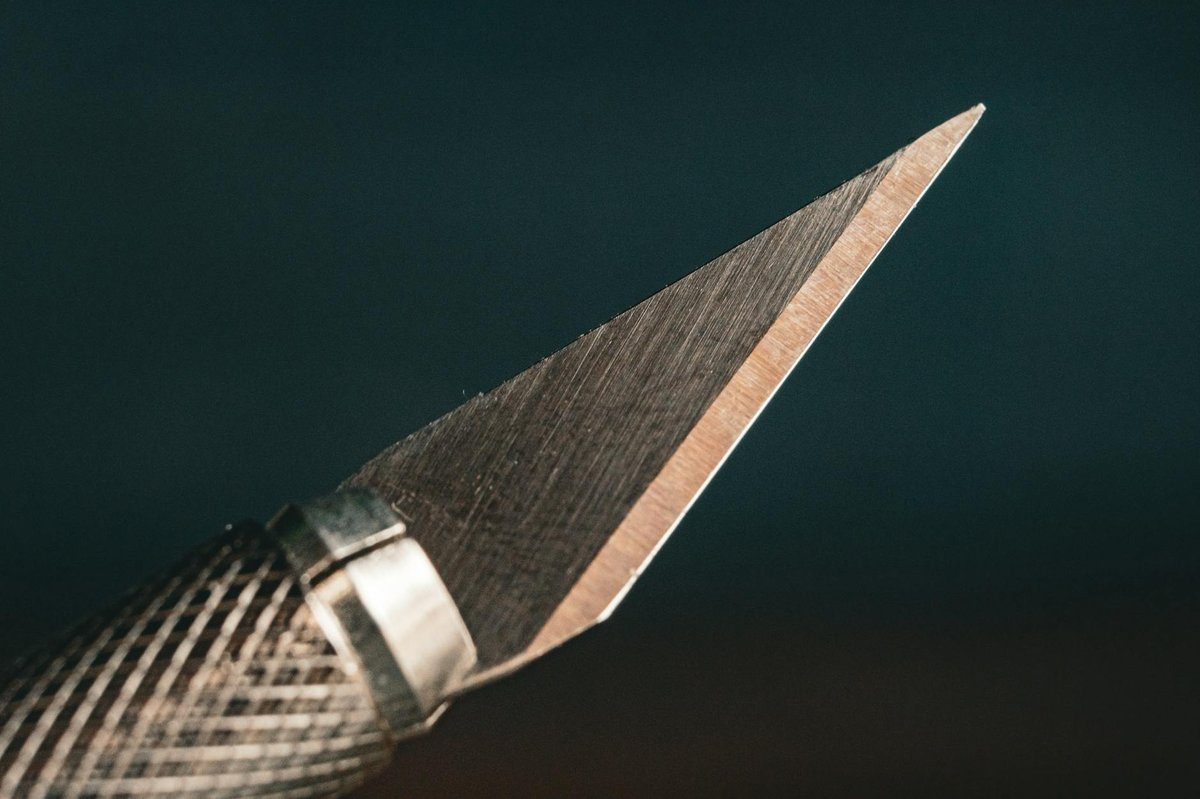
Convex vs Beveled Edge: The 1968 Invention That Changed Everything

For most of human history, scissors had one type of edge. A flat bevel ground into the blade at a fixed angle. It worked. You opened the blades, put hair between them, closed the blades, and the hair was cut. Simple.
Then in 1968, a Japanese manufacturer in Seki City looked at a samurai sword and asked a question that nobody had apparently thought to ask before: what if we ground a scissor blade the same way?
The answer changed everything about what hairdressers could do with a pair of scissors. And it created a divide in the industry that persists to this day.
Before 1968: The Beveled Edge Era
Every scissor made before 1968 used some variation of a beveled or knife edge. The blade is ground at a single angle, typically between 35 and 45 degrees, creating a V-shaped cross section. This is the same basic geometry used in kitchen knives, garden shears, and craft scissors.
Beveled edges are simple to manufacture. You take a flat piece of steel and grind one surface at an angle until you create a cutting edge. Any competent metalworker can do it. Any competent sharpener can restore it. The tools and techniques have been understood for centuries.
The limitation is what a beveled edge can do. When two beveled blades close on hair, they press the hair together and shear it. This works perfectly well for blunt cuts and basic layering. What it does not do well is slice. A beveled edge grabs the hair rather than gliding through it. Try to slide cut with beveled scissors and the hair catches, tugs, and folds rather than separating cleanly.
For most of the history of hairdressing, this was not a problem because the techniques that require a slicing action had not been developed yet. The tool defined the technique. Then the tool changed.
The Convex Edge: Hamaguri-ba
In 1968, the precision convex edge blade was developed in Japan. The Japanese name tells you exactly what it looks like in cross section: hamaguri-ba (ハマグリ刃), literally “clam shell blade.” Look at the profile of a clam shell. It curves outward from both sides, meeting at a thin edge. That is a convex blade.
The geometry was not invented from scratch. It was adapted directly from Japanese sword blade construction. Katana blades use a convex grind, called niku (肉, literally “flesh” or “meat”), to create a blade that is strong at its spine but tapers to an extremely keen edge through a smooth curve. Swordsmiths had been perfecting this geometry for 700 years before someone applied it to scissors.
How Convex Geometry Works
A beveled edge has one angle. A convex edge has a continuously changing angle, created by multiple ground planes that blend into a smooth curve.
The specifics vary by manufacturer, but a typical convex scissor blade works something like this:
| Zone | Approximate Angle | Function |
|---|---|---|
| Cutting edge (刃先) | ~10 degrees | Maximum sharpness for clean cutting |
| Mid-blade | ~20-30 degrees | Transitions from edge to body |
| Blade shoulder | ~42 degrees | Structural strength and stability |
The overall profile has a designed radius, typically around 800mm, though this varies by manufacturer and intended use. Some manufacturers design tighter radii for more aggressive cutting; others use wider radii for smoother, more forgiving performance.
The result is a blade that slices rather than shears. When a convex blade contacts hair, it glides through with minimal resistance. The hair does not catch or fold. It separates cleanly. This is the fundamental mechanical difference that enables modern cutting techniques.
What Convex Edges Made Possible
The invention of the convex edge did not just improve existing cuts. It created entirely new categories of technique:
Slide cutting (スライドカット). Moving the partially open scissors along the hair shaft, removing length and creating texture simultaneously. Impossible with beveled edges because the hair catches on the flat bevel surface.
Point cutting (ポイントカット). Using the tips of the blades to cut into the ends of the hair, creating texture and removing weight. Convex tips are sharp enough to cut cleanly at the very point. Beveled tips tend to push the hair aside.
Feathering and texturizing. Various techniques that require the blade to contact the hair at oblique angles. The smooth convex surface allows the hair to slide along the blade rather than catching.
If you are a stylist trained in the last 40 years, the majority of the techniques in your repertoire probably rely on convex blade geometry. They simply do not work with beveled edges.
Beveled Edges: Not Dead, Not Pointless
It would be easy to read the above and conclude that beveled edges are obsolete. They are not.
Beveled scissors have genuine advantages:
Simpler to manufacture. Lower production costs mean beveled scissors can be offered at lower price points without cutting corners on steel quality or heat treatment.
Easier to sharpen. Almost any sharpener can competently restore a beveled edge. The geometry is forgiving. This means lower maintenance costs and less risk of damage during sharpening.
More powerful for blunt cutting. The aggressive bite of a beveled edge can actually be preferable for certain techniques. German-style scissors from Solingen traditionally use beveled edges, and many stylists trained in European techniques prefer the feel.
More durable. The thicker geometry behind the edge makes beveled blades more resistant to damage from drops or accidental contact with hard surfaces.
The German city of Solingen, Seki’s counterpart in “East Seki, West Solingen” (東の関、西のゾーリンゲン), continues to produce excellent beveled-edge scissors. Brands like Jaguar maintain that beveled edges are the right tool for certain cutting styles. They are not wrong. The choice between convex and beveled is a technique question, not a quality question.
The Hikari Connection
Hikari, a manufacturer based in Seki City, holds patents on hamaguri-ba technology as applied to scissors. They were instrumental in developing and refining the convex edge for professional hairdressing use.
This is worth knowing because it means the technology has a traceable lineage. It was not a vague “Japanese innovation.” It was a specific engineering achievement by identifiable people at identifiable companies, building on centuries of sword-making knowledge.
The Sharpening Problem
Here is where the convex edge story gets complicated and expensive.
A beveled edge is defined by a single angle. Restoring it means grinding that angle back to sharpness. Straightforward.
A convex edge is defined by a designed radius, a precise curve established during manufacturing using specialized equipment and considerable skill. That radius is not arbitrary. It is engineered for specific cutting characteristics.
When a non-manufacturer sharpener takes a flat hone to a convex blade, they remove the designed radius. They flatten the curve. The scissors may feel sharp afterward, but they have lost the geometry that makes them convex. The slide-cutting ability degrades. The cutting feel changes. And here is the critical part: once the designed radius is removed by flat honing, it cannot be fully restored. The steel that formed that curve is gone.
A well-made convex scissor is designed for 20 or more resharpening cycles when maintained by the factory or an authorized sharpener who understands convex geometry. Each cycle removes a tiny amount of material while preserving the designed radius. After 20+ cycles, the blade has narrowed enough that the geometry can no longer be maintained, and the scissors reach the end of their service life.
A single bad sharpening can reduce that lifespan dramatically. This is why many Japanese manufacturers insist on factory sharpening or maintain networks of authorized sharpeners trained on their specific geometry.
The Cost of Bad Sharpening
| Sharpening Method | Designed Radius | Resharpening Cycles Remaining | Cutting Performance |
|---|---|---|---|
| Factory / authorized (convex-aware) | Preserved | 20+ per lifetime | Full capability maintained |
| Skilled independent (convex-trained) | Mostly preserved | 15-20 per lifetime | Slight degradation over time |
| Flat hone sharpener | Partially destroyed | Reduced significantly | Slide cutting compromised |
| Aggressive flat hone | Destroyed | Minimal | Reduced to beveled performance |
This is not snobbery. It is geometry. A convex edge is a precision-engineered surface. Treating it like a beveled edge during sharpening is like taking a sports car to a mechanic who only works on trucks. The tools look similar, but the tolerances are completely different.
Making the Choice
If you primarily do blunt cuts, bobs, and precision geometric work, a beveled-edge scissor from a good German or Japanese manufacturer will serve you well and be cheaper to maintain.
If your technique relies on slide cutting, point cutting, texturizing, or any method that requires the blade to move along the hair shaft, convex is not optional. It is the enabling technology.
If you buy convex, budget for proper sharpening. Factor it into the total cost of ownership from day one. The scissors are an investment; the sharpening is the insurance policy that protects it.
And if someone tells you they can sharpen your Japanese convex scissors for $25 with a quick turnaround, ask them how they maintain the designed radius. If they do not understand the question, find someone who does.
Related reading: Understand the steel types that make convex edges possible, or learn what makes Japanese scissors different in our introductory guide.