Australian buying guide
Best Professional Hair Scissors in Australia: Buying Guide
Compare Yasaka Offset for one everyday cutter, Kasho Blue Offset for compact lengths, or Ichiro Taiyo when both a cutter and texturizer are needed. Settle the shortlist with an AUD quote, usable return terms and a clear service route.
See the model examplesAt a glance
- Use the model examples as a shortlist, not a ranking of Australian stock.
- Ask for the chosen size and configuration in AUD, including delivery and any separately charged costs.
- Check the trial, return destination and service contact before ordering.
https://www.scissorpedia.com/best-professional-hair-scissors-australia/
Three model examples for an Australian shortlist
For one everyday pair, compare Yasaka Offset. For a compact cutter, look at Kasho Blue Offset. For a cutter-and-texturizer purchase, compare Ichiro Premium Taiyo. These are different buying jobs, not first, second and third place.
Here, “in Australia” describes the buyer’s market and ownership needs—not Australian manufacture or confirmed local stock. The selected sources were reviewed on 9 September 2026; there was no hands-on test or market-wide price survey.
Scroll to explore all 3 examples
-
Yasaka

Yasaka Offset
Request a current local quote.
Everyday cutter
Start here if you need one cutting scissor rather than a set. Compare the size and offset handle with your present pair.
Photo: YOI Scissors UK
View sizes & specifications -
Kasho

Kasho Blue Offset
Request a current local quote.
Compact cutter
Kasho lists Blue offset models in 4.5, 5 and 5.5 inches, with VG-10W convex blades and a flat-head screw. A useful compact-length comparison.
Photo: Scissor Hub Australia
View sizes & specifications -
Ichiro

Ichiro Premium Series Taiyo VG10 Cutting and Texturizing Scissor Set
Request a current local quote.

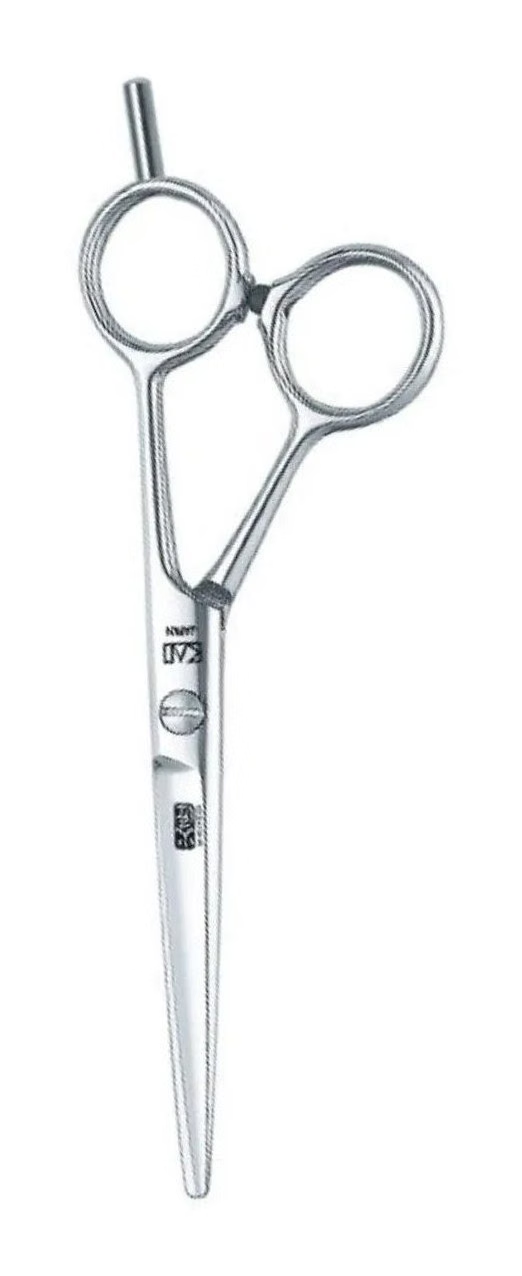

Any displayed price is a dated guide in the labeled currency and market, not a live quote. Where that context is incomplete, we omit the amount. Compare the same size and included pieces, with local tax, delivery and service costs.
Start with the tool, then the brand
The examples represent Yasaka, Kasho and Ichiro. If none addresses your requirement, widen the search to Joewell, Mina, Juntetsu or Jaguar. A national or steel label does not choose the right pair for your hand.
One cutter or a two-piece set?
If your current cutter is the problem, replace that tool first. The Taiyo listing gives a choice of cutter lengths but keeps the 6-inch, 15-tooth texturizer as the companion. That is useful when both pieces fill a gap; it is not a saving if the second tool remains in the case. Retailer-listed configuration.
When compact length is the priority
Kasho lists Blue offset models at 4.5, 5 and 5.5 inches. Compare those lengths when a smaller overall tool is your requirement. Its documented pivot is a flat-head screw. Kasho Blue specifications.
When your work needs a different reach
A shorter pair is not automatically a detail specialist, and a longer pair is not automatically better for barbering. Begin with the reach and tip visibility you need over your comb or section. Compare that requirement with the maker’s size convention and the pair you already control well.
Put two quotes into the same Australian comparison
Ask both sellers to price the same configuration. Do not compare a single cutter with a two-piece set, a used pair with a new one, or a USD guide with an AUD checkout total.
| Field | What to ask for |
|---|---|
| Exact pair | Model code, handedness, size, condition and included pieces |
| AUD total | Item price, delivery and any separately charged tax, import or payment costs |
| Dispatch | Actual fulfillment location and availability of your selected option |
| Trial and return | What use is permitted, deadline, condition requirements and return destination |
| Warranty | Who receives a claim and whether the chosen buying route is covered |
| Service | Who accepts the model, likely shipping and downtime, and access to parts |
Leave an unanswered field visible. A lower quote is not directly comparable until you know which costs or responsibilities it leaves out.
Compare local and overseas purchase routes
Maker or maker-linked contact: use the manufacturer’s own site to ask who supplies your model to Australia and which warranty and service arrangements apply. A directory entry alone does not establish authorization.
Australian specialist storefront: Japan Scissors Australia provides a regional catalog and links to shipping, returns and warranty information. It is one route to investigate, not evidence that every displayed configuration is ready to dispatch from Australia. Ask the seller to confirm the exact option and fulfillment location. Storefront scope.
Overseas seller: compare the charging currency, delivery, return destination and service shipping with the Australian offer. Ask for additional costs in writing; this guide does not calculate import charges or describe your legal rights.
For marketplace, school or event offers, identify the seller and the party responsible for support before paying. A demonstration or familiar-looking packaging does not answer those questions.

Use a permitted trial to settle fit
Check handed construction, ring contact, thumb movement, balance and visibility at the tip. Stay inside the seller’s written trial terms and use the same permitted task when comparing two pairs. Students should involve their educator.
The size reference and edge comparison help you ask consistent questions. A handle label does not promise comfort; stop if you lose control or develop discomfort.
Know where the pair goes for service
Ask the service provider about the exact model before buying. Inspection, adjustment, sharpening and repair are different jobs; establish which are offered and whether the provider can maintain the model’s intended geometry.
Maker arrangements differ. Kikui describes a sales-partner and Japan-factory route, while Naruto publishes factory maintenance and contact guidance. These examples show why a generic promise of “local sharpening” is not enough; they are not service promises for the three pairs above.
Include shipping, expected time away and a usable backup in your decision. Do not assume a particular steel fixes the service interval.
Make the final shortlist a complete purchase
Before ordering, you should be able to finish this sentence: “This exact pair suits this job, costs this much delivered in AUD, can be tried under these conditions, and will be serviced here.”
Save the dated quote, listing, invoice and written answers. If one of those four parts is still missing, resolve it before choosing between the offers.
A few final questions
Frequently asked questions
What are the best professional scissors in Australia?
Start with the tool your work needs. Yasaka Offset is an everyday cutter to compare, Kasho Blue offers compact offset lengths, and Ichiro Taiyo pairs a size-selectable cutter with a texturizer. None is a universal winner: fit, the current AUD total and support in your location decide the purchase.
Where can I buy professional scissors in Australia?
Start with the maker’s current contact or distributor route, then compare the exact listing with an Australian specialist retailer. Japan Scissors Australia is one storefront example here, not an exhaustive dealer list or an endorsement of every listing. Confirm who fulfills the order and handles returns and service.
Are the prices in the product cards Australian dollars?
Read the currency, market and date beside any displayed amount; a historical guide is not an AUD checkout quote. When a card asks for a quote, no adequately scoped amount is published. Request the selected size and set contents in AUD, including delivery and separately charged costs.
Should I buy a set for my first professional kit?
Only if you need both tools. Check your educator’s or salon’s requirements first; a suitable cutter and a service budget may be a better starting purchase than a set containing a texturizer you will not use yet.
Read the original information
Sources and further checks
Evidence status: Selected model and retailer pages reviewed on 9 September 2026. This is not a local stock survey, price ranking, cutting test or comprehensive product fact-check.
Maker specifications and a regional retailer listing support the examples. They do not establish today's Australian stock, delivered price or seller authorization.
- Yasaka Seiki — Product catalogSize-led catalog, basic and offset models, dry-cut and left-handed ranges, and maker-stated thinning cut-rate bands.Checked 9 Sep 2026
- Kasho — Blue Series specificationsBlue offset sizes and KCB model codes, VG-10W convex blades, and flat-head screw. No price or comparative performance verification.Checked 9 Sep 2026
- Japan Scissors Australia — Ichiro Premium Taiyo setRetailer-listed set configuration, cutter lengths, 6-inch 15-tooth companion, offset handles and VG-10 specification. Not independent testing, manufacture verification, or confirmation of stock for a selected variant. No current price is adopted.Checked 9 Sep 2026
- Japan Scissors AustraliaAustralian storefront and its shipping, return and warranty navigation inspected 9 September 2026. Used as a purchase-route example, not proof of authorization or selected-variant stock.
- Kikui — Manufacturer repairsMaker's published sales-partner and Japan-factory repair arrangement. Buyers must confirm current costs and turnaround for their country.Checked 9 Sep 2026
- Naruto — Maintenance and adjustmentFactory sharpening and adjustment through a distributor or direct contact, with model-dependent maintenance-ticket information. No quoted service price or turnaround is adopted here.Checked 9 Sep 2026
Discussion