Hollow Grind (Urasuki)
Scissor anatomyTurn a symptom or feature into a precise service brief
Locate the broad part family, use maker wording, record the observation, and ask a scoped service question. Apply to Hollow Grind (Urasuki)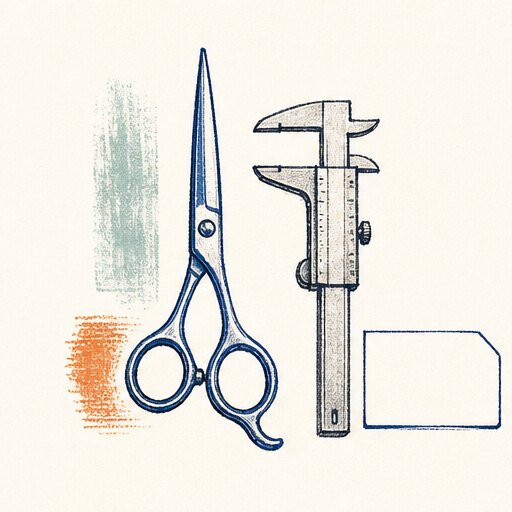
- 01 Locate Start with tip, blade, pivot, shank, rings, rest, or contact area.
- 02 Name Match the exact model's diagram and terminology.
- 03 Describe Record visible condition, sound, resistance, incident, and baseline change.
- 04 Brief Ask what is in scope, what work is proposed, and how return is verified.
Do not inferOne photograph, sound, feel, pull, fold, or visible mark cannot identify a cause or authorise adjustment or repair.
Description
The hollow grind (urasuki) is a concave channel on the inner blade face that reduces friction and improves cutting action. A hallmark of quality Japanese scissors.
Hollow Grind (裏スキ, Urasuki)
Quick look
- What it is: A concave surface machined into the inner face of each blade
- Purpose: Reduces blade-to-blade contact area, lowering friction
- Lifespan: Gets shallower with each sharpening; eventually needs re-machining
- Quality marker: Deeper, more precise hollows indicate higher manufacturing quality
Why it matters
Run your finger along the inside of a professional scissor blade and you’ll feel a subtle scoop. That’s the urasuki (裏スキ), the hollow grind. It’s there for a practical reason: by reducing the surface area where the two blades touch, it dramatically cuts down on friction. This is a big part of why professional scissors feel so much smoother than the household kind.
The hollow also creates a tiny gap between the blades that allows hair to sit properly before being cut. Without it, hair tends to get pushed or pinched between flat surfaces.
The sharpening problem
Here’s the thing most people don’t realize: every time your scissors get sharpened, a thin layer of metal is removed from the inner face. This means the hollow gets shallower over time. After 20 to 30 sharpenings (depending on the original depth), the hollow can become too shallow to function properly. At that point, the blades need re-hollowing, which is a specialist job that not every sharpener can do.
This is one reason why cheaper scissors with shallow factory hollows don’t last as long. The hollow runs out faster — typically reaching the re-hollowing threshold in 5 to 10 sharpenings rather than the 20 to 30 of premium blades. Re-hollowing itself requires either a CNC grinding fixture or an experienced hand-grinder, and not every sharpening service offers it.
Related guide: Maintenance: Sharpening Blueprint
Sources
- ScissorPedia — Urasuki reference (in-depth treatment of the Japanese term)
- Maintenance practice from manufacturer documentation; specific re-hollowing intervals vary by sharpener and original hollow depth.
Context and comparison
The hollow grind separates a professionally-made convex scissor from a machine-ground entry product: the concave back face reduces the metal cross-section behind the cutting edge, allowing the convex face to generate a true hamaguri-ba profile rather than a simple bevel. When the hollow is re-ground by a wheel sharpener rather than hand-finished, the geometry is altered permanently — the blade still cuts, but the glide that the hollow enabled is gone. This is why professional scissor sharpeners trained on Japanese instruments use wet-stone hand finishing rather than belt or wheel equipment on hollow-ground blades; and why the urasuki reference distinguishes the Japanese hollow-grind philosophy from the simpler back-flat beveled approach.
See Also
Frequently Asked Questions
3 answers you can open one at a timeHow many sharpenings does a hollow grind survive before re-hollowing is needed?
Premium blades with a deep factory hollow typically last 20 to 30 sharpening cycles before the urasuki becomes too shallow to function. Cheaper scissors with shallow factory hollows reach the threshold in 5 to 10 cycles — one of the main reasons they do not last as long even with identical use. Each sharpening removes a thin layer of metal from the inner face, and the hollow depth decreases with every pass.
Does the hollow grind actually improve how the scissor cuts hair?
Yes — it is a functional feature, not a decorative one. By reducing the surface area where the two blades touch, the urasuki cuts friction dramatically, which is a major part of why professional scissors feel so much smoother than household scissors. The hollow also creates a tiny gap between the blades that gives hair room to sit properly before being cut, instead of being pushed or pinched between two flat surfaces.
Can any sharpener re-hollow a worn blade?
No — re-hollowing is a specialist job that not every sharpening service offers. It requires either a CNC grinding fixture or an experienced hand-grinder trained specifically on the technique. When your scissors reach the point where the hollow is gone, ask directly whether your sharpener does urasuki restoration. If they say they don’t, the scissor needs to go to a service that does, or to the manufacturer’s authorised technician — improvising with a regular sharpener will permanently destroy the blade geometry.
Comments & questions
Questions or feedback on this topic? Add a comment below.