Nina Shears: A Look at This Chinese OEM Scissors Factory
Most stylists never think about where their shears actually come from. You buy a pair with a brand name on them, you use them, you get them sharpened. The factory behind them stays invisible. But for distributors and brand owners who source scissors at scale, the factory relationship is everything. And when quality control breaks down at the factory level, the consequences land on whoever’s name is on the box.
This article profiles Nina Shears, a Chinese OEM scissors factory based in Zhejiang Province. All company information comes from publicly available sources including their own website and B2B listings. A buyer who wishes to remain anonymous also shared documented quality control issues from a 2025 production run, including photos and a written quality summary issued by the factory.
Who Is Nina Shears?
Nina Shears operates as a hair scissors OEM (Original Equipment Manufacturer) out of Ruian, Zhejiang Province, China. Their stated address is No. 68 Nanshi Street, Feiyun Town, Ruian. The city sits within the broader Wenzhou manufacturing cluster, one of China’s most active light manufacturing zones.
According to their GoldSupplier.com B2B profile, the factory employs between 101 and 200 people. Their website states that the company was “founded to mainly provide hair styling scissors and razor to many famous hair shears brand company around the world for many years.” This positions them as a B2B supplier, not a consumer brand. Their primary business is manufacturing scissors to other companies’ specifications, which those companies then sell under their own names.
The factory lists Japanese HITACHI steel (440C grade) as their standard material, with a stated hardness range of 59 to 61 HRC and an “advanced sub-zero quench process” for heat treatment. Their minimum order quantity is 100 sets, and they state they accept orders based on customer samples with custom specifications for pattern, finish, and packaging.
On paper, these specs place Nina Shears at a mid-range tier within the Chinese OEM scissors market. The HITACHI 440C designation and sub-zero quench are legitimate quality markers when properly executed. They position the factory above entry-level stamped steel production but below hand-forged Japanese domestic manufacturing.
Online Presence
At the time of writing, Nina Shears has a limited online footprint compared to competitors of similar stated size.
Their website (ninashears.com) runs on an older PHP content management system. When ScissorPedia accessed the site, browser security warnings appeared due to an SSL certificate mismatch. This is a technical issue that can happen to any website, but it does affect first impressions for potential buyers evaluating the company.
The factory’s only B2B marketplace listing that ScissorPedia could locate is on GoldSupplier.com. ScissorPedia was unable to find Nina Shears on Alibaba.com, Made-in-China.com, or 1688.com (China’s domestic B2B platform), which are the platforms where most Chinese scissors manufacturers maintain profiles. The company was also not found on Amazon, eBay, or any consumer retail platform.
Their Instagram account (@ninashears) shows modest engagement with approximately 378 followers at the time of research. ScissorPedia found no presence on Facebook, YouTube, TikTok, or LinkedIn. No third-party reviews were found on Trustpilot, Google Reviews, or professional forums.
None of this means the factory doesn’t produce functional scissors. Plenty of legitimate manufacturers have weak online presences. But for buyers doing due diligence before committing to a production run, the lack of independent third-party validation anywhere online is worth noting.
A Buyer’s Quality Control Experience
A buyer who asked to remain anonymous contacted ScissorPedia with documentation from a 2025 production run with Nina Shears. The documentation includes photographs taken by the buyer and, importantly, a written “Summary of Problems” document issued by the Nina Shears factory itself in response to the buyer’s complaints.
The buyer reported placing a substantial order that, upon arrival, contained multiple categories of defects across the run. According to the buyer, the number of affected units with cosmetic damage, scratches, and other defects made a significant portion of the shipment unsellable.
What follows is a summary of the documented issues, paired with the factory’s own written responses.
Handle defects
The buyer photographed scissors with visible holes and surface imperfections in the handle bodies.
Photo submitted by buyer showing handle surface defects
The factory’s written response to this issue stated: “There should be no holes on the handle. Remade.” The factory acknowledged the defect and indicated the affected units would be remade.
Wrong finger rest specification
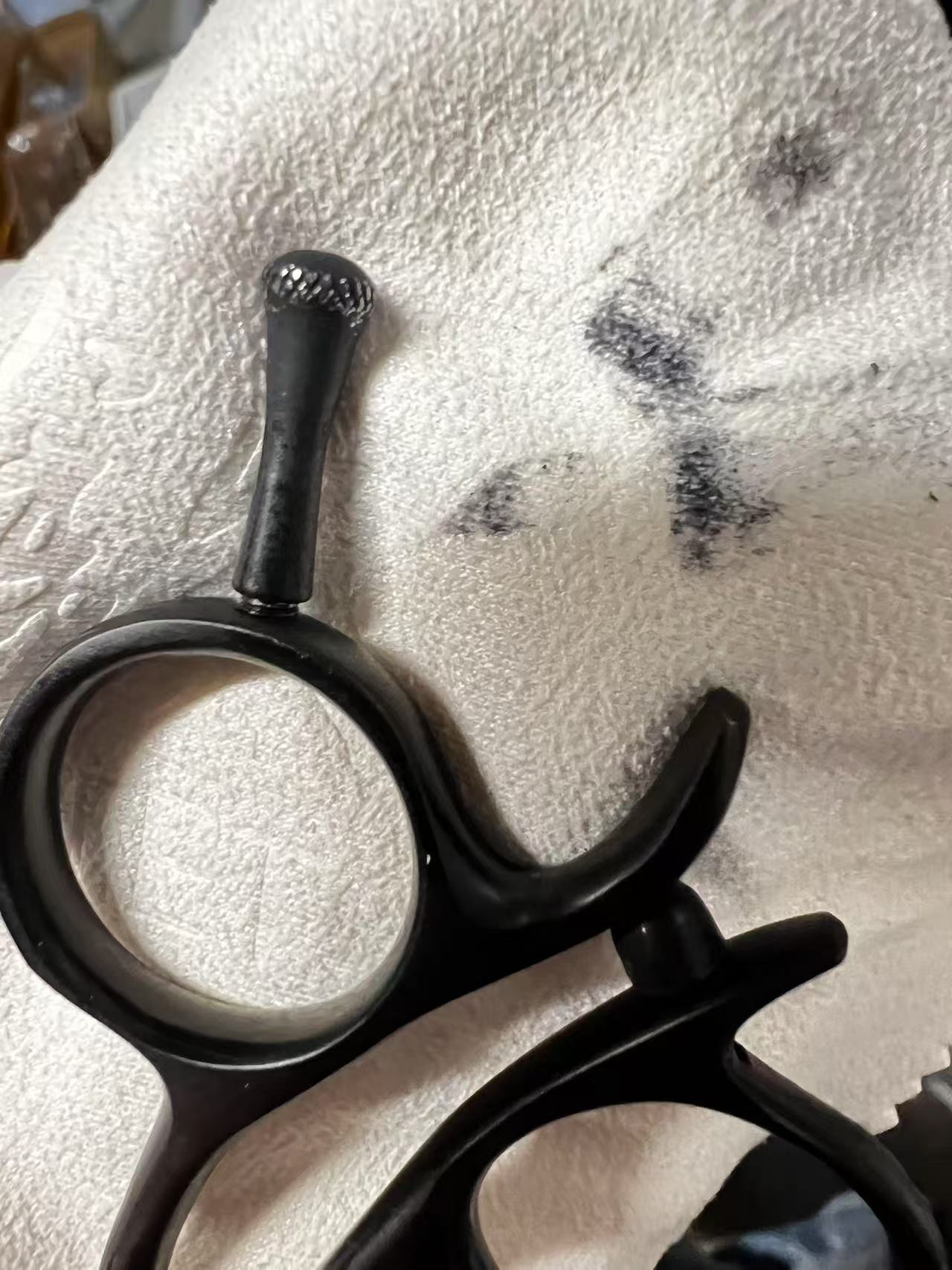
The buyer ordered scissors with removable finger rests. The units arrived with fixed (non-removable) finger rests, and the screws were not fully tightened. The factory’s written summary acknowledged the discrepancy and noted that “most of the German and Japanese customers have basically suggested that we do so,” referring to their standard practice of fixing finger rests permanently. The factory appears to have defaulted to this standard without confirming the buyer’s specification.
This represents two separate issues in one: the wrong specification was applied, and the assembly itself was incomplete.
Missing components
The factory’s own summary document instructed quality control to “Add double black gasket,” confirming that scissors were shipped without a specified gasket component. Whether this was a miscommunication in the order specification or an oversight in assembly is unclear from the documentation.
Cosmetic finishing defects
The buyer documented visible marks in two areas: plating fixture marks on the ring area, and sharpening or grinding marks on the blades.
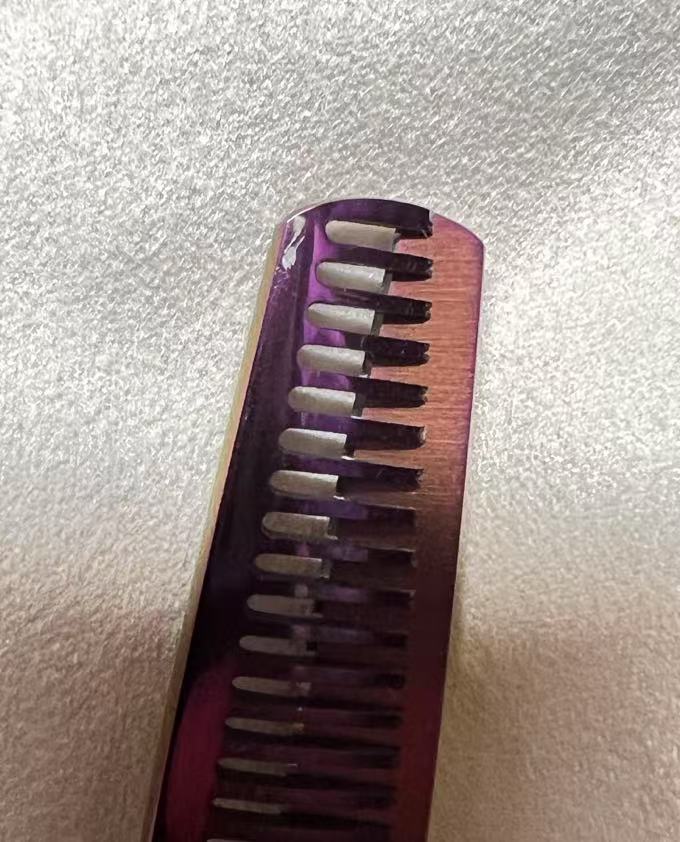 Photo submitted by buyer showing marks on thinning blade surface
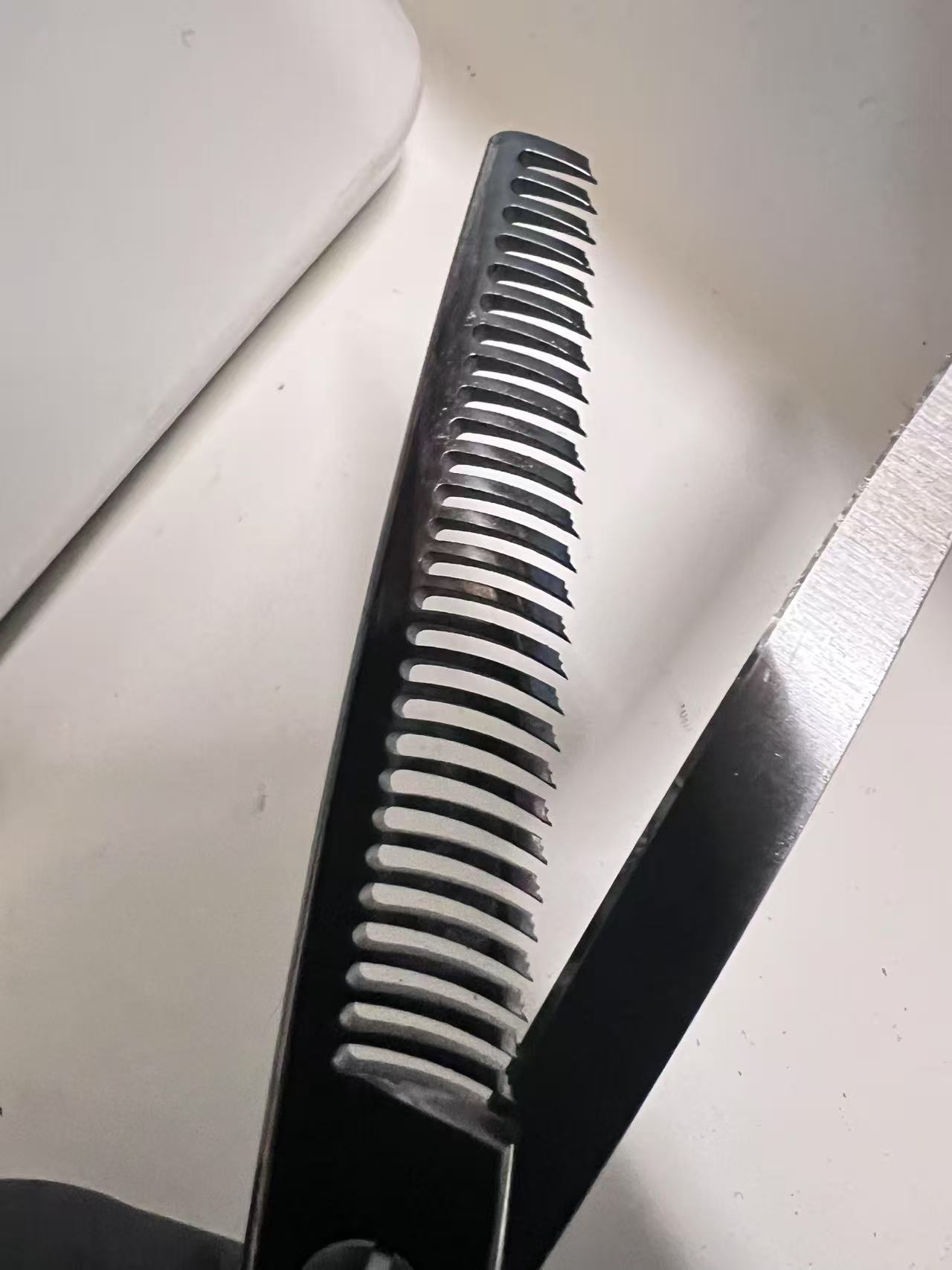 Additional angle showing surface marks across the blade
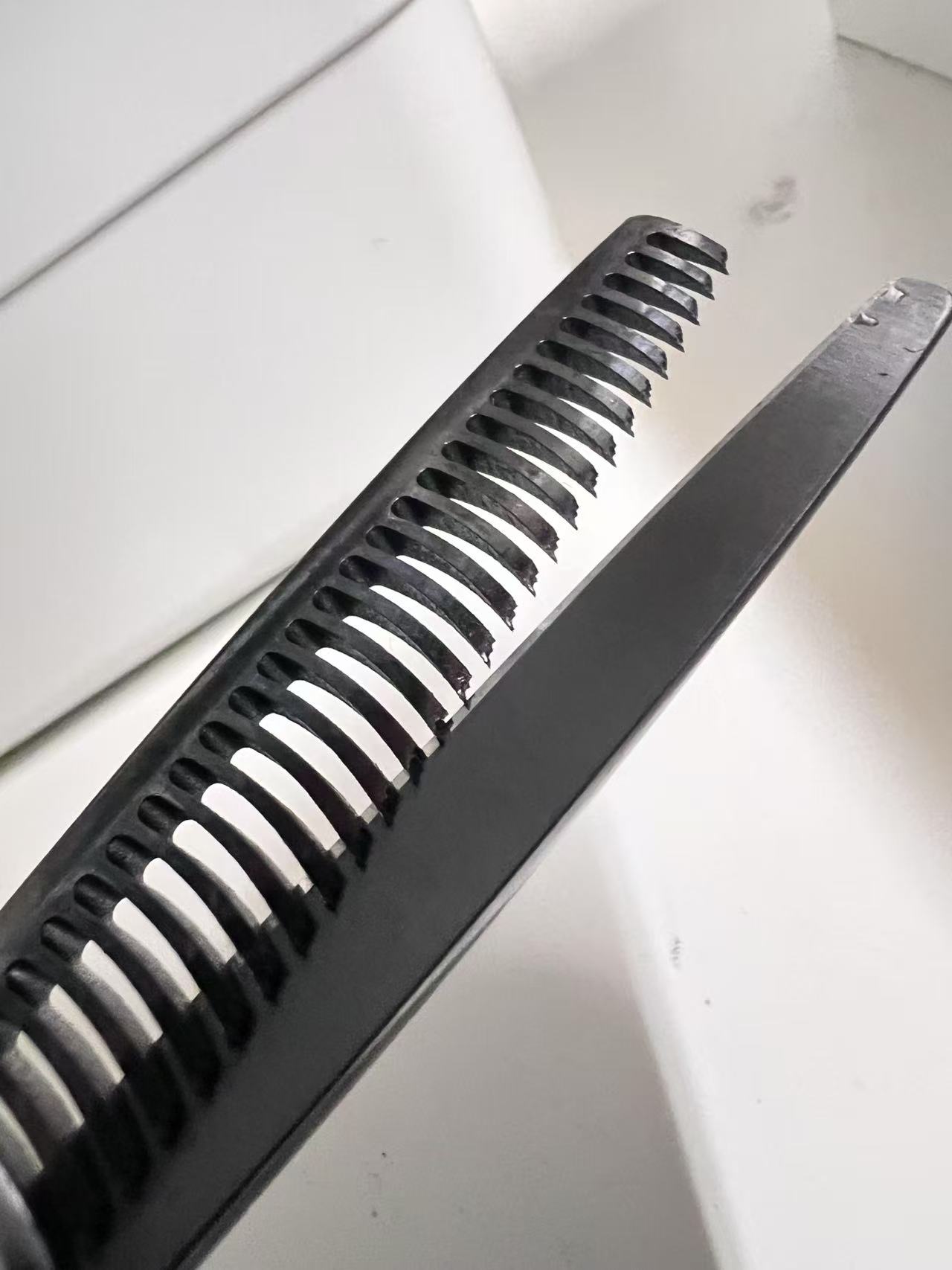 Third angle showing the extent of surface marks along the blade
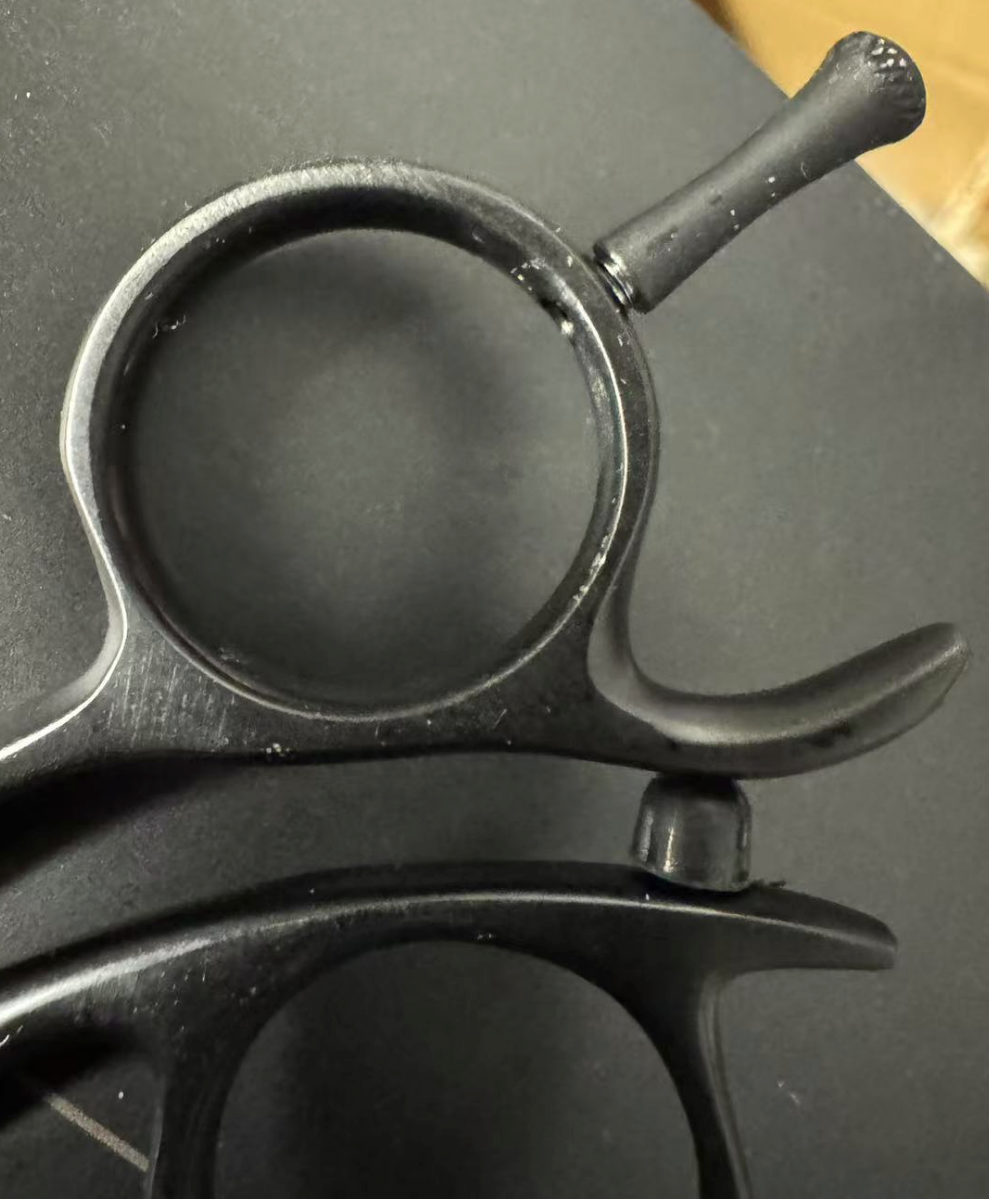 Ring area showing plating fixture marks and surface imperfections on the coating
The factory’s response to the plating marks stated that these are “inevitable” because the hanging point used during the color plating process leaves a mark on the ring area. Regarding the sharpening marks on the blade, the factory’s written instruction to its own quality control team was simply: “Avoid it.”
For scissors specified at HITACHI 440C steel and 59 to 61 HRC, visible cosmetic defects of this nature would typically be considered unacceptable for resale. Professional shears are expected to arrive in retail-ready condition.
Discoloration
The buyer flagged a discolored area on certain blades. The factory’s written response asked the buyer to confirm whether the discoloration at a circled position was indeed the issue, and asked “Can it be avoided next time.”
This response suggests the factory was uncertain about what it was looking at, indicating a reactive rather than proactive approach to quality identification.
Specification gap
The buyer also noted that the factory requested blade length and handle dimensions for a 5.0 inch model, suggesting the factory did not have standardized specifications for this size and was relying on the buyer to define them.
What This Means for Buyers Considering OEM Sourcing
Quality control challenges in OEM manufacturing are not unique to any single factory. They are a known risk across mid-tier production worldwide, in China and elsewhere. The difference between a reliable factory and a problematic one often comes down to how consistently they execute quality checks before shipment, and how they respond when issues arise.
For anyone considering placing an order with an OEM scissors manufacturer, here are some practical steps drawn from industry experience:
Sample first. Always request a sample order (5 to 10 pairs) before committing to a full production run at MOQ. Evaluate finishing quality, specification accuracy, and packaging.
Get specifications in writing. A signed specification sheet that details finger rest type, gasket inclusion, finish standard, and acceptable defect tolerances removes ambiguity.
Consider third-party inspection. Companies like SGS, Bureau Veritas, and QIMA offer pre-shipment factory inspection services in China. The cost is typically a few hundred dollars and can prevent costly surprises on arrival.
Visit if the order justifies it. Ruian is approximately 2.5 hours from Shanghai by high-speed rail. A factory visit tells you more in one afternoon than months of email exchange.
For more on how OEM scissors manufacturing works across the industry, see our guide on OEM and White-Label Manufacturing.
Editorial Disclosure
ScissorPedia received the photographs and factory correspondence referenced in this article from a buyer who requested anonymity. We have reviewed the documentation, including the factory’s own written “Summary of Problems” document, but we have not independently verified every detail of the buyer’s account beyond what the factory’s own written responses confirm.
All company information in this article (location, employee count, steel specifications, product range, website status, platform presence) comes from publicly accessible sources including ninashears.com and the factory’s GoldSupplier.com profile, accessed in March 2026.
The factory’s written quality summary, quoted throughout this article, was authored by Nina Shears and shared with ScissorPedia by the buyer with the factory’s knowledge.
Nina Shears or any representative of the company is welcome to contact ScissorPedia with corrections, context, or an updated response at info@scissorpedia.com. Any substantive response received will be published alongside this article.
This article is intended as buyer education. It is based on publicly available information combined with buyer-submitted documentation. It does not constitute legal advice or a recommendation for or against doing business with any company.