United States buying guide
Best Professional Hair Scissors in the USA: Buying Guide
Compare Yasaka Offset for one everyday cutter and Kasho Blue Offset for a compact alternative. For a school kit, confirm the course brief first; for either purchase, name the US return contact and who will maintain the exact pair.
See US buying and service routesAt a glance
- For students, the school’s tool requirements come before a premium brand or bundle.
- A US purchase, a US return address and domestic servicing are separate things to confirm.
- Kasho and Mizutani publish specific service routes; ask which one applies to the exact pair.
https://www.scissorpedia.com/best-professional-hair-scissors-usa/
Two useful starting points, not a national ranking
Compare Yasaka Offset when you need one everyday cutter. Compare Kasho Blue Offset when a compact pair is the brief. Both still need a fit check and an exact US offer; the examples are not a claim that these are the country’s two best-selling or best-performing scissors.
“In the USA” refers to the buyer’s delivery and ownership needs, not the place of manufacture. Selected sources were reviewed on 9 September 2026. There was no hands-on comparison, national stock survey or current-price ranking.
Scroll to explore all 2 examples
-
Yasaka

Yasaka Offset
Request a current local quote.
One everyday cutter
An offset cutter to compare when replacing your main salon pair. Start with the size and handle you need; a set is unnecessary if you only need one tool.
Photo: YOI Scissors UK
View sizes & specifications -
Kasho

Kasho Blue Offset
Request a current local quote.
Compact offset option
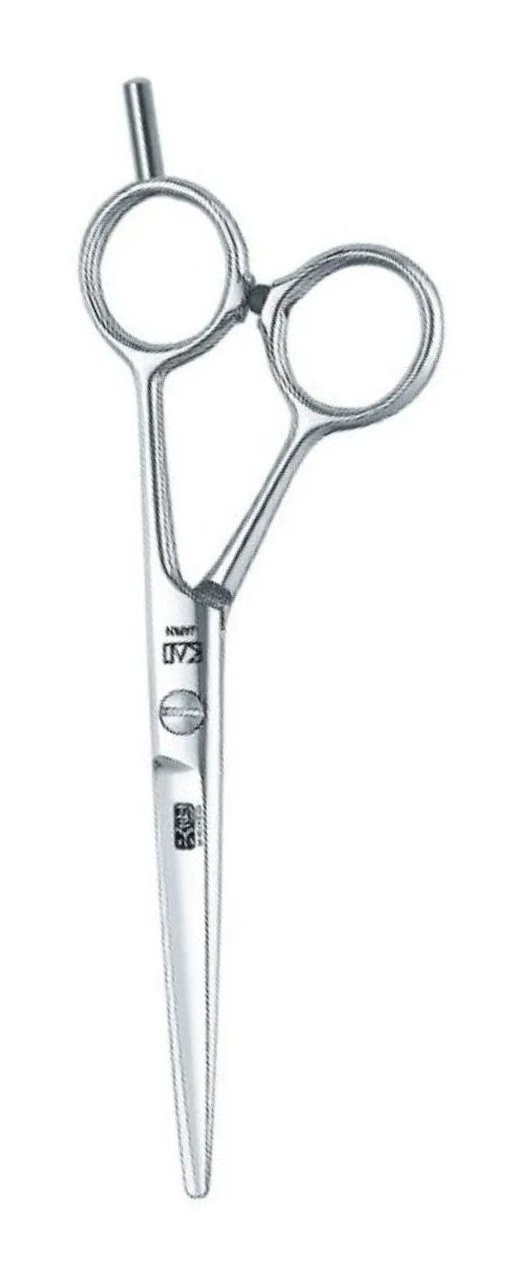
Blue provides a compact-length comparison with a documented flat-head screw. Match the exact model code to the US offer and ask about the published Kasho service route.
Maker evidence 1 · Maker evidence 2
Photo: Scissor Hub Australia
View sizes & specifications

Any displayed price is a dated guide in the labeled currency and market, not a live quote. Where that context is incomplete, we omit the amount. Compare the same size and included pieces, with local tax, delivery and service costs.
Start with your working stage
Learning-stage tool
Start with the school’s kit requirements and supervised control. Avoid buying a specialist or a large bundle before you know which tools the course uses.
Daily working tool
Name the shortcoming in your existing pair: fit, reach, a particular task or servicing downtime. Compare a replacement against that requirement, not simply against a higher price.
Specialist or second tool
Give the additional pair a distinct job. If it repeats your main cutter, make sure it is a deliberate backup rather than an upgrade bought without a clear purpose.
Put school requirements ahead of an on-the-day offer
Ask your instructor to confirm the required handedness, length, cutter and texturizer types before a school demonstration or sales visit. Bring those requirements to the offer.
Get the exact model, included tools, delivered price and return conditions in writing. Ask what handling or practice is allowed before a return becomes unavailable. If the school has not required the extra tool, compare the cost of buying the cutter alone.
The student guide helps organize a first-pair shortlist. A temporary discount does not resolve a fit problem or establish the value of an unused companion.
Separate the seller from the service route
A brand representative, retailer and sharpener can be different businesses. Before comparing offers, identify each responsibility.
| Responsibility | Ask the seller |
|---|---|
| Supply | Which exact size, handed build and condition will I receive? |
| Fulfillment | Who ships the order, and from where? |
| Return | Who approves a trial or return, and where is the pair sent? |
| Warranty inquiry | Which organization receives the claim for this purchase route? |
| Paid servicing | Who accepts this model for adjustment, sharpening or repair? |
| Downtime | What backup will I use while the pair is away? |
Do not assume that an in-person demonstration answers all six questions.
Use the maker’s US-facing routes
Maker-listed country route
Kasho’s US-facing distributor list gives you specific contacts to investigate. Confirm the model code and selected option with the seller; a listing on the maker’s directory is not a stock count or a promise that a demonstration is available today.
Independent retailer or distributor
Ask which maker relationship applies to your model and country. Then check the written trial, return and warranty contacts. A specialist retailer can be useful, but the responsibilities need to be explicit.
Marketplace, event, school, or direct offer
Keep the seller’s name, exact model and written offer after the event or conversation. A familiar logo, case or engraving does not replace confirmation through the responsible maker. Use the authenticity workflow when the details do not line up.
Compare domestic servicing with factory maintenance
Kasho USA: its published mail-in service names Santa Fe Springs, California, and describes cleaning, screw-system inspection, sharpening and adjustment. Ask whether your exact model is accepted and obtain current instructions before shipping. This guide does not turn the page’s advertised fee or timing into a promise for your pair.
Mizutani North America: its service page distinguishes North American certified/authorized service routes from maintenance at the Japan factory. Identify the work required before choosing a route. The source was inspected through its search-indexed company page because direct access returned HTTP 403.
These are examples of how arrangements differ, not claims that either route services every brand. Separate routine sharpening, damaged-pair inspection and factory repair when asking for a quote.

Match the exact model before accepting a price
A displayed USD reference amount is not necessarily a US-market offer; check its date and market. Where a card requests a quote, no sufficiently scoped amount is published. Ask for your size, handedness, included pieces, shipping and separately charged costs on one dated offer.
Kasho’s Blue specification names a flat-head screw. Do not carry another series’ tension-system description into the order. The same principle applies to blade lengths, handles and set contents.
For more options, browse Yasaka, Kasho, Mizutani, Ichiro, Mina, Joewell and Juntetsu. These links widen the search; they do not establish US stock for every model.
Compare fit and geometry, not national stereotypes
A country label does not tell you the whole specification. Compare the maker’s edge and handle descriptions, then ask whether the intended service provider can maintain that model.
The edge comparison and Japanese-versus-German guide explain useful distinctions without deciding the fit for you.
Check the maker’s size convention
Use the size reference and length comparison to keep measurements consistent. During a permitted trial, compare reach, tip visibility, balance and control in the task you need. Stop if control reduces or discomfort develops.
Keep the purchase and service record together
Retain the dated listing, quote, invoice, exact model details, return terms and service correspondence. These help when asking for support or explaining which tool needs work. This guide does not determine tax deductibility or provide tax advice.
Choose a pair you can buy, use and maintain
Shortlist the pair only when you can name its job, confirm fit under permitted conditions and identify the people responsible for supply, returns and servicing. If those answers are clear, compare the complete offers; if one is missing, ask before committing.
A few final questions
Frequently asked questions
What are the best professional scissors in America?
There is no single winner for every US buyer. Yasaka Offset is one everyday cutter to compare; Kasho Blue is a compact offset alternative with a published US mail-in service route. Choose around the work, fit, delivered offer and support—not the brand’s position in a general ranking.
What scissors should cosmetology students buy?
Start with the school’s written requirements for handedness, size and tool types. Ask for an instructor-supervised fit check and compare a single cutter with any proposed bundle. Keep room in the budget for care and service rather than buying tools the course does not yet need.
Where can I buy professional scissors in the USA?
The maker’s US site or current distributor list is a useful first stop. Kasho publishes a US-facing distributor list; other makers may use different regional arrangements. Confirm the exact seller, model, return address and service responsibility before paying.
Does buying in the US mean servicing stays in the US?
Not necessarily. Kasho publishes a California mail-in route, while Mizutani distinguishes North American service from Japan factory maintenance. Ask which work your pair needs, where it will go and how long you should plan to use a backup.
Read the original information
Sources and further checks
Evidence status: Selected model, distributor and service information reviewed 9 September 2026. Mizutani's service page was available through its search index, with direct access returning HTTP 403. No national price survey or cutting test.
Manufacturer specifications and US-facing purchase and service pages support these examples. They are not a national stock survey, live-price comparison or guarantee of service eligibility for your pair.
- Yasaka Seiki — Product catalogSize-led catalog, basic and offset models, dry-cut and left-handed ranges, and maker-stated thinning cut-rate bands.Checked 9 Sep 2026
- Kasho — Blue Series specificationsBlue offset sizes and KCB model codes, VG-10W convex blades, and flat-head screw. No price or comparative performance verification.Checked 9 Sep 2026
- Kasho USA — Sharpening servicePublished mail-in service process, cleaning, screw-system inspection, sharpening and adjustment, and service location in Santa Fe Springs, California. No current service-price or turnaround guarantee is adopted; confirm exact-model eligibility before shipping.Checked 9 Sep 2026
- Mizutani North America — Service and maintenance routesSearch-indexed company page distinguishes Japan factory maintenance from North American certified and authorized service routes. Direct access returned HTTP 403. No specific provider appointment, current fee, turnaround or warranty eligibility is confirmed.Indexed copy retrieved 9 Sep 2026; original page not inspected.
- Kasho USA — Distributor listUS-facing distributor page inspected 9 September 2026. Use it to locate a current contact; inclusion does not confirm exact-model stock, trial terms or an appointment.
Discussion