Japanese and Chinese Professional Scissors: A Model-by-Model Guide
Compare Japanese and Chinese professional scissors through exact models, materials, blade geometry, fit, finish, price, retailer support, and service.

Japan and China are both important centers for professional-scissor production. Each country contains different makers, factories, product ranges, materials, and approaches, so a useful buying decision starts with two exact models rather than a broad national ranking.
Quick answer
Choose by the complete scissor and the support around it. Compare blade length, edge and blade geometry, handle, pivot, material, finish, handedness, fit, price, returns, warranty, and sharpening options. Manufacturing location is a meaningful product detail, but it works best as one part of that full comparison.
How common product labels differ
| Product wording | What it describes |
|---|---|
| Japanese steel | The stated source or family of the blade material |
| Designed in Japan | The location associated with product design |
| Made in Japan | The manufacturing origin stated for the finished product |
| Made in China | The manufacturing origin stated for the finished product |
A single product may include more than one location in its design, material, component, production, distribution, and service story. Current maker and retailer pages can explain which description applies to the model you are considering.
Six Japanese models for an exact-product comparison
Six Japanese professional-scissor examples
-

-

-

-

-

-



Product photos from the ScissorPedia catalog; see each product page for provenance.
These examples show how much variation exists within one national category:
- Yasaka Offset: an offset cutter; its edge and steel depend on the exact Yasaka model code.
- Ichiro Taiyo: a VG-10 cutter and 15-tooth texturizer set.
- KASHO Design Master Offset: a VG-10W cutter with a semi-convex edge and disc tension system.
- Mina Sakura II: an offset cutter offered across five lengths.
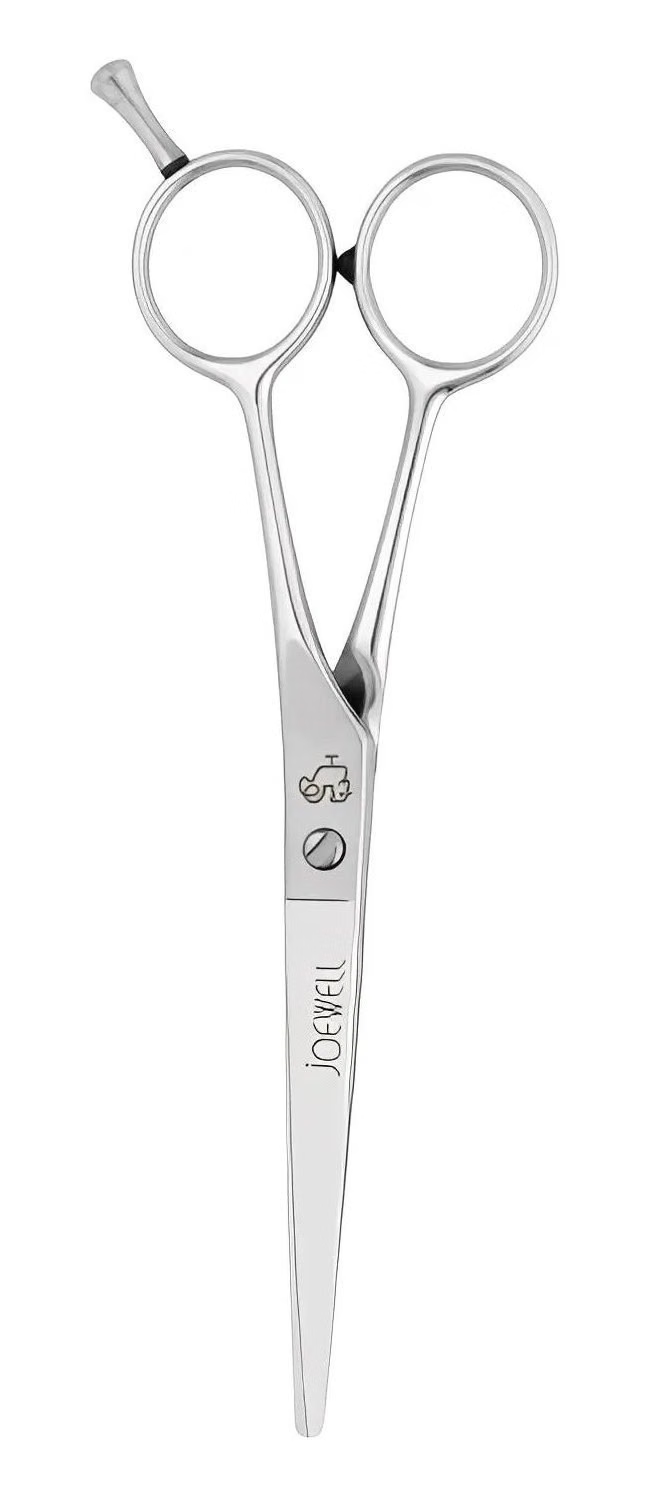
- Joewell Classic: a classic-handle cutter with Joewell’s standard blade, offered from 4.5 to 7.0 inches.
- Juntetsu Mastersmith: a 7.0-inch cutter and texturizer set in ATS-314 cobalt steel.
Distributors and specialist retailers serving Australia, New Zealand, the United States, Canada, and other markets receive stock from Japan across these ranges. Exact models, sizes, sets, and delivery terms vary by seller and country.
Manufacturing context
Seki City is one of Japan’s recognized blade-making centers, supported by specialist workshops and a long cutlery tradition. Japan also has professional-scissor businesses and production activity in Tokyo, Chiba, Nara, Osaka, Hyogo, Wakayama, and other regions.
Yangjiang is a major Chinese cutting-tool manufacturing center. Its industrial network supports a wide variety of materials, production volumes, custom specifications, and finished-tool ranges for domestic and international markets.
Both contexts are broader than any one pair of scissors. The current model page is the best place to see the particular material, geometry, finish, and manufacturing description selected by its maker.
Compare the exact configuration
Blade and edge
Start with the work the scissor needs to perform. A convex or semi-convex cutter may suit slide and general salon cutting, while a bevelled or micro-serrated edge may give a different sense of control. The blade line, width, tip, and length also shape how the pair behaves.
Handle and fit
Offset, crane, even, and swivel handles place the hand differently. Ring size, thumb position, finger rest, opening span, and balance can matter more to daily comfort than the country label. Compare the exact handed build and trial the pair within the seller’s written terms where possible.
Material and finish
Material descriptions can include stainless, molybdenum, cobalt-bearing, VG-10, 440C, powder steel, and other families. Heat treatment, grinding, assembly, and final finishing work with the material to produce the finished blade. Coatings and decorative finishes add another model-specific choice.
Pivot and adjustment
Flat screws, click systems, bearings, and conventional tension screws each have their own feel and care needs. Check whether the maker recommends user adjustment and which tools or service route apply.
Compare the complete buying experience
Use the same practical fields for every candidate:
| Field | Model A | Model B |
|---|---|---|
| Maker and exact model | ||
| Size and handedness | ||
| Material and finish | ||
| Blade and edge geometry | ||
| Handle and pivot | ||
| Fit and controlled trial | ||
| Current delivered price | ||
| Returns and warranty | ||
| Sharpening and service |
This format works for Japanese-to-Chinese, Japanese-to-Japanese, Chinese-to-Chinese, or any other model comparison.
Questions to ask before buying
- Is the selected model available in the correct size and handed build?
- Which blade, edge, handle, and pivot configuration does it use?
- What material and finish does the current product page list?
- What is included with the pair or set?
- What is the complete delivered price?
- How do returns, warranty, replacement parts, and sharpening work in your country?
- Can the seller help with model selection and after-sales service?
Build a balanced shortlist
Start with the technique and fit you need, then select products with comparable configurations. If one option is a 7.0-inch barber set, compare it with another long barber set rather than a 5.0-inch detail cutter. If one is a true left-handed build, use the same requirement for every candidate.
For Japanese ranges, Yasaka, Ichiro, KASHO, Mina, Joewell, and Juntetsu offer distinct models across cutters, texturizers, compact salon lengths, longer barber formats, and matched sets. Apply the same exact-product approach to Chinese makers and every other brand in the shortlist.
Bottom line
Japan and China both contribute a wide range of professional scissors to the international market. The most useful comparison is model by model: configuration, fit, finish, seller, returns, warranty, service, and delivered cost.
Choose the pair that matches your hand and work, and use the current maker and retailer information for the details that matter to you.
Frequently Asked Questions
4 answers you can open one at a timeHow should I compare Chinese-made professional scissors?
Compare the exact model’s material, blade and edge geometry, handle, pivot, finish, size, fit, current price, returns, warranty, and sharpening support. Chinese manufacturers offer many different specifications, so the individual product is the useful level of comparison.
Does Japanese steel mean the finished scissors were made in Japan?
Japanese steel describes the stated material source, while Made in Japan describes the finished product’s manufacturing origin. Both can be useful product details when the maker lists them for the exact model.
Where can I find manufacturing information for a scissor?
Start with the current maker and exact-model page, then check the product description, packaging, retailer listing, warranty, and service information supplied with the pair.
Should I pay more for Japanese-made scissors?
Choose the model whose configuration, fit, finish, trial terms, retailer support, and service best suit your work. Manufacturing origin can be part of that choice, but price and country alone do not determine comfort or suitability.
Contents
Discussion