Build your working kit
Build a Japanese Scissor Kit: Choose, Use and Maintain
Give every pair a job before adding another. Start with your main cutter, add texture or specialist tools only for a real gap, and plan how the kit keeps working while a pair is away for service.

At a glance
- Build around repeated cutting tasks, not a target number of scissors.
- A set is useful only when both the cutter and companion fill a gap.
- Keep the maker’s care instructions and a service-ready backup plan.
https://www.scissorpedia.com/inside-a-japanese-salon-how-stylists-choose-use-and-maintain-their-scissors/
Build the smallest kit that covers your work
Start with the work, not the number of pairs. Name your main cutting task, the texture work you repeat and what will happen when a tool needs servicing. That gives you a buying brief.
This is a planning guide for working stylists, barbers and students using Japanese or Japan-associated scissor ranges. It is not a report from inside a named salon, and it does not suggest that Japanese stylists all work with the same kit.
| Kit role | Add it when | Question to settle |
|---|---|---|
| Primary cutter | You need the pair that handles your main cutting work | Which handed build, length and handle can you control for that work? |
| Texturizing or thinning tool | You can name a repeated texture or weight-removal task | Which tooth pattern and maker-described result match it? |
| Specialist cutter | Reach, tip access or a different cutting task exposes a real gap | What does this pair add that the primary cutter cannot? |
| Backup | Servicing or damage could interrupt your work | Is the spare suitable for the main task and ready to use? |
For a student, the course requirements come first. For a working professional, start with the gap in the existing kit. Neither needs to buy every row of the table at once.
Give each pair a one-line job
Write a plain label beside each tool: “main salon cutter”, “finishing texturizer” or “backup for the main cutter”. Add a specific task or length only when it genuinely defines the role.
Two pairs with the same job may be a deliberate backup, not waste. The useful distinction is whether the duplication is planned. Equally, a tool that serves several tasks does not need replacing simply because a specialist version exists.
Compare a single tool with a set
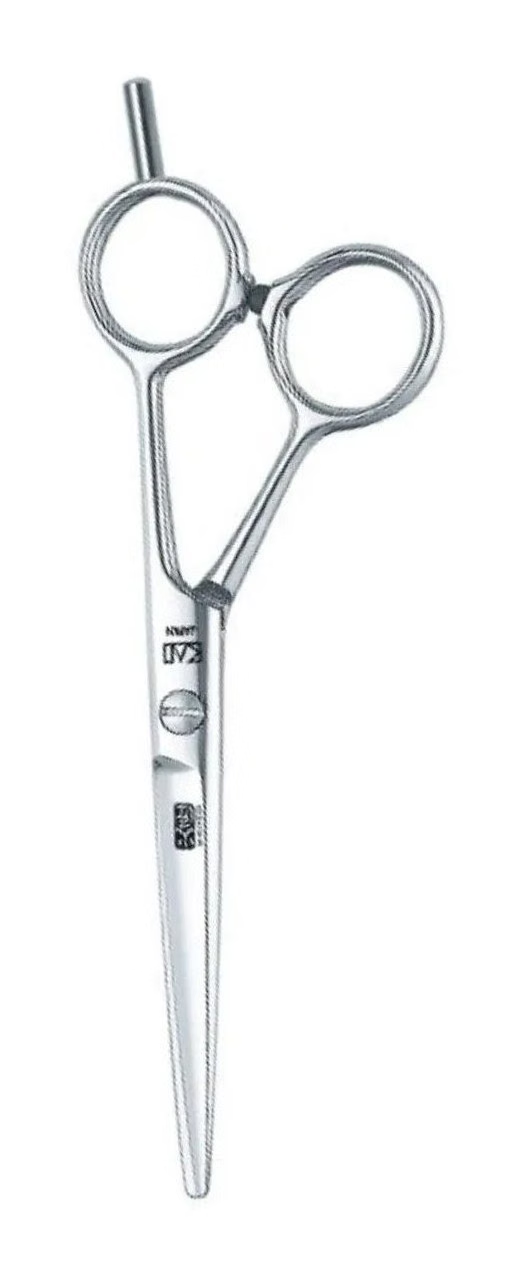
A Kasho Blue Offset gives you one cutting tool to assess. The Ichiro Taiyo listing pairs a size-selectable cutter with a 6-inch, 15-tooth texturizer. The difference is not prestige: it is whether you need one new job covered or two.
Scroll to explore all 2 examples
-
Kasho

Kasho Blue Offset
Request a current local quote.
One defined cutter
A compact offset cutter to compare when that length and handle fit the job. Blue's flat-head screw is a reminder to identify the exact adjustment system.
Photo: Scissor Hub Australia
View sizes & specifications -
Ichiro

Ichiro Premium Series Taiyo VG10 Cutting and Texturizing Scissor Set
Request a current local quote.

Any displayed price is a dated guide in the labeled currency and market, not a live quote. Where that context is incomplete, we omit the amount. Compare the same size and included pieces, with local tax, delivery and service costs.
Further model choices include Yasaka Offset, Kasho Design Master Offset, Mina Sakura II, Joewell Classic and Juntetsu Mastersmith. Open only the models that address your brief; this is not a list of tools every kit should contain.
Check fit before adding another specification
Start with handed construction and the maker’s size convention. Within the seller’s written trial conditions, compare ring contact, thumb movement, balance, reach and visibility at the tip. Keep the permitted practice task consistent between candidates.
Ask a student educator or suitably experienced colleague to help you describe what is happening; do not turn their preference into a universal recommendation. Stop if control reduces or discomfort develops. A handle label does not guarantee comfort or a medical outcome.
The tool-fit assessment gives you a fuller set of questions.
Keep the care instructions with the exact pair
Do not apply one tension-adjustment or cleaning routine to every tool in the case. Identify the model and its instructions first. For example, Kasho’s Blue specification names a flat-head screw; that detail should not be replaced with another series’ adjustment-system name.
Build a care note that answers:
- Where are the current maker instructions for this model?
- Which cleaning, drying, lubrication and adjustment methods do they specify?
- What storage and transport protection do they require?
- Who should assess damage or an unexplained change in closing action?
For disinfection, follow the product instructions and your workplace’s current local requirements. This article does not supply a chemical recipe, contact time or substitute sanitation procedure. After a drop or suspected damage, stop using the pair and seek an appropriate inspection rather than forcing its action.
Arrange service before you need it
Ask whether the provider accepts your exact model, what work it performs, how it handles the intended blade geometry and adjustment system, and what it will not repair. Include shipping and likely time away in the plan.
The maker examples show why this matters: Kikui describes repairs through its sales partners and Japan factory, while Naruto publishes factory maintenance and adjustment guidance. Those are brand-specific arrangements, not promises that the same route services every tool in your kit.
Keep the backup usable and accessible. The first sign that you need it should not be the day your main cutter leaves for sharpening.
Compare the complete configuration
For a single pair, compare the same task, handedness and size convention. For a set, repeat that check for each piece. Different companion lengths or texturizer options can make two similarly priced sets quite different purchases.
Then ask for the complete delivered price, permitted trial, return terms, warranty contact and service route. A lower set price does not compensate for a companion that has no job.
Keep one useful record per tool
Use a notebook or simple spreadsheet; you do not need a complicated inventory system.
| Keep | Why it helps |
|---|---|
| Maker, exact model, size and handedness | Identifies the pair when ordering parts or asking for help |
| Its job and your fit notes | Explains why it belongs in the kit |
| Seller, invoice and warranty contact | Keeps the purchase and support route together |
| Maker care instructions | Prevents a generic routine replacing the model’s guidance |
| Service date, work done and next observation | Makes changes in condition easier to discuss with the provider |
| Backup arrangement | Keeps service downtime from becoming a surprise |
Add the next pair only when you can name the gap
Label the tools you already own before shopping. If a repeated task has no suitable pair, write that task into the buying brief. If every job is covered, improving the care or service plan may be more useful than adding another scissor.
A few final questions
Frequently asked questions
How many pairs of scissors does a stylist need?
There is no target number in this guide. Begin with the cutter that covers your main work, identify any repeated texture or specialist task, and decide how you will cover servicing downtime. Add a pair when it has a clear role rather than because a particular type of stylist is said to own one.
Should every technique have its own scissors?
Not automatically. First identify where your current tool falls short, then compare the maker’s intended tasks and the exact model’s fit and configuration. A specialist purchase should solve a repeated problem, not duplicate a tool that already does the job.
How often should I sharpen professional scissors?
Use the maker’s advice and an appropriate service assessment for the exact pair. This guide does not prescribe a universal interval from the brand, steel or country label. Keep notes on changes in cutting behavior and plan a usable backup while the pair is inspected or serviced.
Does this describe what happens inside a Japanese salon?
No. This is a kit-planning explainer using named product and service examples. It is not based on a reported salon visit, interviews or a survey of Japanese stylists.
Read the original information
Sources and further checks
Evidence status: Revised as a practical kit-planning explainer, not a salon visit, practitioner survey or universal maintenance protocol. Selected product and maker service sources support the examples.
Product examples illustrate kit choices; manufacturer pages show why service arrangements are model-specific. This is not a report from a named Japanese salon or a clinical fit assessment.
- Kasho — Blue Series specificationsBlue offset sizes and KCB model codes, VG-10W convex blades, and flat-head screw. No price or comparative performance verification.Checked 9 Sep 2026
- Japan Scissors Australia — Ichiro Premium Taiyo setRetailer-listed set configuration, cutter lengths, 6-inch 15-tooth companion, offset handles and VG-10 specification. Not independent testing, manufacture verification, or confirmation of stock for a selected variant. No current price is adopted.Checked 9 Sep 2026
- Kikui — Manufacturer repairsMaker's published sales-partner and Japan-factory repair arrangement. Buyers must confirm current costs and turnaround for their country.Checked 9 Sep 2026
- Naruto — Maintenance and adjustmentFactory sharpening and adjustment through a distributor or direct contact, with model-dependent maintenance-ticket information. No quoted service price or turnaround is adopted here.Checked 9 Sep 2026
Discussion