Forward-Set Thumb
Handle typesCompare a handle through contact, movement, and control
Handle names describe layouts; the exact handed build and individual trial determine the useful fit record. Apply to Forward-Set Thumb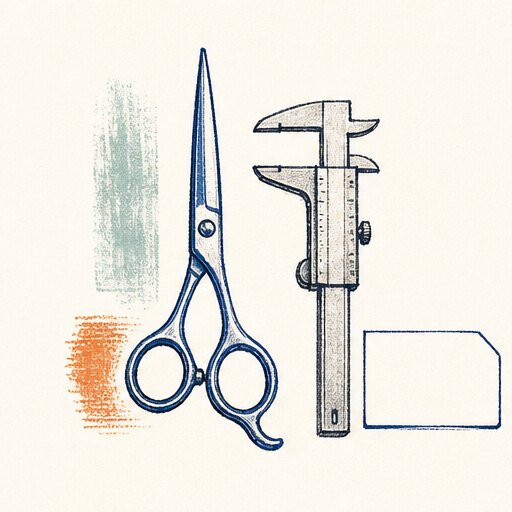
- 01 Verify handedness Check blade stack, ring layout, and model variant.
- 02 Observe contact Record rings, approved inserts, binding, floating, and pressure.
- 03 Observe travel Check opening, stopping, release, and repositioning without forcing.
- 04 Trial the task Include reach, visibility, pace, control, and recovery.
Do not inferOffset, crane, swivel, lightweight, or ergonomic language cannot guarantee comfort, injury prevention, treatment, or suitability.
Description
The forward-set thumb handle positions the thumb ring ahead of the pivot for a natural grip angle. Learn how this design improves control on slide and point techniques.
Forward-Set Thumb Handle (フォワードサム)
Quick look
- Also known as: Extended crane; short thumb handle
- What it is: A handle where the thumb ring is positioned very close to — or ahead of — the pivot, minimising thumb travel on each stroke
- Purpose: Reduces repetitive micro-movement of the thumb joint; a targeted intervention for thumb and tendon strain
- Best for: High-volume precision cutting; stylists managing thumb tendonitis or early RSI
Why it matters
Every scissor stroke requires the thumb to open and close the blade. In a standard or offset handle, that motion traces a consistent arc — small, but repeated thousands of times per working week. The forward-set thumb handle shortens that arc to nearly nothing by positioning the thumb ring so close to the pivot that the thumb barely moves relative to the scissors body during each closure.
The cumulative benefit is substantial for stylists working at high volume or managing tendon pain. The median nerve and the flexor pollicis longus tendon — the primary structures affected by carpal tunnel syndrome and thumb tendonitis in hairdressers — experience proportionally less load with each stroke. Across hundreds of thousands of cuts over a career, that reduction is meaningful.
Sam Villa’s design philosophy
Sam Villa’s Signature Series Swivel Shear is the most widely recognised forward-set thumb design. The brand specifically positions the handle as a career-longevity tool, designed around preserving the thumb joint for working stylists in their thirties through their fifties who cut full five-day schedules. The design assumes that technique is no longer in question and the priority has shifted to sustainable daily execution.
Trade-offs
The very short thumb lever changes the feedback from each cut. Stylists accustomed to feeling the resistance in the thumb ring as a measure of cut progress need time to recalibrate. Heavy scissor-over-comb work, which benefits from a wider blade arc and more closing force, is less well-suited to this design than to a conventional offset or crane. Stylists with long thumbs may find the forward position restrictive — the ring can feel as though it is pulling the thumb toward the blade rather than allowing natural flexion.
Sources
- Sam Villa RSI Prevention Guide (src-052)
See Also
Sources Reviewed
1 scoped source behind this entry- Secondary Sam Villa — RSI Prevention Guide (professional education)
Frequently Asked Questions
5 answers you can open one at a timeWhat work is the forward-set thumb designed for?
Close-range precision work where the thumb moves frequently through small arcs — fringe cutting, outline shaping, interior detailing. The very short thumb shank reduces thumb travel to almost nothing, which minimises the repetitive micro-movement that accumulates into thumb joint and tendon strain over high-volume sessions. It is also used by stylists already managing thumb tendonitis or early repetitive strain symptoms who need to stay on the floor.
Who should use a forward-set thumb handle?
Stylists with thumb joint pain, tendonitis, or carpal tunnel symptoms that are aggravated by standard or offset handles. Also stylists doing very high-volume precision work — tight fringe sessions, detailed outline cutting, or any session where the thumb opens and closes the scissors hundreds of times per hour over many clients. The design is less suited to heavy power cutting, scissor-over-comb, or any technique that benefits from a wider blade arc.
How does forward-set thumb differ from standard offset?
A standard offset shortens the thumb shank moderately and drops it below the finger shank level. A forward-set thumb goes further — the shank is very short, sometimes to the point where the thumb ring sits ahead of the pivot line rather than behind it. The effect is that the thumb barely moves relative to the scissors body on each opening. This takes the offset ergonomic principle to its logical limit in one direction at the cost of reduced blade travel per stroke. a natural grip angle. Learn how this design improves control on slide and point techniques.
Who should use Forward-Set Thumb handles?
The forward-set thumb handle positions the thumb ring ahead of the pivot for a natural grip angle. Learn how this design improves control on slide and point techniques. Handle choice affects wrist alignment, fatigue levels, and long-term ergonomic health for professional stylists.
Does Forward-Set Thumb handle design reduce hand fatigue?
Handle ergonomics directly impact fatigue during long cutting sessions. Forward-Set Thumb handles position your hand and wrist in a specific alignment that can reduce strain. The best handle type depends on your cutting posture, hand size, and any existing conditions.
Comments & questions
Questions or feedback on this topic? Add a comment below.