What is a Pivot Point?
Glossary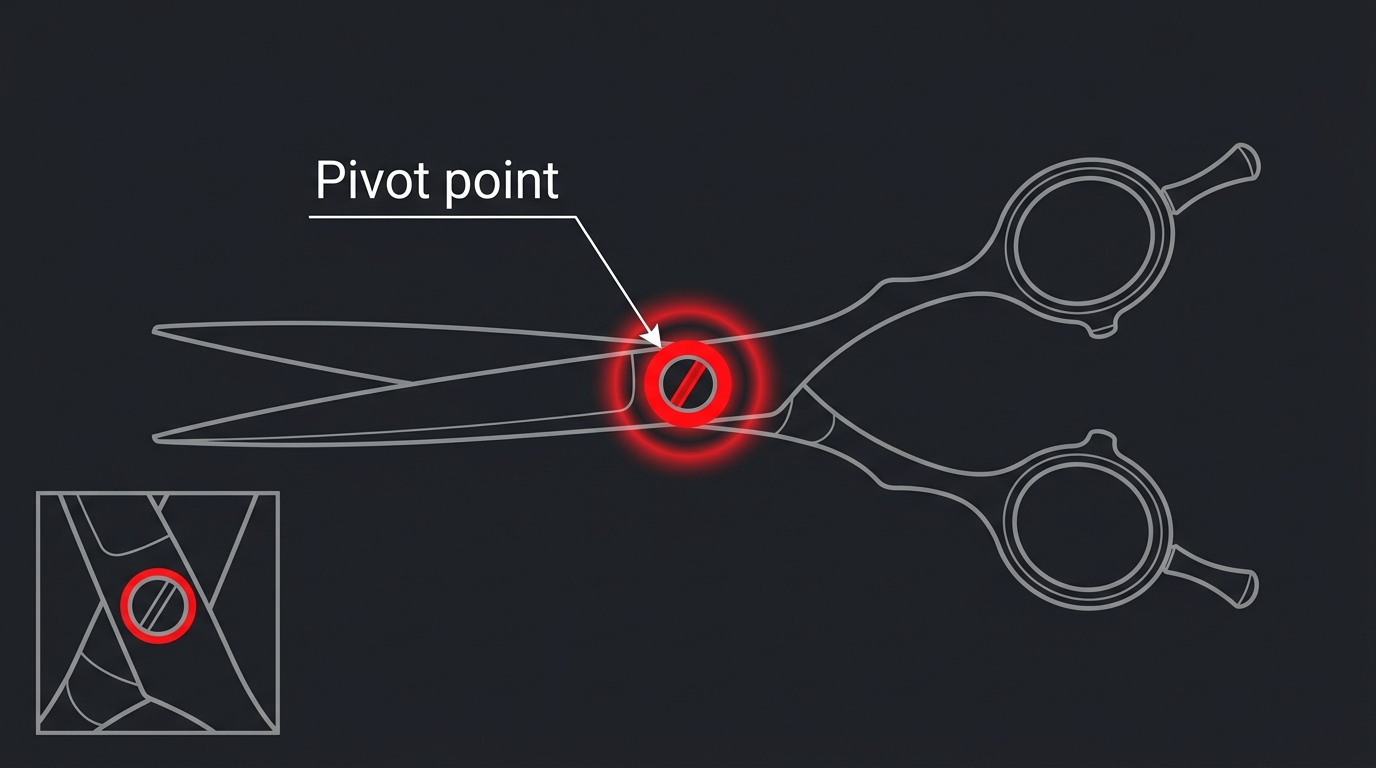
Keep a translated term attached to language and scope
Technical vocabulary can shift by maker, market, era, and component; preserve the original term before mapping it. Apply to What is a Pivot Point?
- 01 Original Retain script, romanisation where useful, and literal wording.
- 02 Source Record maker, catalogue, curriculum, standard, market, and date.
- 03 Scope Name the part, geometry axis, process, technique, or trade context.
- 04 Map carefully Show overlap and disagreement instead of forcing one English synonym.
Do not inferA dictionary translation or shared characters cannot prove that two makers, countries, components, or techniques mean the same thing.
Description
The pivot point is the central assembly where both scissor blades connect and rotate. It consists of a screw or bolt, washer, and tension mechanism. Alignment tolerance is critical — even 0.1mm misalignment causes uneven blade closure and poor cutting performance.
What is a Pivot Point?
The pivot point is the central assembly where both scissor blades connect and rotate. It consists of a screw or bolt, washer, and tension mechanism. Alignment tolerance is critical — even 0.1mm misalignment causes uneven blade closure and poor cutting performance. The pivot is both the structural heart and the most mechanically complex part of a scissor.
Why It Matters for Scissors
The pivot point determines how smoothly the blades open and close, how consistently the ride line tracks from pivot to tip, and how well the scissors maintain their adjustment over time. A poorly machined or assembled pivot introduces play (wobble) between the blades, which destroys cutting precision regardless of how good the blades themselves are.
There are three main pivot categories in professional scissors. Flat screw pivots are the simplest — a bolt passes through both blades with flat washers between them. Ball bearing pivots add a ring of small ball bearings between the blades, reducing rotational friction by 40-60%. Sealed bearing pivots enclose the bearings in a cartridge, protecting them from hair debris and water.
Naruto Scissors (成田) of Seki City developed the most complex proprietary pivot design in the industry: the compound circular 3D contact point (複合円形立体触点). This system uses a multi-surface contact geometry that self-centers the blades during rotation, maintaining alignment even as components wear over thousands of cuts.
Technical Detail
Related Terms
Sources
- Naruto Scissors — Technology
- V.ROAD / Yaoki Industry — Manufacturing Process
See Also
Frequently Asked Questions
2 answers you can open one at a timeHow often should you adjust the pivot tension?
Check tension weekly or whenever the scissors feel different. Daily use gradually loosens the pivot. A quick test: hold one handle and let the other drop — the blade should close smoothly to about 80% and stop, not swing fully closed or stay open.
What is the difference between a screw pivot and a bearing pivot?
A screw pivot uses a simple bolt and nut with flat washers, relying on surface-to-surface contact. A bearing pivot adds ball bearings or sealed bearings between the blades, reducing rotational friction and providing smoother opening and closing action.
Comments & questions
Questions or feedback on this topic? Add a comment below.