
Scissor Care in Humid and Coastal Environments
Protect your scissors from humidity, salt air, and accelerated corrosion with environment-specific care protocols, steel selection, and storage strategies.
Humidity and salt air do not just accelerate rust — they attack the cutting edge first, where the steel is thinnest and most vulnerable. A scissor that lasts 1,000 haircuts in Denver may need sharpening after 500 in Miami and 350 on a cruise ship. Your care protocol must match your environment.
How humidity and salt air attack your scissors
All steel corrodes. The question is how fast. In a climate-controlled inland salon with moderate humidity (30-50% RH), corrosion is slow enough that standard maintenance protocols keep it in check. In humid coastal environments (60-90%+ RH with airborne salt), the chemistry changes dramatically.
Humidity provides the electrolyte. Corrosion requires moisture on the steel surface to act as an electrolyte for the electrochemical reaction that produces iron oxide (rust). Above 60% relative humidity, a thin water film forms on steel surfaces even without visible condensation. This invisible moisture layer is enough to initiate corrosion.
Salt accelerates the reaction. Sodium chloride dissolved in that moisture film dramatically increases its conductivity. The corrosion reaction that might take weeks in dry air can happen in days or hours when salt is present. Coastal air carries aerosolised salt particles that deposit on every surface in your salon — including your scissor blades.
The edge is the weakest point. The cutting edge of your scissors is ground to a thickness measured in microns. This is where corrosion does the most damage first, because there is less material to lose before the edge geometry is compromised. A microscopic rust pit on the flat of the blade is cosmetic. The same pit on the cutting edge creates a dull spot that folds or tears hair.
The chromium connection
Stainless steel resists corrosion because chromium in the alloy forms a passive oxide layer (Cr2O3) on the surface that blocks further oxidation. The amount of chromium determines how robust this protective layer is.
| Steel | Chromium content | Corrosion resistance | Typical HRC | Common use |
|---|---|---|---|---|
| VG-10 | ~15.0% | High | 60-62 | Premium all-purpose |
| ATS-314 | ~14.5% | High | 60-62 | High-wear-resistance applications |
| ZA-18 | ~14.5% | High | 60-63 | Premium Japanese shears |
| 440C | ~17.0% | Very high (raw Cr%) | 58-60 | Workhorse; note: carbon content reduces effective Cr |
| GIN-3 | ~13.0% | Moderate | 58-60 | Budget Japanese steel |
| AUS-8 | ~13.5% | Moderate | 58-59 | Budget shears |
| Carbon steel (Shirogami, Aogami) | 0% | None | 60-67 | Traditional Japanese blades; not for humid environments |
A critical nuance: raw chromium percentage does not tell the full story. Some chromium binds with carbon to form chromium carbides, which strengthens the steel but removes that chromium from corrosion protection duty. A steel with 17% total chromium but high carbon content may have less effective corrosion resistance than a steel with 15% chromium and lower carbon. VG-10’s balance of 15% Cr with moderate carbon makes it one of the most corrosion-resistant professional scissor steels in practice.
The 13% threshold. Below approximately 13% effective chromium in the matrix, the passive oxide layer becomes unreliable. Steels at or near this threshold — including some budget alloys — are vulnerable to pitting corrosion in humid environments, especially when salt is present.
Daily care protocol for humid environments
The standard daily care protocol is your baseline, but humid and coastal environments require additional steps.
During the working day
- Wipe after every client. Use a dry chamois cloth (not tissue, which leaves fibres that trap moisture). In standard environments, wiping every two or three clients is acceptable. In humid coastal environments, every single client matters.
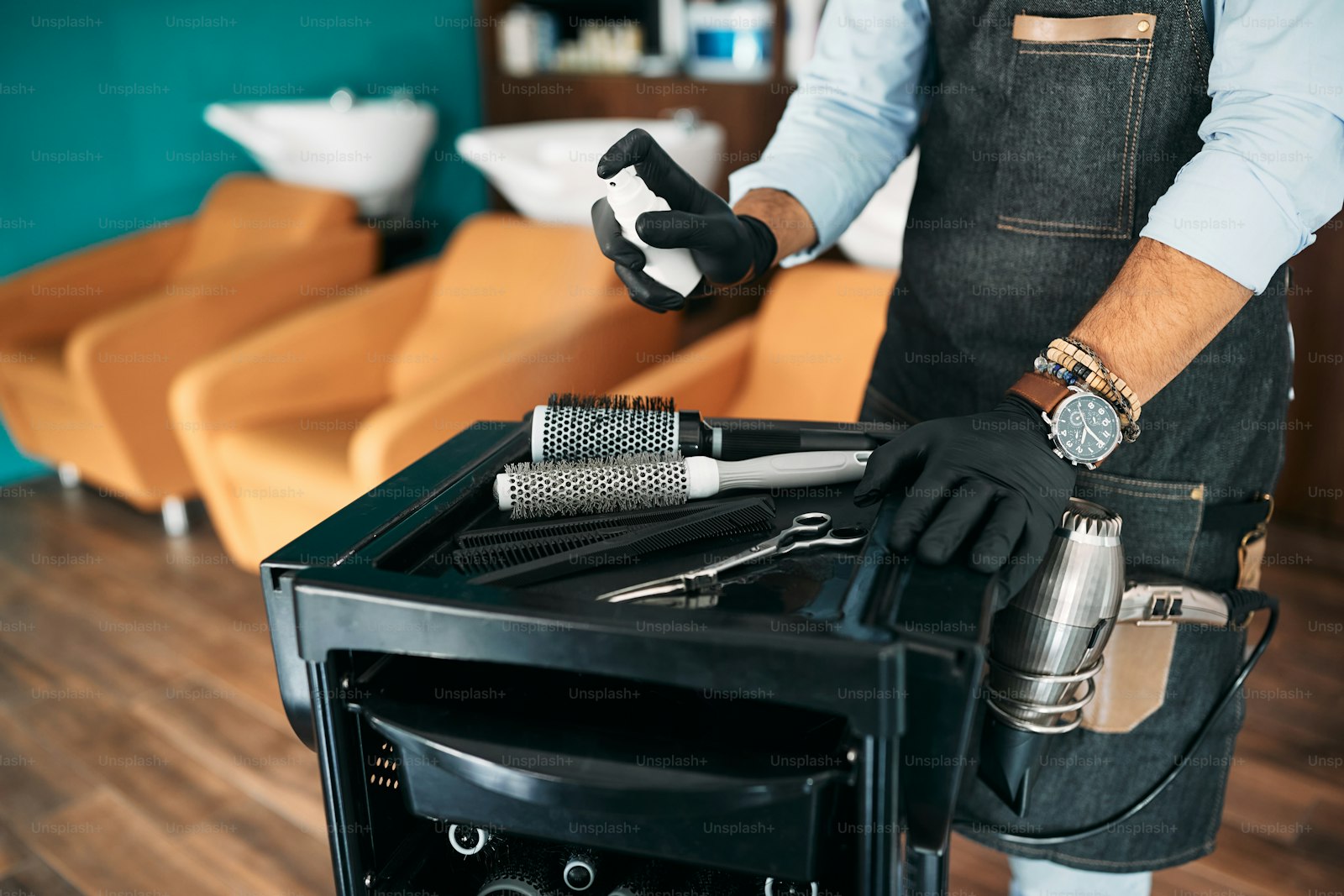
- Oil the pivot at midday. Standard protocol calls for oiling once at end of day. In high humidity, add a midday application. One drop of camellia oil or dedicated scissor oil at the pivot, open and close 10-15 times to distribute.
- Dry immediately after any water contact. If you cut wet hair, dry the blades thoroughly before setting the scissors down. Water left on blades for even 30 minutes in a humid salon starts the corrosion clock.
- Check for salt deposits. In beachside salons or open-air environments, salt deposits appear as a faint white haze on the blade surface. Wipe with a cloth dampened (not wet) with distilled water, then dry immediately and oil.
End of day
- Follow the full seven-minute daily protocol.
- Add an extra step: apply a thin film of camellia oil along the entire blade surface, not just the pivot. This creates a barrier layer against overnight moisture.
- Never leave scissors in an open holster or on a workstation overnight. Store them in a closed case.
Weekly
- Inspect blades under bright light for any discolouration, pitting, or early rust spots. Catch these early and they can be addressed with a gentle polish. Left unchecked, pitting corrosion becomes a sharpening issue that removes blade material.
- Clean the inside of your storage case. Moisture and salt can accumulate in fabric-lined cases.
- Replace silica gel packets if they have changed colour (most indicate saturation by shifting from blue to pink).
Anti-corrosion products and techniques
| Product type | Examples | Application | Frequency |
|---|---|---|---|
| Camellia oil (tsubaki oil) | Pure tsubaki oil; some scissor oil brands | Thin film on blade surface and pivot | Daily (blade), twice daily (pivot) |
| Scissor-specific oil | Joewell oil, Kasho maintenance oil | Pivot and blade care | Daily or more |
| Renaissance Wax | Micro-crystalline wax | Very thin coating on blade flat surfaces | Weekly for extreme environments |
| Silicone-treated cloth | Anti-tarnish storage wraps | Wrap scissors before case storage | Each time stored |
| Corrosion inhibitor paper | VCI (Volatile Corrosion Inhibitor) paper | Line storage case interior | Replace monthly |
Do not use: WD-40, sewing machine oil, cooking oils, or petroleum jelly. WD-40 is a water displacer, not a long-term lubricant — it evaporates and leaves residue that gums up pivot mechanisms. Cooking oils oxidise and become rancid, attracting debris. Petroleum jelly is too heavy and attracts dust.
Storage solutions
Storage is where most humid-environment corrosion happens. Your scissors spend 14+ hours per day in storage. If that storage environment is uncontrolled, those are 14 hours of active corrosion.
Silica gel. Place 2-3 silica gel packets (5-10g each) inside your scissor case. Silica gel adsorbs moisture from the enclosed air space, keeping relative humidity below the corrosion threshold. Replace or regenerate (bake at 120C for 2 hours) when the indicator changes colour.
Climate-controlled cases. Some high-end scissor cases include built-in dehumidifying elements. These are worth the investment for stylists in tropical or coastal environments. At minimum, store your case inside a sealed container (a zip-lock bag works) with silica gel if you do not have a climate-controlled case.
Never leave scissors in open air overnight. This is standard advice everywhere, but in humid environments it is critical. A single night left on a salon station in a Gulf Coast barbershop can produce visible surface oxidation on susceptible steels.
Avoid fabric-lined drawers. Fabric holds moisture against the blade. If your salon station has a fabric-lined drawer, line it with VCI paper or store scissors in their case inside the drawer.
Steel recommendations for coastal and tropical stylists
If you are purchasing new scissors and you work in a humid or coastal environment, factor corrosion resistance into your steel selection.
Recommended
- VG-10 — 15% chromium provides strong corrosion resistance with excellent cutting performance. The all-round best choice for humid environments.
- ATS-314 — similar corrosion resistance to VG-10 with higher wear resistance. Excellent for stylists who want longer intervals between sharpenings.
- 440C — high raw chromium content (17%) provides good baseline corrosion resistance, though some chromium is locked in carbides. Still a solid choice and significantly more affordable than VG-10.
Use with caution
- AUS-8 and 9Cr18MoV — lower chromium (13-13.5%) puts these steels closer to the corrosion vulnerability threshold. Acceptable if you follow the enhanced care protocol rigorously, but not ideal.
Avoid
- Carbon steels (Shirogami, Aogami) — zero chromium, zero corrosion resistance. These steels rust in minutes when exposed to salt air. They are exceptional cutting tools in dry environments but have no place in a coastal salon.
- Budget steels with unknown composition — if the brand cannot name the alloy, you cannot assess its chromium content or corrosion resistance.
Special case: cruise ship stylists
Cruise ship salon work represents the extreme end of humid coastal conditions. You are surrounded by salt air 24 hours a day, humidity rarely drops below 70%, and your access to professional sharpening and supplies is limited to port stops.
The cruise ship challenge
| Factor | Impact | Mitigation |
|---|---|---|
| Constant salt exposure | Accelerated edge and surface corrosion | Enhanced daily protocol; VG-10 or ATS-314 steel only |
| High humidity 24/7 | Continuous moisture film on all metal surfaces | Silica gel storage; oil barrier on blades nightly |
| Limited sharpening access | 6-month contracts with few port stops near quality sharpeners | Bring backup scissors; research port-city sharpeners in advance |
| Shared storage spaces | Others may handle your tools; cases may be left open | Use a locking case; label clearly; store with VCI paper |
| Vibration from ship engines | Can loosen pivot tension over time | Check tension daily; carry spare tension screws |
Cruise ship preparation checklist
Before embarking on a cruise ship contract:
- Bring at least three pairs of scissors. One primary, one backup, one emergency. A six-month contract with limited sharpening access means you need redundancy.
- Stock supplies. Pack 2-3 bottles of camellia oil, 20+ silica gel packets, VCI paper, a chamois cloth, and a small tension adjustment key. These items may be unavailable onboard.
- Research sharpeners in major port cities. Identify professional sharpeners in your most frequent ports (Miami, Barcelona, Southampton, Singapore). Contact them before departure and confirm turnaround times. See the Sharpener Vetting guide for evaluation criteria.
- Choose the right steel. VG-10 or ATS-314 only. Do not bring 440C as your primary — it will require sharpening more frequently than your port schedule allows. Do not bring any carbon steel under any circumstances.
- Establish a twice-daily care routine. Morning (before first client): wipe, oil pivot, check tension. Evening (after last client): full seven-minute protocol plus blade-surface oil barrier.
Expected edge life at sea
In a standard inland salon, a VG-10 scissor might last 800-1,000 haircuts between sharpenings. On a cruise ship, expect approximately 400-500 haircuts from the same steel. The combination of salt air, high humidity, and the inability to control your storage environment roughly halves the expected edge life. Plan your sharpening schedule accordingly — a busy ship stylist cutting 8-12 clients per day will need sharpening every 6-8 weeks, not the 12-16 weeks typical on land.
Recognising corrosion early
Early corrosion is treatable. Advanced corrosion requires professional intervention and material removal.
| Stage | Visual sign | Action |
|---|---|---|
| Surface film | Faint discolouration or haze on blade | Wipe with chamois, oil, adjust storage protocol |
| Pitting | Tiny dark dots on the blade surface | Gentle polish with metal polish cloth; inspect edge under magnification |
| Edge corrosion | Dull spots or micro-roughness along cutting edge | Professional sharpening required; sharpener must remove affected material |
| Deep pitting | Visible pits, rough texture to touch | May require blade reconditioning or replacement; consult sharpener |
If you catch corrosion at the surface film stage, no permanent damage occurs. If it progresses to edge corrosion, you lose blade material during the corrective sharpening, shortening the overall lifespan of the scissors. Prevention is always cheaper than repair.
Next steps
- Review the Daily Shear Care Protocol as your baseline before adding the humidity-specific enhancements.
- Compare steel corrosion resistance in the Steel Alloys Deep Dive to make informed purchasing decisions.
- Evaluate your sharpener’s experience with corrosion-related blade work using the Sharpener Vetting guide.
- Set up a maintenance tracking system with the Sharpening Log Templates to monitor accelerated wear patterns in your environment.
Frequently Asked Questions
Wipe blades after every client with a dry chamois cloth. Oil the pivot twice daily minimum. Store scissors in a climate-controlled case with silica gel packets overnight. Choose steels with higher chromium content — VG-10 (15% Cr) resists corrosion better than 440C (13% Cr). Never leave scissors exposed to open air overnight in a coastal or tropical environment.
Yes. Salt air is highly corrosive to steel. Sodium chloride particles settle on blade surfaces and accelerate oxidation, particularly along the cutting edge where the steel is thinnest. Stylists working in coastal cities, beach-adjacent salons, or on cruise ships should follow an enhanced care protocol and consider higher-chromium steels.
Choose VG-10 or ATS-314 steel with at least 15% chromium content. Avoid carbon steels entirely. Bring your own camellia oil and silica gel packets. Plan for professional sharpening access at port stops every 8-12 weeks, or arrange mail-in sharpening. The constant salt air exposure at sea accelerates edge degradation roughly twice as fast as a standard inland salon.